
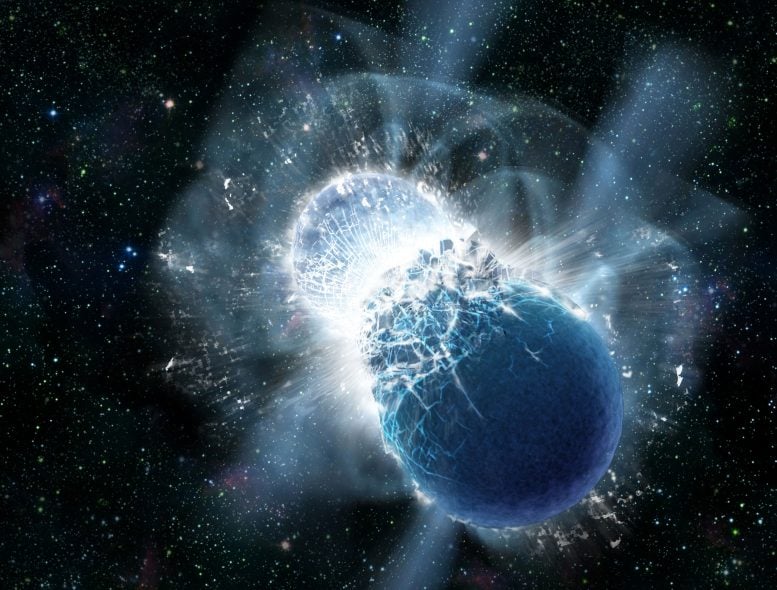
A machine learning-powered simulation is giving researchers a new window into the processes that create some of the universe’s heaviest elements.
Where do the gold in jewelry, the uranium in nuclear fuel, and many of the universe’s heaviest elements come from? Scientists believe they are forged in some of the most violent events in the cosmos, but simulating these processes in detail remains a major computational challenge.
Now, researchers at GSI/FAIR and their international collaborators have developed a machine learning-based model that provides deeper insight into how elements are formed during extreme events such as neutron star mergers. For the first time, the team incorporated a deep learning neural network into hydrodynamic simulations to model the energy released during r-process nucleosynthesis. Their findings were published in Physical Review D.
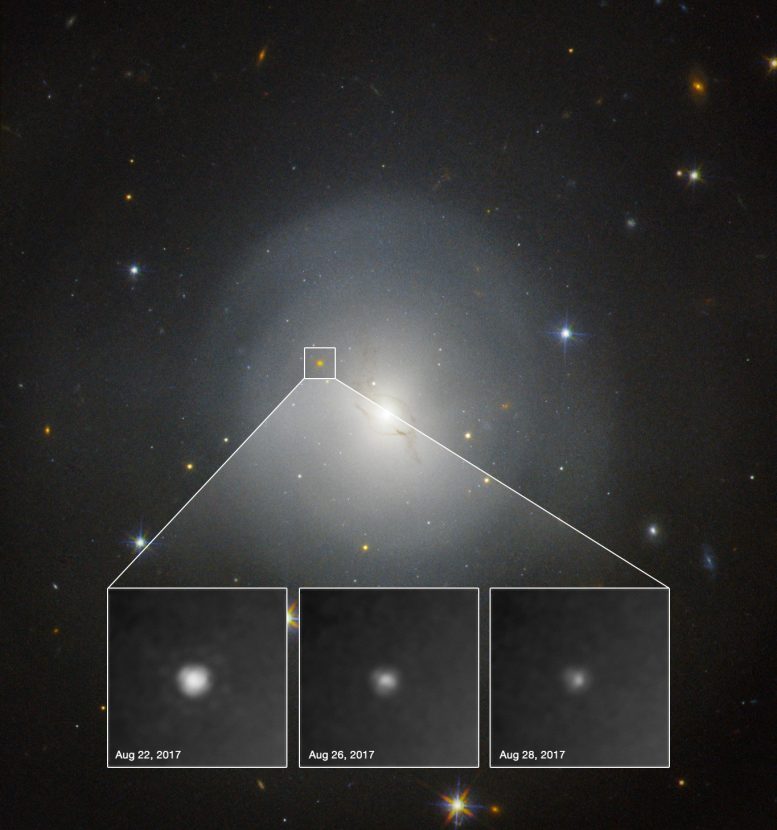
Many chemical elements are created in powerful astrophysical events, including supernova explosions and neutron star mergers. These environments generate enormous amounts of energy and free neutrons, enabling the rapid neutron-capture process, or r-process, which is responsible for producing many of the elements heavier than iron. During this process, atomic nuclei rapidly absorb neutrons that later transform into protons, building increasingly heavier elements.
“Researchers around the world strive to make these complex reactions understandable through theoretical simulations. However, modeling all parameters requires incredible computing power, which is why the models often have to be simplified,” says Dr. Oliver Just, first author of the publication and researcher in the department “Nuclear Astrophysics & Structure” at GSI/FAIR. “Our new model RHINE, which uses artificial intelligence, offers an efficient alternative.”
RHINE Uses Deep Learning for r-Process Heating
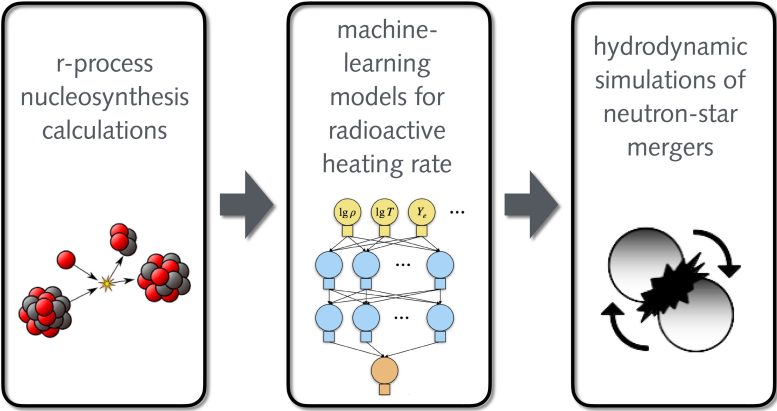
RHINE (r-process heating implementation in hydrodynamic simulations with neural networks) applies machine learning, specifically a deep learning neural network, to represent the energy released by nuclear reactions during the r-process within hydrodynamic simulations. This energy release, known as heating, can significantly influence the motion and speed distribution of material ejected during an explosion. It can also affect the electromagnetic signals produced by these events, including the kilonovae observed after neutron star mergers.
“First the ML models are trained using a large number of reference calculations produced with a full set of nuclear reactions. Subsequently, the models are adopted in running hydrodynamical simulations to approximate the heating rates during the r-process with minimal effort,” explained Dr. Zewei Xiong, a scientist in GSI/FAIR’s Nuclear Astrophysics & Structure department who played a central role in designing the machine learning models.
“With detailed comparisons, we validated our ML scheme against reference data. The high degree of agreement suggests that the use of ML models can save a tremendous amount of computing time. We also deduced from the results that r-process heating is an important effect that should be better accounted for in future modeling.”
The researchers say RHINE could enable more detailed simulations in the future, helping connect results from experiments at the upcoming FAIR facility with astronomical observations of stellar explosions and neutron star mergers.
Reference: “r-process heating implementation in hydrodynamic simulations with neural networks” by Oliver Just, Zewei Xiong and Gabriel Martínez-Pinedo, 16 April 2026, Physical Review D.
DOI: 10.1103/gl2l-7f3g
The RHINE source code is publicly available for use. Among others, the project was co-funded by the European Research Council (ERC).
Never miss a breakthrough: Join the SciTechDaily newsletter.
Follow us on Google and Google News.