
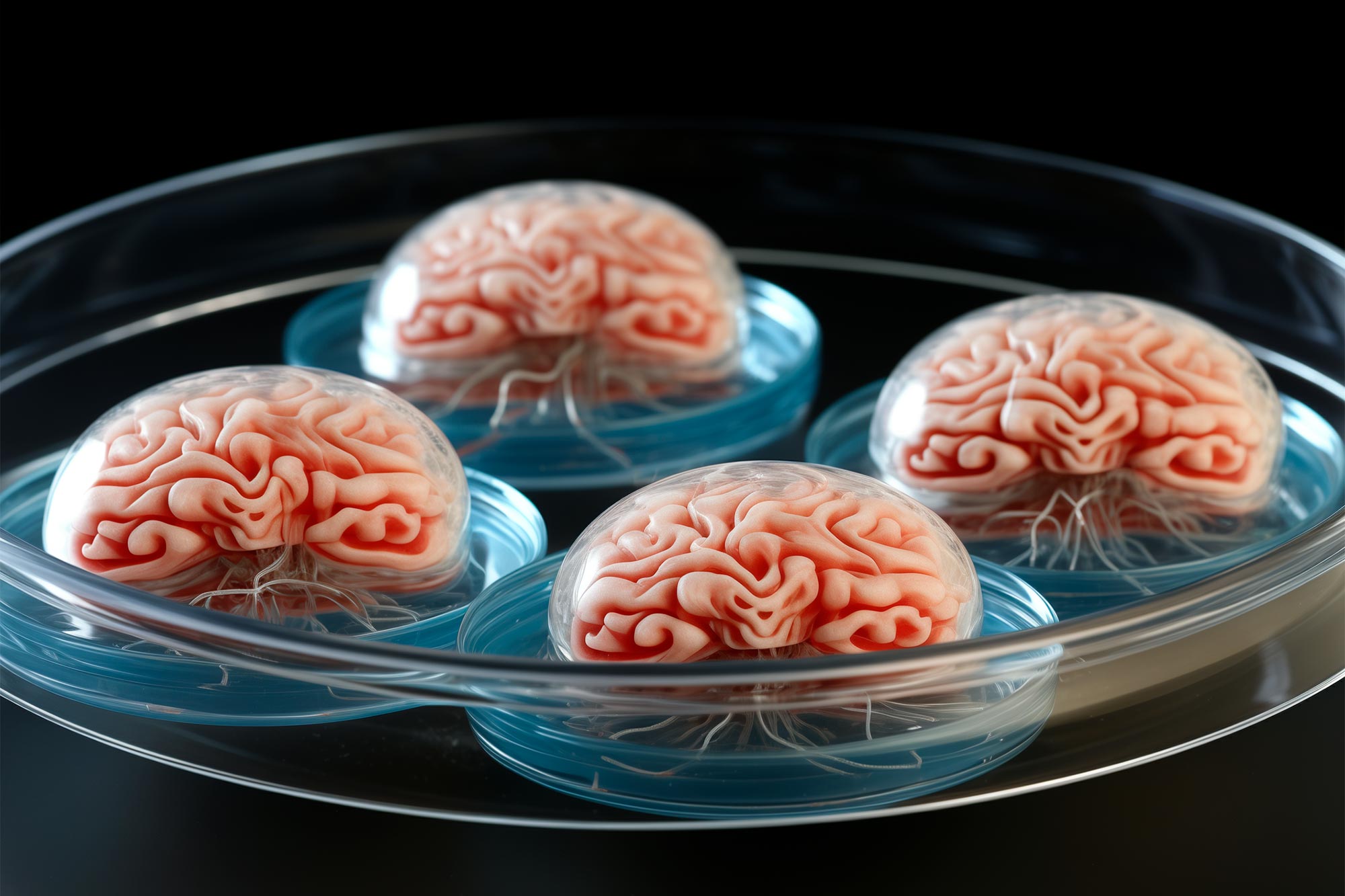
A new algorithm has revealed that 3D models created with mature brain cells closely replicate the brain biology observed in human patients. This breakthrough enables researchers to test multiple drugs simultaneously and make more informed predictions about drug targets and therapies.
A decade ago, researchers introduced a groundbreaking model for studying Alzheimer’s disease. Known as “Alzheimer’s in a dish,” this model uses cultures of mature brain cells suspended in a gel to replicate the processes that occur in the human brain over 10 to 13 years—in just six weeks.
But does the model truly produce the same changes that take place in patients?
In a new study, researchers from Mass General Brigham, in collaboration with colleagues at Beth Israel Deaconess Medical Center (BIDMC), created an algorithm to assess, in an unbiased manner, how well models of Alzheimer’s disease mimic the function and gene expression patterns seen in patients’ brains.
Their results, published in Neuron, identify crucial shared pathways, confirming that the Alzheimer’s in a dish model can be used to assess new drugs accurately and rapidly as well as point the way to drug discovery.
Enhancing Drug Discovery and Model Validation
“Our goal is to find the best model with the most similar activity to what we see in the brains of patients with Alzheimer’s disease,” said co-senior author Doo Yeon Kim, PhD, of the Department of Neurology at Massachusetts General Hospital (MGH), a founding member of the Mass General Brigham healthcare system. “We developed this 3D cell culture model for Alzheimer’s 10 years ago. Now we have the data that show that this model can accelerate drug discovery.”
The new study was made possible through a collaboration between researchers with expertise in neurology and data-driven systems, with a shared goal of finding better treatments for Alzheimer’s disease (AD). For decades, the field of AD research has faced challenges due to some of the limitations of mouse models of the disease, which do not develop amyloid plaques or other hallmarks of AD seen in humans. Different models have been developed by Kim and colleagues but, until now, it had not been possible to determine the extent to which these models accurately reflect the molecular and functional changes seen in the brain.
“We faced a fundamental challenge: understanding which models truly reflect the complexity of Alzheimer’s in the human brain,” said co-senior author Winston Hide, PhD, of the Department of Pathology at BIDMC. “By shifting focus from individual genes to the broader biological pathways they shape, we’ve created a system that transforms how we discover and test drugs.”
To address this need, the research team, led by Pourya Naderi Yeganeah, PhD, and Sang Su Kwak, PhD, co-lead authors, developed a novel integrative pathway activity analysis (IPAA) platform. The platform can determine which models most closely recapitulate the functional changes seen in AD and identify the most relevant pathways for drug discovery. In their paper, the researchers identified 83 dysregulated pathways shared across brain samples from deceased patients with Alzheimer’s disease and 3D cellular models.
Promising Drug Discovery and Future Clinical Trials
The researchers looked at one pathway—p38 mitogen-activated protein kinase (MAPK)—as a proof of concept, testing drugs that target this pathway. Interestingly, they discovered that a clinical p38 MAPK inhibitor, which has not yet been tested in AD patients, is highly effective at reducing AD pathology in a dish, highlighting its potential for future clinical trials.
Even more compelling, their findings extend beyond a single pathway—the platform’s capacity to identify promising drug targets, combined with the speed and scalability of the Alzheimer’s in a dish model, enables simultaneous testing of multiple drugs to identify potential therapies. Already, the researchers have tested hundreds of approved drugs and natural products using the Alzheimer’s in a dish model, setting the stage for clinical trials.
“Now we have a system that not only allows us to test new drugs quickly, but also an algorithmic platform that can predict which drugs will work best.” said co-senior author Rudolph Tanzi, PhD, Director of the McCance Center for Brain Health and Genetics and Aging Research Unit at MGH. “Together, these advancements bring us closer to finding better drugs and getting them to patients.”
Reference: “Integrative pathway analysis across humans and 3D cellular models identifies the p38 MAPK-MK2 axis as a therapeutic target for Alzheimer’s disease” by Pourya Naderi Yeganeh, Sang Su Kwak, Mehdi Jorfi, Katjuša Koler, Thejesh Kalatturu, Djuna von Maydell, Zhiqing Liu, Kevin Guo, Younjung Choi, Joseph Park, Nelson Abarca, Grisilda Bakiasi, Murat Cetinbas, Ruslan Sadreyev, Ana Griciuc, Luisa Quinti, Se Hoon Choi, Weiming Xia, Rudolph E. Tanzi, Winston Hide and Doo Yeon Kim, 27 November 2024, Neuron.
DOI: 10.1016/j.neuron.2024.10.029
This work is supported by grants from the Cure Alzheimer’s fund; JPB Foundation; Coins for Alzheimer’s Research Trust; BIDMC Spark Grant; National Institutes of Health (R01AG062547-01, 1RF1AG048080-01, 5P01AG15379, 2R01AG014713, 5R37MH060009, 1R01AG082093-01), the National Institute of Aging and McKnight Brain research foundation (1U19AG073172-01, 2R01AG063913, RF1AG063913).
Never miss a breakthrough: Join the SciTechDaily newsletter.
Follow us on Google and Google News.