
A new study suggests that some of the world’s oxygen-deprived oceans could eventually regain higher oxygen levels in the centuries ahead, even as the planet continues to warm.
- About 16 million years ago, the Arabian Sea contained more oxygen than it does today, even though Earth’s climate was warmer at the time.
- Strong monsoons, shifting ocean currents, and connections between seas play a major role in controlling oxygen levels, making future changes harder to predict.
- Over very long timescales, ocean oxygen levels could rise again, although the effects on marine life remain uncertain.
Researchers from the University of Southampton (UK) and Rutgers University (USA) analyzed fossilized plankton from the Arabian Sea and uncovered a surprising pattern. During a period of intense global warming about 16 million years ago, oxygen levels in this region were higher than they are today. The Arabian Sea did not become severely oxygen-deficient until roughly four million years later, when global temperatures had begun to decline.
Regional Ocean Forces Changed the Outcome
The team also found that the Arabian Sea, located off India’s west coast, followed a different path than a comparable low-oxygen zone in the Pacific Ocean. This contrast suggests that regional processes played a major role. Strong winds, shifting ocean currents, and water flowing from nearby seas appear to have delayed the onset of severe oxygen loss in the Arabian Sea.
The study’s findings were published in the Nature journal Communications Earth & Environment.
Why Ocean Oxygen Matters for Life
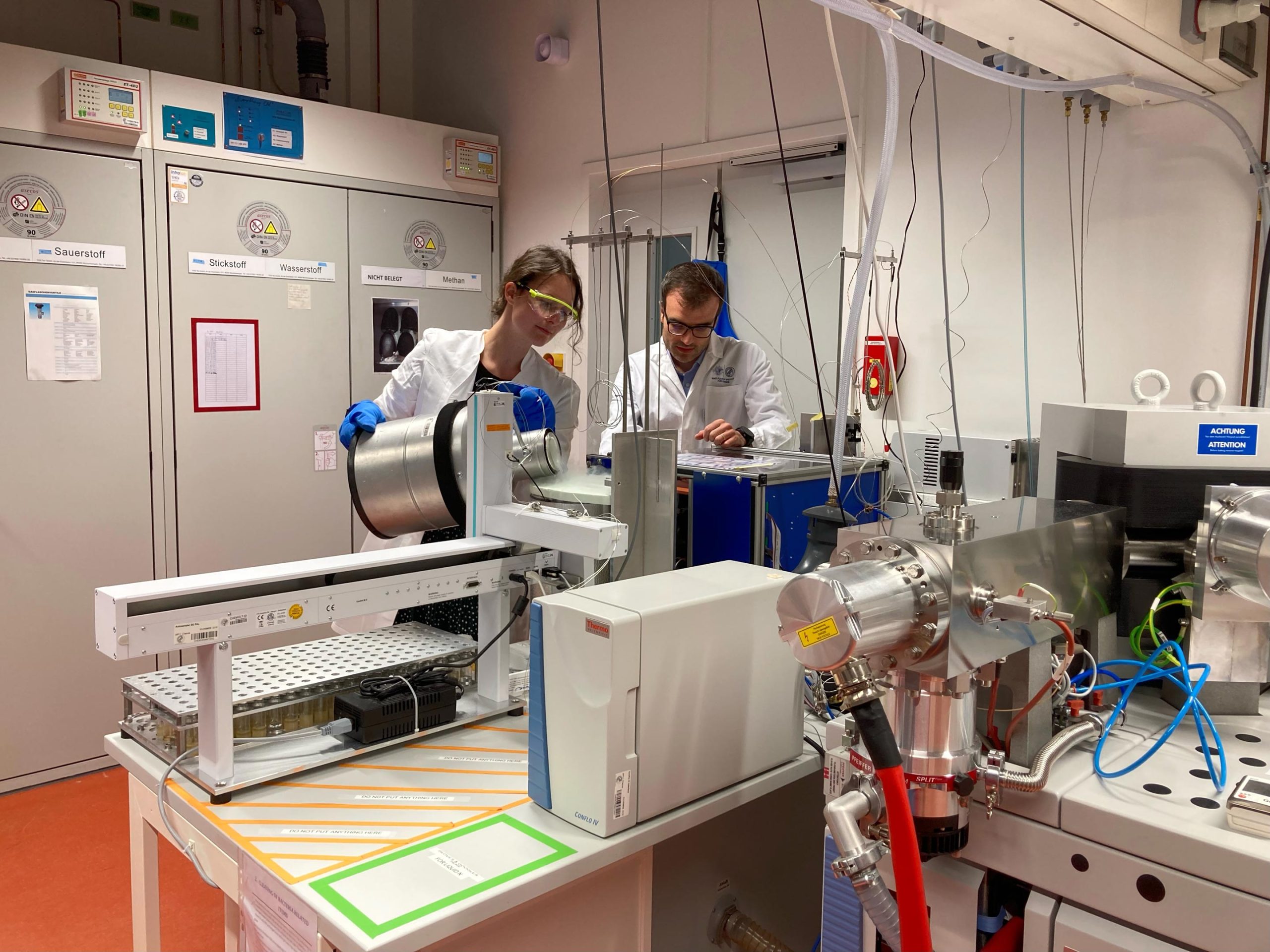
“Oxygen dissolved in our oceans is essential for sustaining marine life, promoting greater biodiversity and stronger ecosystems. However, over the past 50 years, two percent of oxygen in the seas worldwide has been lost each decade as global temperatures rise,” explains co-lead author, Dr. Alexandra Auderset of the University of Southampton and formerly of Max Planck Institute of Chemistry, Mainz.
She adds: “The Miocene Climatic Optimum (MCO), a period approximately 17 to 14 million years ago, had similar temperatures and atmospheric conditions to those we predict will occur after 2100. We have taken a snapshot of sea oxygenation during the MCO to help understand how things might develop a-hundred years or more from now.”
Fossil Plankton Preserve a Long Oxygen Record
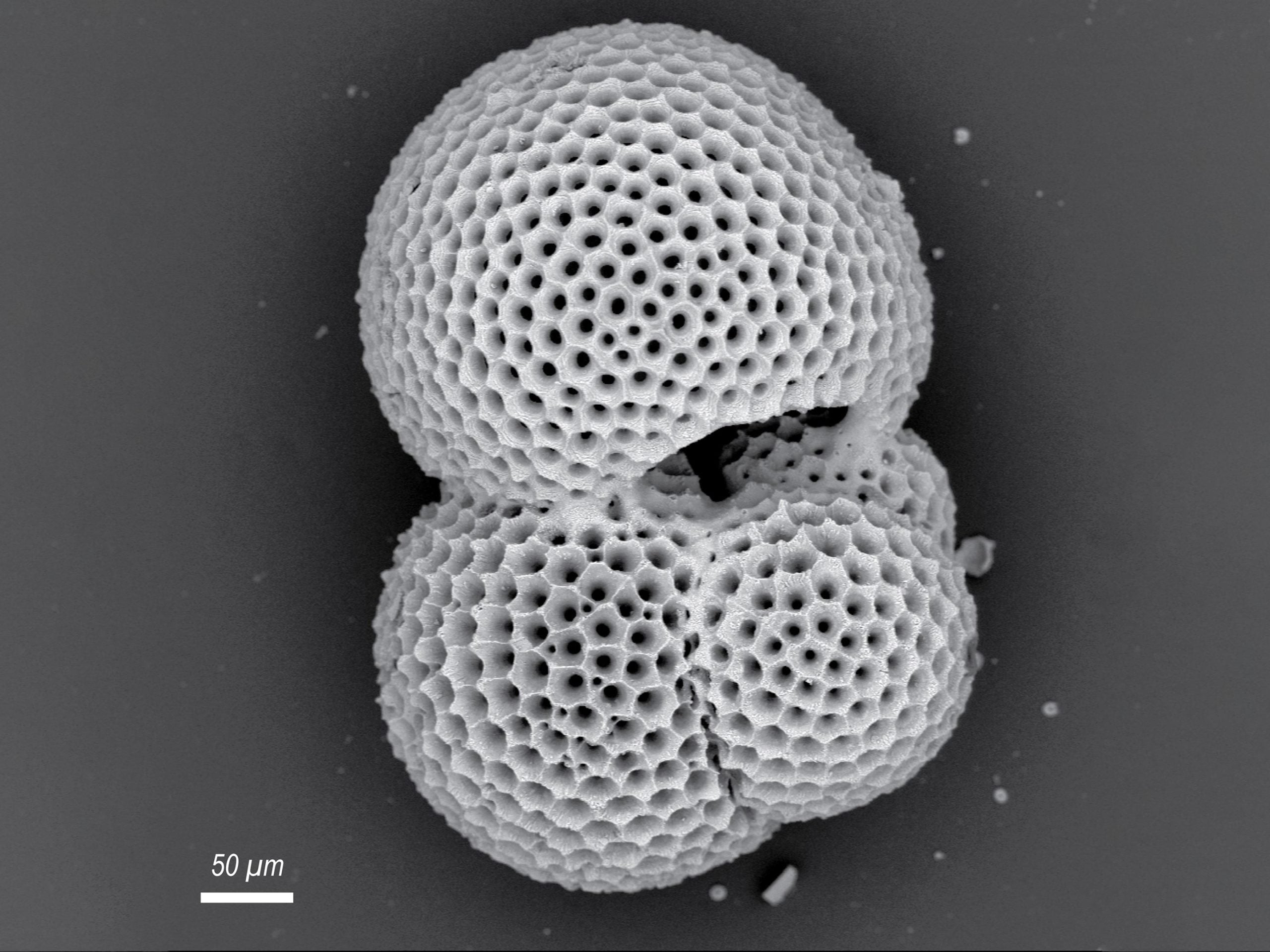
To reconstruct ancient ocean conditions, the researchers examined microscopic fossilized plankton known as foraminifera (forams). These fossils were extracted from sediment cores provided by the Ocean Drilling Program (ODP). Chemical signatures preserved in the shells of these organisms allow scientists to estimate oxygen concentrations in seawater across millions of years.
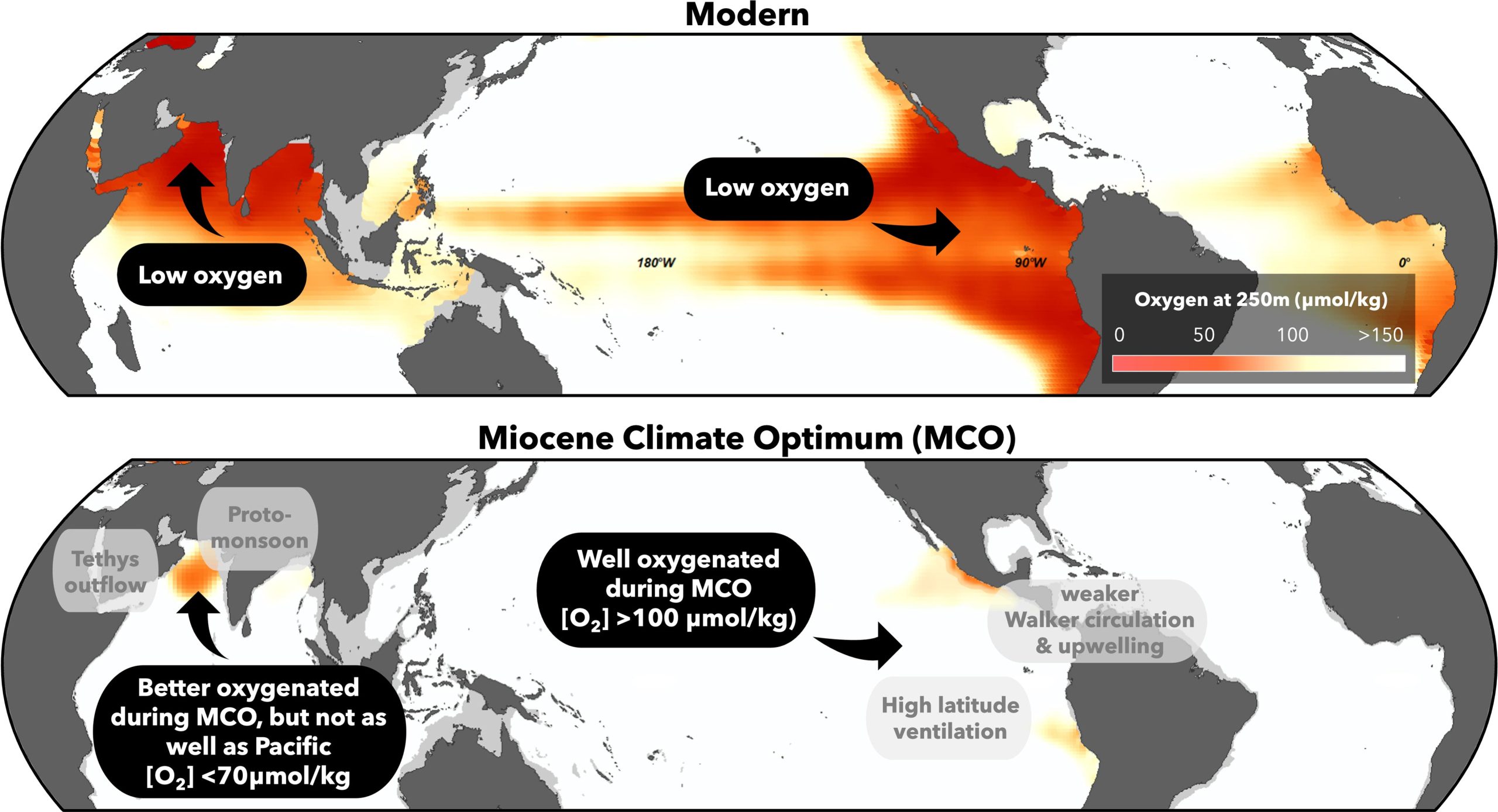
The analysis revealed that an Oxygen Minimum Zone (OMZ) existed in the Arabian Sea from the early Miocene period, starting around 19 million years ago and lasting until about 12 million years ago. During this time, oxygen levels remained below roughly 100 micromol per kilogram of water.
Severe Oxygen Loss Was Delayed
Despite low oxygen levels, conditions during this period were not extreme enough to trigger the release of nitrogen from seawater into the atmosphere, a process observed in the Arabian Sea today. That shift occurred later, after the 12 million year mark, showing that the most severe oxygen depletion developed well after the warmest phase.
“Today, parts of the Arabian Sea are ‘suboxic’, supporting only limited marine life due to minimal oxygenation. This same region during the MCO, under similar climatic conditions, was hypoxic – so comparatively moderate oxygen content, supporting a wider range of organisms,” says Dr. Auderset.
Comparing the Arabian Sea With the Pacific
Co-lead-author, Dr. Anya Hess of George Mason University, and formerly of Rutgers University and Woods Hole Oceanographic Institution, adds: “The MCO is the closest comparison we have to climate warming beyond 2100 under a high-emissions scenario. One of our previous studies shows the eastern tropical Pacific was actually well oxygenated during this period, in contrast to the deoxygenation trend we see today.
“The Arabian Sea was also better oxygenated during the MCO, but not as much as the Pacific, with moderate oxygenation and an eventual decline that lagged behind the Pacific by about 2 million years.”
What This Means for Future Oceans
Dr. Auderset concludes: “Our results suggest that ocean oxygen loss, already underway today, is strongly shaped by local oceanography. Global models that focus solely on climate warming, risk not capturing the regional factors that may either amplify or counteract those more general trends.
“Our research shows ocean response to climate warming is complex, and this means that we will need to be ready to adapt to changing ocean conditions.”
Reference: “Contrasting evolution of the Arabian Sea and Pacific Ocean oxygen minimum zones during the Miocene” by Anya V. Hess, Alexandra Auderset, Yair Rosenthal, Daniel M. Sigman and Alfredo Martínez-García, 16 January 2026, Communications Earth & Environment.
DOI: 10.1038/s43247-025-03112-4
Never miss a breakthrough: Join the SciTechDaily newsletter.
Follow us on Google and Google News.
1 Comment
“During a period of intense global warming about 16 million years ago, oxygen levels in this region were higher than they are today.”
With respect to the focus of this study, were atmospheric oxygen levels higher during those ‘hot house’ events, compared to today?
What drove the Miocene Climate Optimum? Of, for that matter, the Paleocene-Eocene Thermal Maximum?
The current approach to climatology appears to be a violation of Occam’s Razor, which states, “Entities must not be multiplied beyond necessity.” Another way of saying that is that the simplest explanation is preferred because it is probably correct. If there had never been temperature spikes previously in the global climate, then one would be justified in suggesting a correlation between anthropogenic sources of CO2 and temperature. However, inasmuch as there have been numerous ‘hot house’ climates prior to the Industrial Revolution, some hotter than what we are currently experiencing, the situation is less clear. Because such events are common in the past, Occam’s Razor suggests that warming and cooling are part of the natural variation and it is not necessary to invoke anthropogenic emissions, which could just be coincidence. Or, the cause-and-effect are inverted. Computer modeling is not much help because most models run warm, suggesting design problems.
Actually, there are good reasons to assume that the relationship between global temperatures and atmospheric concentrations of CO2 are a feedback loop where the increase in CO2 is a product of increasing global temperatures and temperatures are also increased by CO2. After about 4 decades, there is no agreement by researchers on the sensitivity of atmospheric temperatures to a doubling of CO2, spanning a range of almost an order of magnitude. That may be because the sensitivity is temperature dependent and because modern estimates are based on an “ensemble’ of computer model results, despite the obvious problem that the ensemble can only have one best result, and averaging them all dilutes the superior result with the inferior results.
However, in an open public debate, which has never occurred, I think that the evidence would be compelling that the dominant effect is for rising temperatures to increase biogenic CO2, albeit with at least an annual lag in CO2.