
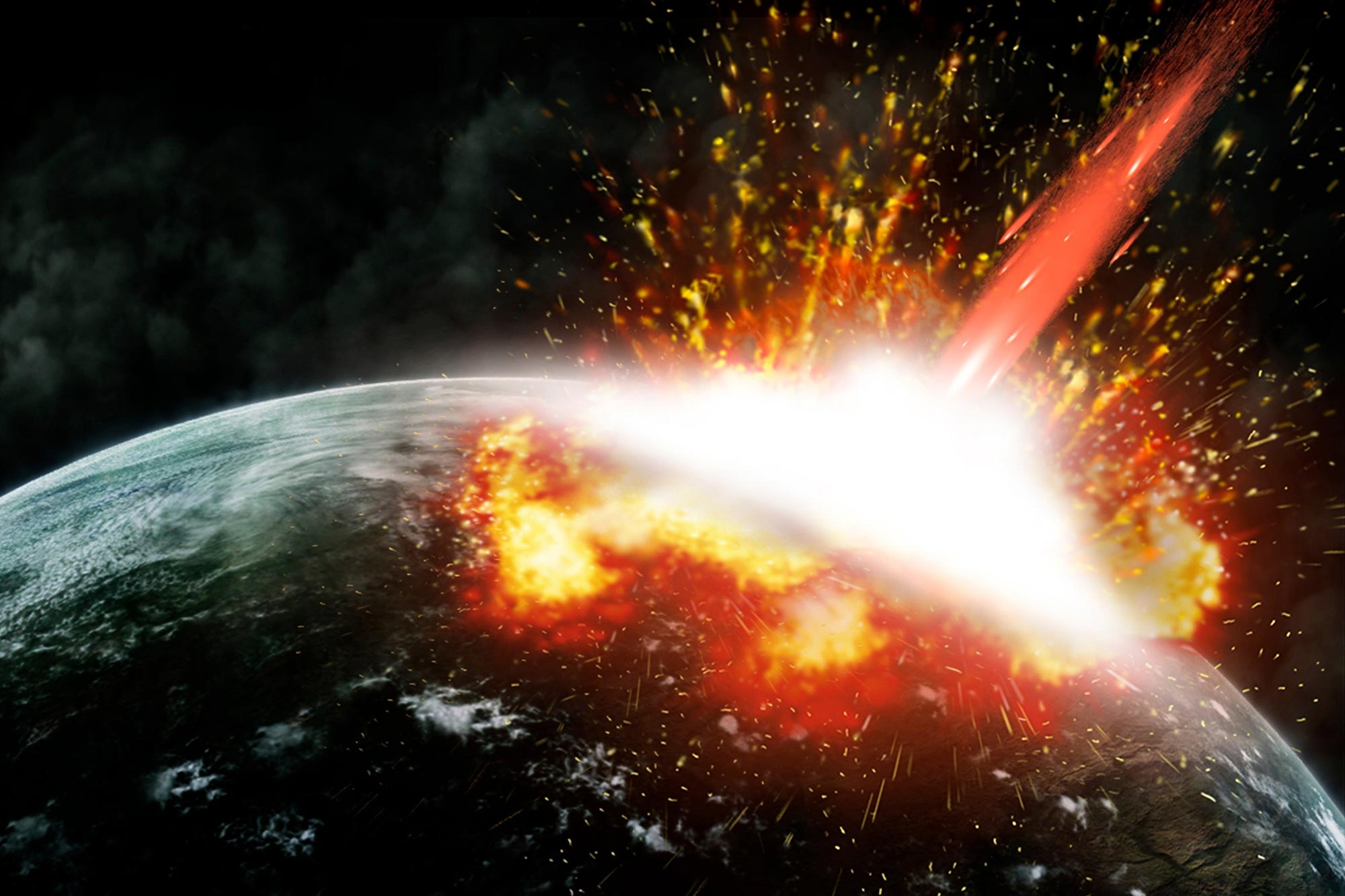
What would happen if a 500-meter asteroid hit Earth? Scientists at the IBS Center for Climate Physics modeled the aftermath, revealing a dramatic plunge into an “impact winter” with temperatures dropping by 4°C, rainfall decreasing by 15%, and ozone depletion reaching 32%.
The result? A global food crisis as land-based photosynthesis declines by up to 30%. But the ocean tells a different story—plankton, fueled by iron-rich asteroid dust, could thrive, triggering massive algae blooms. This unexpected marine boom might provide a lifeline for the biosphere. Could past asteroid impacts have shaped human evolution? Future studies aim to explore how our ancestors might have endured such cataclysms.
Asteroid Impact: A Climate and Life-Changing Event
A recent climate modeling study, published on February 5 in Science Advances by researchers at the IBS Center for Climate Physics (ICCP) at Pusan National University in South Korea, explores how Earth’s climate and ecosystems might respond to the impact of a medium-sized (~500-meter) asteroid.
The solar system contains many near-Earth objects, most of which pose no threat. However, some have a small but significant chance of colliding with Earth. One such object is the asteroid Bennu, which is about 500 meters (~1640 feet) in diameter. According to a 2021 study (Farnocchia et al.), Bennu has a 1-in-2,700 chance of striking Earth in September 2182—a probability comparable to flipping a coin 11 times in a row and getting the same result each time.
Simulating the Aftermath of an Asteroid Strike
To determine the potential impacts of an asteroid strike on our climate system and on terrestrial plants and plankton in the ocean, researchers from the ICCP set out to simulate an idealized collision scenario with a medium-sized asteroid using a state-of-the-art climate model. The effect of the collision is represented by a massive injection of several hundred million tons of dust into the upper atmosphere. Unlike previous studies, the new research also simulates terrestrial and marine ecosystems, as well as the complex chemical reactions in the atmosphere.
Supercomputer Predictions: A Dark and Cold Earth
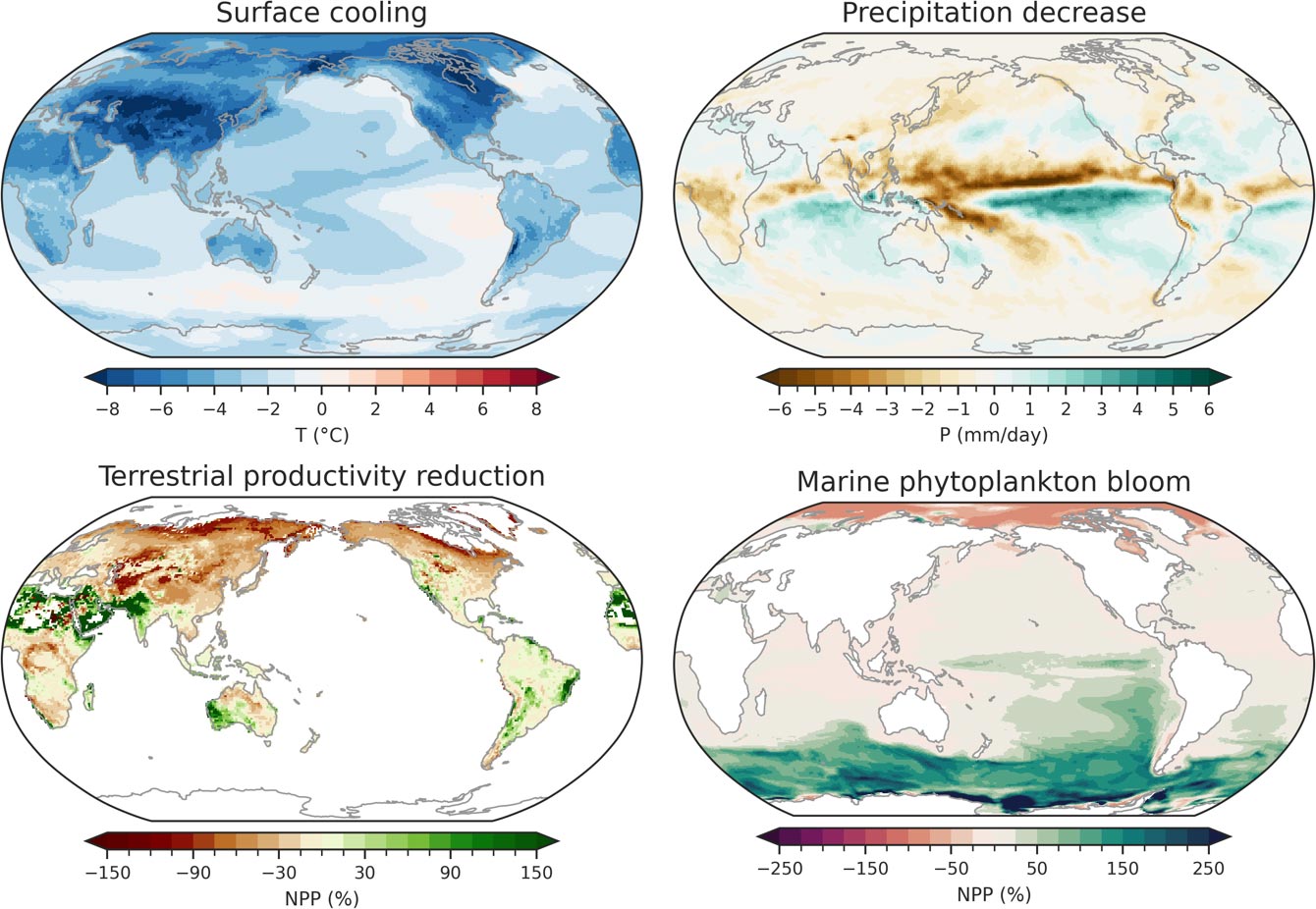
Using the IBS supercomputer Aleph, the researchers ran several dust impact scenarios for a Bennu-type asteroid collision with Earth. In response to dust injections of 100-400 million tons, the supercomputer model simulations show dramatic disruptions in climate, atmospheric chemistry, and global photosynthesis in the 3-4 years following the impact (Figure 1). For the most intense scenario, solar dimming due to dust would cause global surface cooling of up to 4°C (7.2°F), a reduction of global mean rainfall by 15%, and severe ozone depletion of about 32%. However, regionally, these impacts could be much more pronounced.
“The abrupt impact winter would provide unfavorable climate conditions for plants to grow, leading to an initial 20-30% reduction of photosynthesis in terrestrial and marine ecosystems. This would likely cause massive disruptions in global food security,” says Dr. Lan Dai, postdoctoral research fellow at the ICCP and lead author of the study.
A Surprising Ocean Rebound
When the researchers looked into ocean model data from their simulations, they were surprised to find that plankton growth displayed a completely different behavior. Instead of the rapid reduction and slow two-year-long recovery on land, plankton in the ocean recovered already within 6 months and even increased afterward to levels not even seen under normal climate conditions.
“We were able to track this unexpected response to the iron concentration in the dust,” says Prof. Axel TIMMERMANN, Director of the ICCP and co-author of the study. Iron is a key nutrient for algae, but in some areas, such as the Southern Ocean and the eastern tropical Pacific, its natural abundance is very low. Depending on the iron content of the asteroid and of the terrestrial material, that is blasted into the stratosphere, the otherwise nutrient-depleted regions can become nutrient-enriched with bioavailable iron, which in turn triggers unprecedented algae blooms. According to the computer simulations, the post-collision increase of marine productivity would be most pronounced for silicate-rich algae—referred to as diatoms. Their blooms would also attract large amounts of zooplankton—small predators, which feed on the diatoms.
Could Plankton Blooms Counterbalance Disaster?
“The simulated excessive phytoplankton and zooplankton blooms might be a blessing for the biosphere and may help alleviate emerging food insecurity related to the longer-lasting reduction in terrestrial productivity,” adds Dr. Lan Dai.
“On average, medium-sized asteroids collide with Earth about every 100–200 thousand years. This means that our early human ancestors may have experienced some of these planet-shifting events before with potential impacts on human evolution and even our own genetic makeup,” says Prof. Timmermann.
Looking to the Past for Clues to the Future
The new study in Science Advances provides new insights into the climatic and biospheric responses to collisions with near-Earth orbit objects. In the next step the ICCP researchers from South Korea plan to study early human responses to such events in more detail by using agent-based computer models, which simulate individual humans, their life cycles and their search for food.
Reference: “Climatic and ecological responses to Bennu-type asteroid collisions” by Lan Dai and Axel Timmermann, 5 February 2025, Science Advances.
DOI: 10.1126/sciadv.adq5399
Never miss a breakthrough: Join the SciTechDaily newsletter.
Follow us on Google and Google News.
3 Comments
Beats a nuclear war, which seems an ever-increasing probability thanks to the psychopaths we call our “leaders”.
“a probability comparable to flipping a coin 11 times in a row and getting the same result each time”.
Yes; well I achieved that in a statistics class once upon a long time ago. 13 tails from the first toss of 100. What was also remarkable was that the English copper penny realised that it had done wrong and at completion of toss #100 the score was 47 heads and 53 tails, which plus or minus a bit of error, given only 100 tosses being a limited range, and definitely not infinite, was sen as okay. So there you are; some asteroid is going to hit the Earth at sometime. Odds on that nuclear war will put us out of our misery and worries about asteroids first.
What a waste of money. How about focusing on the now.
Bad Chad!