
Using the ESO 3.6-meter telescope, an international team of astronomers has identified a planet just like Jupiter orbiting at the same distance from the Sun-like star HIP 11915.
According to current theories, the formation of Jupiter-mass planets plays an important role in shaping the architecture of planetary systems. The existence of a Jupiter-mass planet in a Jupiter-like orbit around a Sun-like star opens the possibility that the system of planets around this star may be similar to our own Solar System. HIP 11915 is about the same age as the Sun and, furthermore, its Sun-like composition suggests that there may also be rocky planets orbiting closer to the star.
So far, exoplanet surveys have been most sensitive to planetary systems that are populated in their inner regions by massive planets, down to a few times the mass of the Earth. This contrasts with our Solar System, where there are small rocky planets in the inner regions and gas giants like Jupiter farther out.
According to the most recent theories, the arrangement of our Solar System, so conducive to life, was made possible by the presence of Jupiter and the gravitational influence this gas giant exerted on the Solar System during its formative years. It would seem, therefore, that finding a Jupiter twin is an important milestone on the road to finding a planetary system that mirrors our own.
A Brazilian-led team has been targeting Sun-like stars in a bid to find planetary systems similar to our Solar System. The team has now uncovered a planet with a very similar mass to Jupiter, orbiting a Sun-like star, HIP 11915, at almost exactly the same distance as Jupiter. The new discovery was made using HARPS, one of the world’s most precise planet-hunting instruments, mounted on the ESO 3.6-meter telescope at the La Silla Observatory in Chile.
Although many planets similar to Jupiter have been found at a variety of distances from Sun-like stars, this newly discovered planet, in terms of both mass and distance from its host star, and in terms of the similarity between the host star and our Sun, is the most accurate analogue yet found for the Sun and Jupiter.
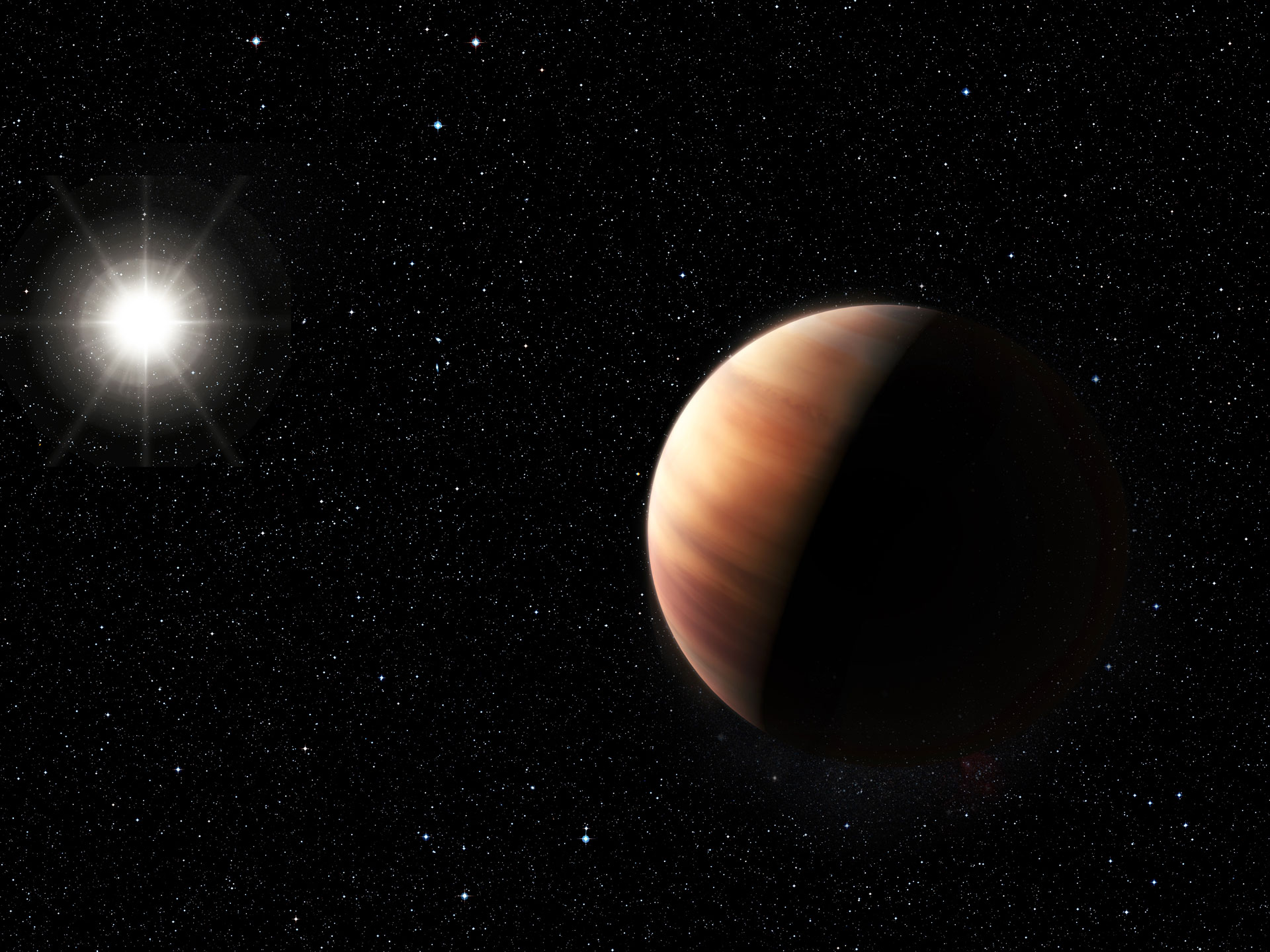
An artist’s impression showing a newly discovered Jupiter twin gas giant orbiting the solar twin star, HIP 11915. The planet is of a very similar mass to Jupiter and orbits at the same distance from its star as Jupiter does from the Sun. This, together with HIP 11915’s Sun-like composition, hints at the possibility of the system of planets orbiting HIP 11915 bearing a resemblance to our own Solar System, with smaller rocky planets orbiting closer to the host star. Credit: ESO/M. Kornmesser
The planet’s host, the solar twin HIP 11915, is not only similar in mass to the Sun, but is also about the same age. To further strengthen the similarities, the composition of the star is similar to the Sun’s. The chemical signature of our Sun may be partly marked by the presence of rocky planets in the Solar System, hinting at the possibility of rocky planets also around HIP 11915.
According to Jorge Melendez, of the Universidade de São Paulo, Brazil, the leader of the team and co-author of the paper, “the quest for an Earth 2.0, and for a complete Solar System 2.0, is one of the most exciting endeavors in astronomy. We are thrilled to be part of this cutting-edge research, made possible by the observational facilities provided by ESO.”
Megan Bedell, from the University of Chicago and lead author of the paper, concludes: “After two decades of hunting for exoplanets, we are finally beginning to see long-period gas giant planets similar to those in our own Solar System thanks to the long-term stability of planet hunting instruments like HARPS. This discovery is, in every respect, an exciting sign that other solar systems may be out there waiting to be discovered.”
Follow-up observations are needed to confirm and constrain the finding, but HIP 11915 is one of the most promising candidates so far to host a planetary system similar to our own.
Reference: “The Solar Twin Planet Search II. A Jupiter twin around a solar twin” by M. Bedell, J. Meléndez, J. L. Bean, I. Ramírez, M. Asplund, A. Alves-Brito, L. Casagrande, S. Dreizler, T. Monroe, L. Spina and M. Tucci Maia, 28 August 2015, Astronomy & Astrophysics.
DOI: 10.1051/0004-6361/201525748
PDF
Never miss a breakthrough: Join the SciTechDaily newsletter.
Follow us on Google and Google News.