
Close Menu
    Facebook X (Twitter) Instagram
    SciTechDaily
    • Biology
    • Chemistry
    • Earth
    • Health
    • Physics
    • Science
    • Space
    • Technology
    Facebook X (Twitter) Pinterest YouTube RSS
    SciTechDaily
    Home»Space»Astronomers Discover an Intermediate-Mass Black Hole
    Space

    Astronomers Discover an Intermediate-Mass Black Hole

    By Harvard-Smithsonian Center for AstrophysicsFebruary 9, 2017No Comments4 Mins Read
    Facebook Twitter Pinterest Telegram LinkedIn WhatsApp Email Reddit
    Share
    Facebook Twitter LinkedIn Pinterest Telegram Email Reddit
    Black Hole is Hiding at the Center of a Giant Star Cluster
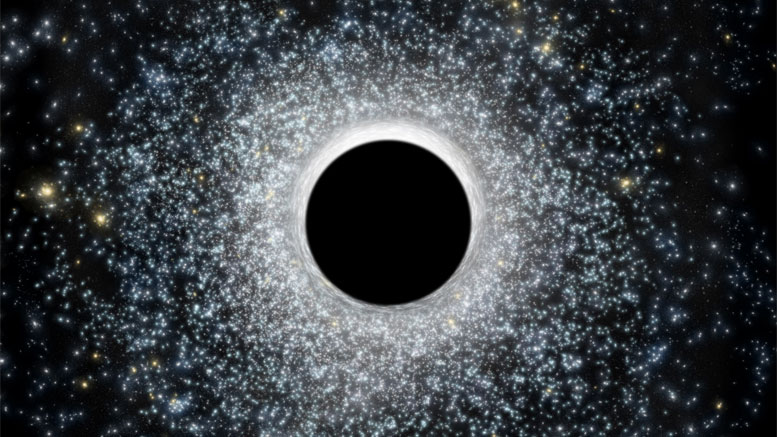
    In this artist’s illustration, an intermediate-mass black hole in the foreground distorts light from the globular star cluster in the background. New research suggests that a 2,200 solar-mass black hole resides at the center of the globular cluster 47 Tucanae.

    Astronomers from the Harvard-Smithsonian Center for Astrophysics reveal new evidence that an intermediate-mass black hole weighing 2,200 Suns is hiding at the center of the globular star cluster 47 Tucanae.

    All known black holes fall into two categories: small, stellar-mass black holes weighing a few Suns, and supermassive black holes weighing millions or billions of Suns. Astronomers expect that intermediate-mass black holes weighing 100 – 10,000 Suns also exist, but so far no conclusive proof of such middleweights has been found. Today, astronomers are announcing new evidence that an intermediate-mass black hole (IMBH) weighing 2,200 Suns is hiding at the center of the globular star cluster 47 Tucanae.

    “We want to find intermediate-mass black holes because they are the missing link between stellar-mass and supermassive black holes. They may be the primordial seeds that grew into the monsters we see in the centers of galaxies today,” says lead author Bulent Kiziltan of the Harvard-Smithsonian Center for Astrophysics (CfA).

    This work appears in the prestigious science journal Nature.

    47 Tucanae is a 12-billion-year-old star cluster located 13,000 light-years from Earth in the southern constellation of Tucana the Toucan. It contains hundreds of thousands of stars in a ball only about 120 light-years in diameter. It also holds about two dozen pulsars that were important targets of this investigation.

    47 Tucanae has been examined for a central black hole before without success. In most cases, a black hole is found by looking for X-rays coming from a hot disk of material swirling around it. This method only works if the black hole is actively feeding on nearby gas. The center of 47 Tucanae is gas-free, effectively starving any black hole that might lurk there.

    The supermassive black hole at the center of the Milky Way also betrays its presence by its influence on nearby stars. Years of infrared observations have shown a handful of stars at our galactic center whipping around an invisible object with a strong gravitational tug. But the crowded center of 47 Tucanae makes it impossible to watch the motions of individual stars.
    Middleweight Black Hole is Hiding at the Center of a Giant Star Cluster
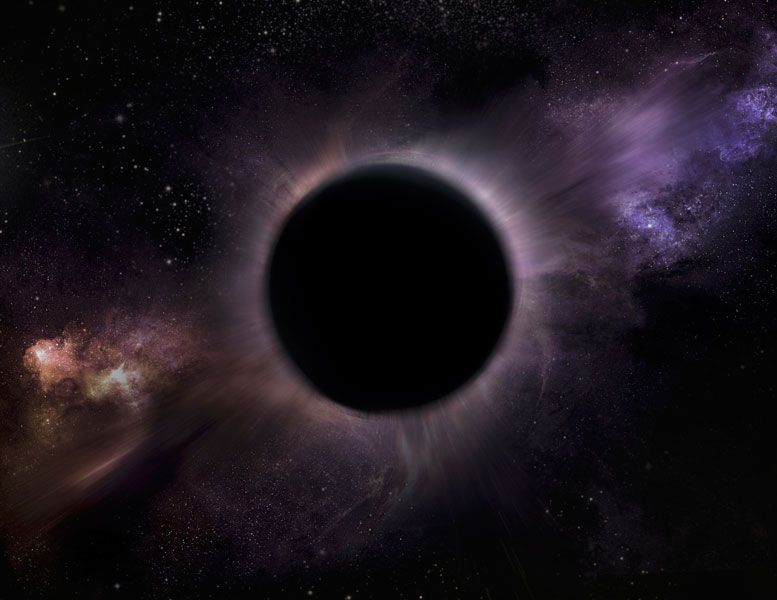
    This artist’s conception shows another representation of the intermediate-mass black hole that may lurk in the center of the globular cluster 47 Tucanae.

    The new research relies on two lines of evidence. The first is overall motions of stars throughout the cluster. A globular cluster’s environment is so dense that heavier stars tend to sink to the center of the cluster. An IMBH at the cluster’s center acts like a cosmic “spoon” and stirs the pot, causing those stars to slingshot to higher speeds and greater distances. This imparts a subtle signal that astronomers can measure.

    By employing computer simulations of stellar motions and distances, and comparing them with visible-light observations, the team finds evidence for just this sort of gravitational stirring.

    The second line of evidence comes from pulsars, compact remnants of dead stars whose radio signals are easily detectable. These objects also get flung about by the gravity of the central IMBH, causing them to be found at greater distances from the cluster’s center than would be expected if no black hole existed.

    Combined, this evidence suggests the presence of an IMBH of about 2,200 solar masses within 47 Tucanae.

    Since this black hole has eluded detection for so long, similar IMBHs may be hiding in other globular clusters. Locating them will require similar data on the positions and motions of both the stars and any pulsars within the clusters.

    Reference: “An intermediate-mass black hole in the centre of the globular cluster 47 Tucanae” by Bülent Kızıltan, Holger Baumgardt and Abraham Loeb, 9 February 2017, Nature.
    DOI: 10.1038/nature21361

    Never miss a breakthrough: Join the SciTechDaily newsletter.
    Follow us on Google and Google News.

    Astrophysics Black Hole Cosmology Harvard-Smithsonian Center for Astrophysics Popular
    Share. Facebook Twitter Pinterest LinkedIn Email Reddit

    Related Articles

    Breakthrough Allows Astronomers To See What Makes Sagittarius A* Glow

    Chandra Reveals X-Ray Binary Stars at the Galactic Center

    Astronomers Put Basic Principle of Black Holes to the Test

    Astronomers Discover a Cosmic Particle Accelerator in Abell 3411 and 3412

    Astrophysicists Show Milky Way Had a Blowout Bash 6 Million Years Ago

    Astronomers Discover Evidence of a ‘Direct-Collapse Black Hole’

    New Research Shows LIGO’s Twin Black Holes Might Have Been Born Inside a Single Star

    Cloud of Hydrogen and Helium Plunging Toward the Galactic Center

    Gamma-Ray Beams Suggest Milky Way’s Central Black Hole Had Active Past

    Leave A Reply Cancel Reply

    • Facebook
    • Twitter
    • Pinterest
    • YouTube

    Don't Miss a Discovery

    Subscribe for the Latest in Science & Tech!

    Trending News

    Millions Take These IBS Drugs, But a New Study Finds Serious Risks

    Scientists Unlock Hidden Secrets of 2,300-Year-Old Mummies Using Cutting-Edge CT Scanner

    Bread Might Be Making You Gain Weight Even Without Eating More Calories

    Scientists Discover Massive Magma Reservoir Beneath Tuscany

    Europe’s Most Active Volcano Just Got Stranger – Here’s Why Scientists Are Rethinking It

    Alzheimer’s Symptoms May Start Outside the Brain, Study Finds

    Millions Take This Popular Supplement – Scientists Discover a Concerning Link to Heart Failure

    The Universe Is Expanding Too Fast and Scientists Can’t Explain Why

    Follow SciTechDaily
    • Facebook
    • Twitter
    • YouTube
    • Pinterest
    • Newsletter
    • RSS
    SciTech News
    • Biology News
    • Chemistry News
    • Earth News
    • Health News
    • Physics News
    • Science News
    • Space News
    • Technology News
    Recent Posts
    • Simple Blood Test May Predict Alzheimer’s Years Before Brain Scans Show Signs
    • Scientists Say Adding This Unusual Seafood to Your Diet Could Reverse Signs of Aging
    • U.S. Waste Holds $5.7 Billion Worth of Crop Nutrients
    • Scientists Say a Hidden Structure May Exist Inside Earth’s Core
    • Doctors Surprised by the Power of a Simple Drug Against Colon Cancer
    Copyright © 1998 - 2026 SciTechDaily. All Rights Reserved.
    • Science News
    • About
    • Contact
    • Editorial Board
    • Privacy Policy
    • Terms of Use

    Type above and press Enter to search. Press Esc to cancel.