
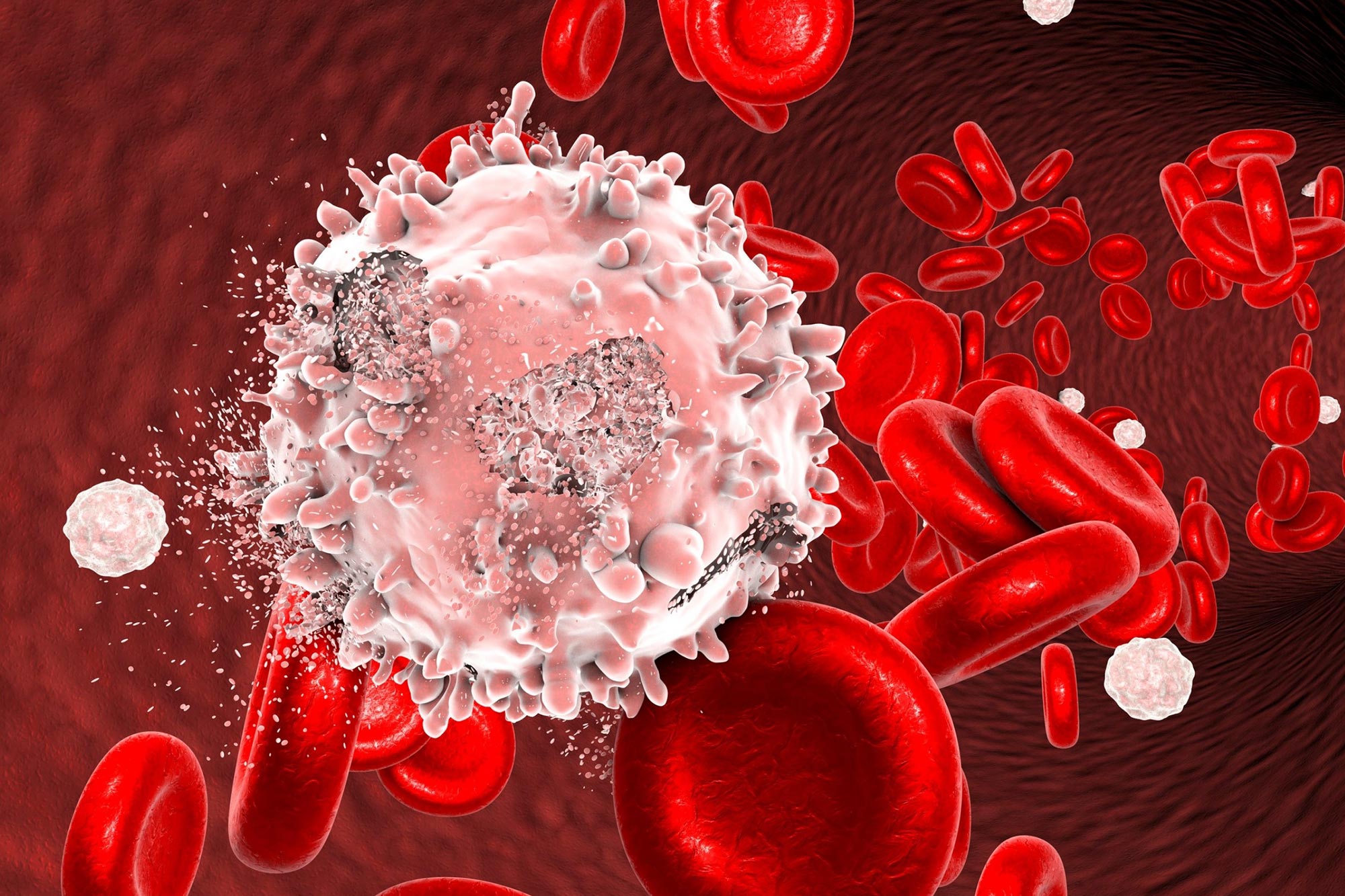
For people with blood cancers called myelodysplastic syndromes, osteoporosis may hold an overlooked clue to survival, a three-year observational study suggests.
In blood cancers that develop in the bone marrow, an important clue to a patient’s survival may lie in the bones themselves. Myelodysplastic syndromes (MDS), a group of cancers that primarily affect older adults, interfere with the body’s ability to produce healthy blood cells.
Treatment typically focuses on managing anemia, monitoring blood counts, and providing transfusions when necessary. However, new research suggests that bone health, an often-overlooked aspect of MDS care, may reveal important information about patients’ overall health and prognosis.
In a three-year study involving 111 patients with MDS and 84 age-matched control participants, researchers found that people with MDS had significantly lower bone density at the outset and continued to lose bone mass over time. More notably, patients who already had osteoporosis at the beginning of the study also had poorer overall survival. Although the findings do not establish a cause-and-effect relationship, they point to a potentially important connection between bone deterioration and blood cancer outcomes.
“In patients with MDS, the bone-aging process seems to be sped up,” says Prof. Lorenz Hofbauer, director of the University Center for Healthy Aging at Dresden University Hospital.
MDS becomes more common with age
MDS is among the most common cancers of the blood-forming system. Several thousand people receive an MDS diagnosis in Germany each year. Its incidence rises from approximately 4 to 5 cases per 100,000 people in the general population to more than 30 per 100,000 among people older than 70.
“The results are crucial to our understanding of aging processes,” says Hofbauer. “MDS occurs primarily in elderly individuals, precisely during a phase of life in which bone mass, muscle strength, and physical reserves also decline. Often, there is a chronic, subtle inflammatory process present without there being any apparent cause or infection. In addition, MDS is frequently associated with heart attacks and Alzheimer’s disease.”

A genetic clue connects blood and bone
Within blood-forming cells, a specific mutation in the DNMT3A gene was associated with lower bone density, providing another connection for researchers to investigate between blood formation and bone health. Participants with low bone density or osteoporosis were also more likely to have low calcium levels.
Hofbauer initiated BoHemE in 2016 with Prof. Uwe Platzbecker, Chief Medical Officer of Dresden University Hospital and a specialist in hematology and oncology. The study involved Dresden and Leipzig University Hospitals, along with other partners in Germany.
The findings open opportunities to investigate how blood formation, aging, and bone metabolism influence one another. This is a systems medicine approach, which examines relationships among biological systems and clinical diseases. Collaboration among specialists in blood disorders, bone health, orthopedics, trauma surgery, computer science, and evidence-based medicine could help uncover further connections and support both research and patient care, particularly for older adults with complex conditions.
“The message of the BoHemE study is clear: If you want to treat MDS comprehensively, you should also keep an eye on bone health,” says Hofbauer.
“Strong bones, a high degree of mobility, and a maintained quality of life are part of a healthy aging process and should be systematically taken into account during the diagnosis and ongoing management of MDS. The Osteoporosis Center at Dresden University Hospital provides suitable treatment options for the individualized management of bone diseases in MDS patients.”
Reference: “Bone health in myelodysplastic neoplasms: results from the prospective longitudinal BoHemE study” by Heike Weidner, Elena Tsourdi, Anne Sophie Platzbecker, Martina Rauner, Ulrike Baschant, Maria G. Ledesma-Colunga, Karolina Basiak, Katja Sockel, Ekaterina Balaian, Susann Winter, Anna Harig, Klaus H. Metzeler, Katharina S. Götze, Dominic Brauer, Nicole Modler, Michael Cross, Marie Schneider, Jörg Lützner, Andreas Roth, Thomas Zerjatke, Gabriele Müller, Uwe Platzbecker and Lorenz C. Hofbauer, 9 October 2026, Leukemia.
DOI: 10.1038/s41375-026-03125-8
The study was funded with EUR 1.8 million over a period of three years by the CHOICE project of the German Consortium for Translational Cancer Research (DKTK) and the German Cancer Research Center (DKFZ), Heidelberg.
Never miss a breakthrough: Join the SciTechDaily newsletter.
Follow us on Google and Google News.