
Close Menu
    Facebook X (Twitter) Instagram
    SciTechDaily
    • Biology
    • Chemistry
    • Earth
    • Health
    • Physics
    • Science
    • Space
    • Technology
    Facebook X (Twitter) Pinterest YouTube RSS
    SciTechDaily
    Home»Space»Astronomers Reveal That All Galaxies Rotate Once Every Billion Years
    Space

    Astronomers Reveal That All Galaxies Rotate Once Every Billion Years

    By Gregory Rowbotham, International Centre for Radio Astronomy Research (ICRAR)March 14, 2018No Comments3 Mins Read
    Facebook Twitter Pinterest Telegram LinkedIn WhatsApp Email Reddit
    Share
    Facebook Twitter LinkedIn Pinterest Telegram Email Reddit
    Scientists Reveal That All Galaxies Rotate Once Every Billion Years
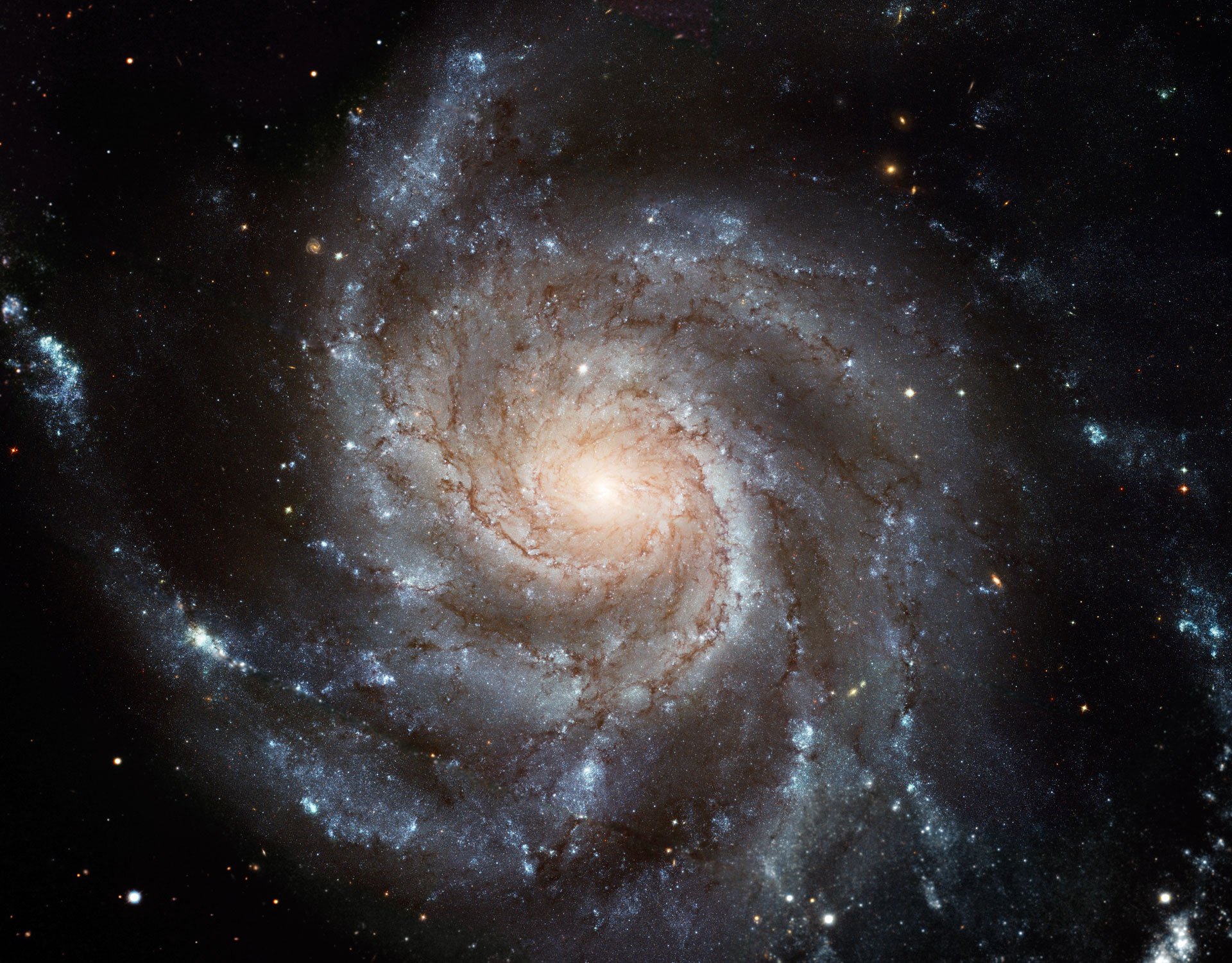
    This Hubble image reveals the gigantic Pinwheel galaxy, one of the best known examples of “grand design spirals,” and its supergiant star-forming regions in unprecedented detail. The image is the largest and most detailed photo of a spiral galaxy ever released from Hubble. Credit: ESA/NASA

    Astronomers have discovered that all galaxies rotate once every billion years, no matter how big they are. The Earth spinning around on its axis once gives us the length of a day, and a complete orbit of the Earth around the Sun gives us a year.

    “It’s not Swiss watch precision,” said Professor Gerhardt Meurer from the UWA node of the International Center for Radio Astronomy Research (ICRAR). “But regardless of whether a galaxy is very big or very small, if you could sit on the extreme edge of its disk as it spins, it would take you about a billion years to go all the way around.”

    Professor Meurer said that by using simple maths, you can show all galaxies of the same size have the same average interior density.

    “Discovering such regularity in galaxies really helps us to better understand the mechanics that make them tick—you won’t find a dense galaxy rotating quickly, while another with the same size but lower density is rotating more slowly,” he said.

    Professor Meurer and his team also found evidence of older stars existing out to the edge of galaxies. “Based on existing models, we expected to find a thin population of young stars at the very edge of the galactic disks we studied,” he said.

    “But instead of finding just gas and newly formed stars at the edges of their disks, we also found a significant population of older stars along with the thin smattering of young stars and interstellar gas.”

    “This is an important result because knowing where a galaxy ends means we astronomers can limit our observations and not waste time, effort, and computer processing power on studying data from beyond that point,” said Professor Meurer. “So because of this work, we now know that galaxies rotate once every billion years, with a sharp edge that’s populated with a mixture of interstellar gas, with both old and young stars.”

    Professor Meurer said that the next generation of radio telescopes, like the soon-to-be-built Square Kilometer Array (SKA), will generate enormous amounts of data, and knowing where the edge of a galaxy lies will reduce the processing power needed to search through the data.

    “When the SKA comes online in the next decade, we’ll need as much help as we can get to characterize the billions of galaxies these telescopes will soon make available to us.”

    Reference: “Cosmic clocks: A Tight Radius – Velocity Relationship for HI-Selected Galaxies” by Gerhardt R Meurer, Danail Obreschkow, O Ivy Wong, Zheng Zheng, Fiona M Audcent-Ross and D J Hanish, 9 March 2018, Monthly Notices of the Royal Astronomical Society.
    DOI: 10.1093/mnras/sty275

    Never miss a breakthrough: Join the SciTechDaily newsletter.
    Follow us on Google and Google News.

    International Centre for Radio Astronomy Research (ICRAR) Popular
    Share. Facebook Twitter Pinterest LinkedIn Email Reddit

    Related Articles

    15,000 Light-Years Away, Something Is Blinking – And It Might Rewrite Physics

    Astronomers Find Mysterious Stellar Object Blasting Out Radio Waves Every 22 Minutes

    SOFIA Looking Deep Into the Orion Nebula

    NASA Probe Takes Close-Up Photos of Giant Vesta Asteroid

    Comet Survives after Close Brush With the Sun

    Two Largest Black Holes Ever Discovered

    3D Video Offers A Tour Over Asteroid Vesta

    Astronomers Discover 18 New Planets

    NASA Curiosity Heads to Mars

    Leave A Reply Cancel Reply

    • Facebook
    • Twitter
    • Pinterest
    • YouTube

    Don't Miss a Discovery

    Subscribe for the Latest in Science & Tech!

    Trending News

    Popular Sugar-Free Sweetener Linked to Liver Disease, Study Warns

    What Is Hantavirus? The Deadly Disease Raising Alarm Worldwide

    Scientists Just Discovered How the Universe Builds Monster Black Holes

    Scientists Unveil New Treatment Strategy That Could Outsmart Cancer

    A Simple Vitamin May Hold the Key to Treating Rare Genetic Diseases

    Scientists Think the Real Fountain of Youth May Be Hiding in Your Gut

    Ravens Don’t Follow Wolves, They Predict Them

    This Common Knee Surgery May Be Doing More Harm Than Good

    Follow SciTechDaily
    • Facebook
    • Twitter
    • YouTube
    • Pinterest
    • Newsletter
    • RSS
    SciTech News
    • Biology News
    • Chemistry News
    • Earth News
    • Health News
    • Physics News
    • Science News
    • Space News
    • Technology News
    Recent Posts
    • Scientists Identify Simple Supplement That Greatly Reduces Alzheimer’s Damage
    • You May Have a Dangerous Type of Cholesterol Even if Your Tests Look Normal
    • Study Reveals Dangerous Flaw in AI Symptom Checkers
    • New MRI Breakthrough Captures Stunningly Clear Images of the Eye and Brain
    • Scientists Warn Sitting Too Much Can Harm Your Body in Surprising Ways
    Copyright © 1998 - 2026 SciTechDaily. All Rights Reserved.
    • Science News
    • About
    • Contact
    • Editorial Board
    • Privacy Policy
    • Terms of Use

    Type above and press Enter to search. Press Esc to cancel.