

Close Menu
    Facebook X (Twitter) Instagram
    SciTechDaily
    • Biology
    • Chemistry
    • Earth
    • Health
    • Physics
    • Science
    • Space
    • Technology
    Facebook X (Twitter) Pinterest YouTube RSS
    SciTechDaily
    Home»Space»Astrophysicist Discovers Numerous Multiple Star Systems With Exoplanets
    Space

    Astrophysicist Discovers Numerous Multiple Star Systems With Exoplanets

    By Friedrich Schiller University JenaNovember 13, 2019No Comments5 Mins Read
    Facebook Twitter Pinterest Telegram LinkedIn WhatsApp Email Reddit
    Share
    Facebook Twitter LinkedIn Pinterest Telegram Email Reddit
    Proxima Centauri b
    The nearest exoplanet Proxima Centauri b is situated in a multiple star system. This is what the system might look like when seen from the planet’s surface (artist’s impression). Credit: ESO/M. Kornmesser

    Is Earth the only habitable planet in the universe or are there more worlds somewhere out there that are capable of supporting life? And if there are, what might they look like? In a bid to answer these fundamental questions, scientists are searching space for exoplanets: distant worlds that orbit other stars outside our solar system.

    More than 4,000 exoplanets are known to date, most of them orbiting single stars like our Sun. Now astrophysicist Dr. Markus Mugrauer of Friedrich Schiller University Jena has discovered and characterized many new multiple-star systems that contain exoplanets. The findings confirm assumptions that the existence of several stars influences the process by which planets are formed and developed. The study by Mugrauer, of the Astrophysical Institute and University Observatory of the University of Jena, has now been published in the renowned specialist journal Monthly Notices of the Royal Astronomical Society.

    Space telescope provides precise data

    “Multiple star systems are very common in our Milky Way,” explains Mugrauer. “If such systems include planets, they are of particular interest to Astrophysics, because the planetary systems in them can differ from our solar system in fundamental ways.” To find out more about these differences, Mugrauer searched more than 1,300 exoplanet host stars with exoplanets orbiting them to see whether they have companion stars. To this end, he accessed the precise observation data of the Gaia space telescope, which is operated by the European Space Agency (ESA).

    Exoplanet Host Stars With Companion Stars
    These images show some of the exoplanet host stars with companion stars (B, C) that were found during the project. The images are RGB composite images taken with the Panoramic Survey Telescope and Rapid Response System (PanSTARRS) in the y- (960 nm), i- (760 nm), and g-band (480 nm). The image in the middle shows a hierarchical triple star system. Credit: Mugrauer, PanSTARRS

    In this way, he succeeded in demonstrating the existence of around 200 companion stars to planetary host stars that are up to 1,600 light-years away from the Sun. With the help of the data, Mugrauer was also able to characterize the companion stars and their systems in more detail. He found that there are both tight systems with distances of only 20 astronomical units (au) – which in our solar system corresponds approximately to the distance between the Sun and Uranus – as well as systems with stars that are over 9,000 au from each other.

    Red and white dwarfs

    The companion stars also vary as to their mass, temperature, and stage of evolution. The heaviest among them weigh 1.4 times more than our Sun, while the lightest have only 8 percent of the Sun’s mass. Most of the companion stars are low-mass, cool dwarf stars that glow faintly red.

    HIP116454
    HIP116454 is a planetary host star in the Pisces constellation and it is approx. 200 light years from the Earth. The star is accompanied by a significantly fainter white dwarf (B). The image is an RGB composite image composed of images taken in the i- (760 nm), r- (620 nm), and g-band (480 nm) as part of the Sloan Digital Sky Survey (SDSS). Credit: ugrauer, SDSS

    However, eight white dwarfs were also identified among the faint stellar companions. A white dwarf is the burnt-out core of a sun-like star, which is only about as big as our Earth, but half as heavy as our Sun. These observations show that exoplanets can indeed survive the final evolutionary stage of a nearby sun-like star.

    Double, triple, and quadruple star systems with exoplanets

    The majority of the star systems with exoplanets identified in the study have two stars. However, some two dozen hierarchical triple-star systems and even a quadruple-star system were detected. In the range of distances investigated, of approximately 20 and 10,000 astronomical units, a total of 15 percent of the stars studied have at least one companion star. This is only about half the frequency expected in general for solar-like stars. In addition, the companion stars detected show distances about five times greater than in ordinary systems.
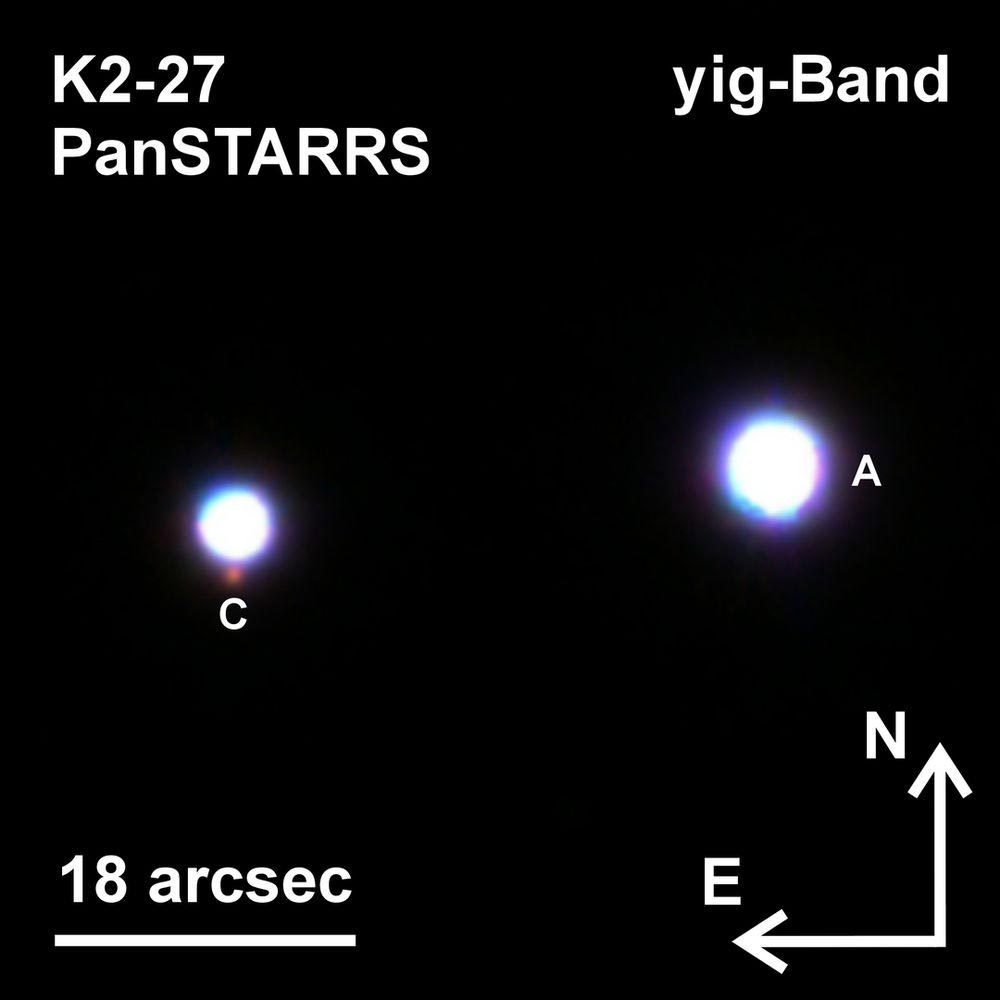
    Triple Star System
    A triple star system approx. 800 light-years from the Earth in the Leo constellation with the planetary host star K2-27 (bright star on the left). The image is an RGB composite image taken with PanSTARRS in the y- (960 nm), i- (760 nm), and g-band (480 nm). To the right of it, the first companion star (A) can be clearly distinguished. Just below K2-27 is the second companion star (C) that glows faintly red. Credit: Mugrauer, PanSTARRS

    “These two factors taken together could indicate that the influence of several stars in a star system disrupts the process of planet formation as well as the further development of their orbits,” says Mugrauer. The cause of this could be first the gravitational impact of a stellar companion on the gas and dust disc in which planets form around their host star. Later, the gravitation of the stellar companion influences the motion of the planets around their host star.

    Markus Mugrauer would like to pursue the project further. In the future, too, the multiplicity of newly discovered planetary host stars would be studied using data from the Gaia mission and any companion stars detected would be precisely characterized. “In addition, we will combine the results with those of an international observational campaign, which we are currently conducting on the same topic at the Paranal Observatory of the European Southern Observatory in Chile,” added Mugrauer. “We will then be able to investigate the precise influence of stellar multiplicity on the formation and development of planets.”

    Reference: “Search for stellar companions of exoplanet host stars by exploring the second ESA-Gaia data release” by Markus Mugrauer, 13 November 2019, Monthly Notices of the Royal Astronomical Society.
    DOI: 10.1093/mnras/stz2673

    Never miss a breakthrough: Join the SciTechDaily newsletter.
    Follow us on Google and Google News.

    Astronomy Exoplanet Friedrich Schiller University Jena
    Share. Facebook Twitter Pinterest LinkedIn Email Reddit

    Related Articles

    Habitable Planets With Earth-Like Biospheres May Be Much Rarer Than Thought

    Alien Life in These Star-Systems Could Have Spotted Earth After Human Civilization Blossomed

    Mind the Gap: Direct Link Uncovered Between Protoplanetary Disk Structures and Giant Exoplanets

    Out of This World Discovery by Citizen Scientists: Two Gaseous Planets Around a Bright Sun-Like Star

    New Neptune-Sized Exoplanet Discovered With a Substantial Atmosphere Ripe for Study

    Model Developed for the Distribution of Inner Planetary Systems May Help Unravel Cosmic Mystery

    Breakthrough: Shrinking Planets Could Explain Mystery of Universe’s Missing Worlds

    Investigating Baked Meteorites Yields Clues to Planetary Atmospheres

    How Habitable Are Planets That Orbit Red Dwarfs – The Most Common Type of Stars in the Galaxy?

    Leave A Reply Cancel Reply

    • Facebook
    • Twitter
    • Pinterest
    • YouTube

    Don't Miss a Discovery

    Subscribe for the Latest in Science & Tech!

    Trending News

    This Alien Planet Has Rock Clouds That Vaporize Before Sunset

    The Simple Habit That Could Lower Your Cancer Risk

    146,000-Year-Old Discovery Rewrites the Story of Human Creativity

    The Type of Alcohol You Drink Could Affect How Long You Live

    This Common Vitamin May Help Stop Prediabetes From Turning Into Diabetes

    Scientists Finally Solve the Mystery of “Clockwork” Earthquakes

    Breakthrough Parkinson’s Drug Targets Disease at Its Genetic Roots

    Just 4 Weeks of Simple Diet Changes Reversed Signs of Aging in Older Adults

    Follow SciTechDaily
    • Facebook
    • Twitter
    • YouTube
    • Pinterest
    • Newsletter
    • RSS
    SciTech News
    • Biology News
    • Chemistry News
    • Earth News
    • Health News
    • Physics News
    • Science News
    • Space News
    • Technology News
    Recent Posts
    • New Vitamin B12-Based Therapy Could Change How Brain Cancer Is Treated
    • This Common Fat Could Be Fueling Type 2 Diabetes, Researchers Warn
    • Scientists Discover Low-Cost Route To Clean Hydrogen Production
    • Scientists Crack Key Mystery Behind High-Temperature Superconductors
    • New Holographic 3D Printing Method Is 70x More Efficient
    Copyright © 1998 - 2026 SciTechDaily. All Rights Reserved.
    • Science News
    • About
    • Contact
    • Editorial Board
    • Privacy Policy
    • Terms of Use

    Type above and press Enter to search. Press Esc to cancel.