
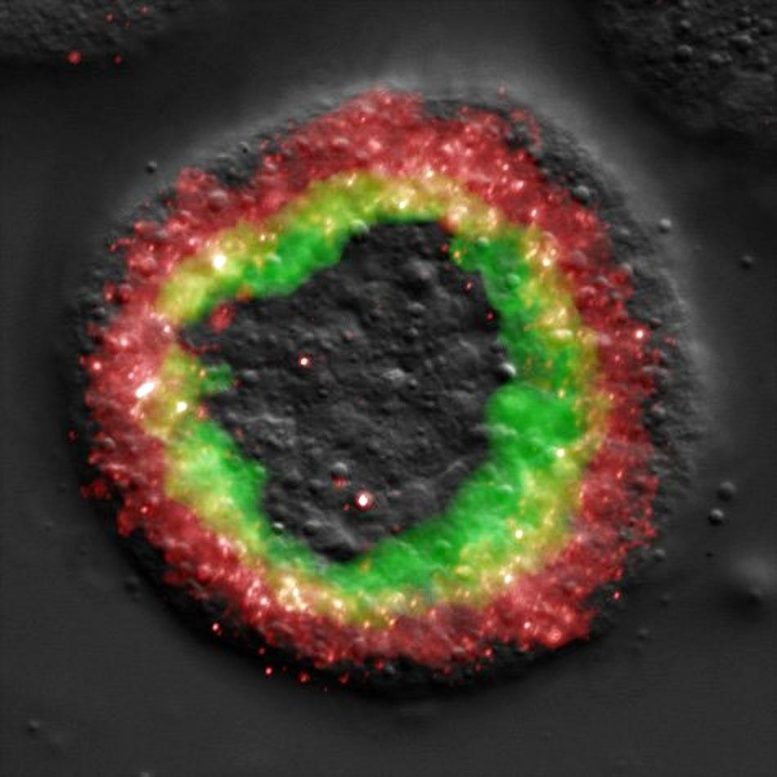
By translating their biological knowledge into very simple Boolean statements, biologists at the California Institute of Technology have created the first predictive computational model of gene networks that control the development of sea urchin embryos.
As an animal develops from an embryo, its cells take diverse paths, eventually forming different body parts—muscles, bones, heart. In order for each cell to know what to do during development, it follows a genetic blueprint, which consists of complex webs of interacting genes called gene regulatory networks.
Biologists at the California Institute of Technology (Caltech) have spent the last decade or so detailing how these gene networks control development in sea-urchin embryos. Now, for the first time, they have built a computational model of one of these networks.
This model, the scientists say, does a remarkably good job of calculating what these networks do to control the fates of different cells in the early stages of sea-urchin development—confirming that the interactions among a few dozen genes suffice to tell an embryo how to start the development of different body parts in their respective spatial locations. The model is also a powerful tool for understanding gene regulatory networks in a way not previously possible, allowing scientists to better study the genetic bases of both development and evolution.
“We have never had the opportunity to explore the significance of these networks before,” says Eric Davidson, the Norman Chandler Professor of Cell Biology at Caltech. “The results are amazing to us.”
The researchers described their computer model in a paper in the Proceedings of the National Academy of Sciences that appeared as an advance online publication on August 27.
The model encompasses the gene regulatory network that controls the first 30 hours of the development of endomesoderm cells, which eventually form the embryo’s gut, skeleton, muscles, and immune system. This network—so far the most extensively analyzed developmental gene regulatory network of any animal organism—consists of about 50 regulatory genes that turn one another on and off.
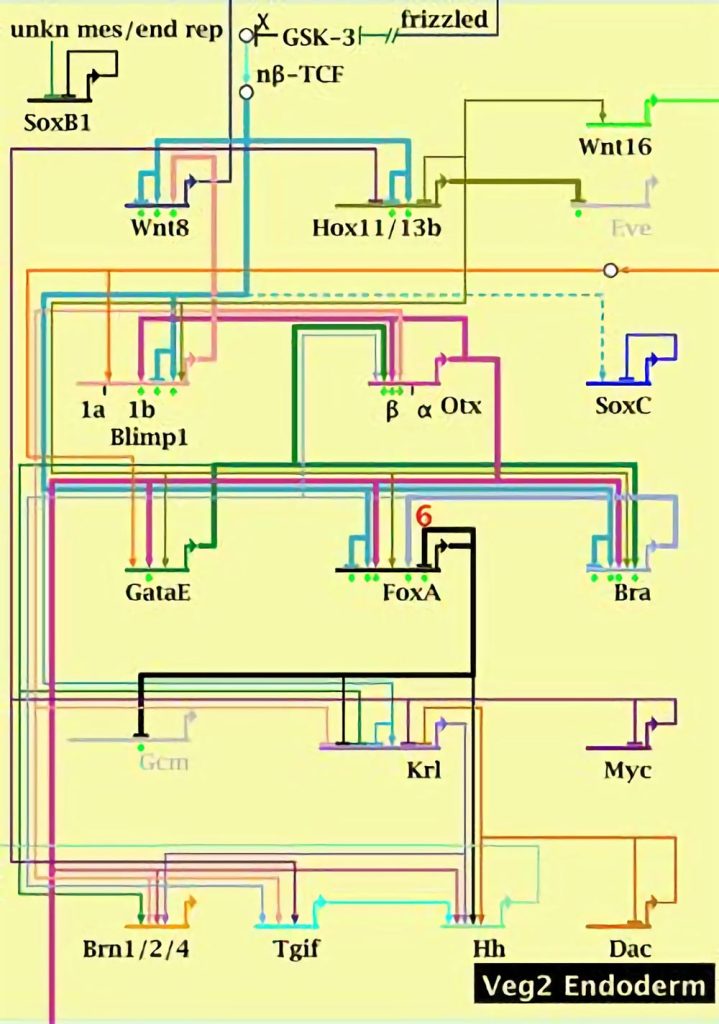
To create the model, the researchers distilled everything they knew about the network into a series of logical statements that a computer could understand. “We translated all of our biological knowledge into very simple Boolean statements,” explains Isabelle Peter, a senior research fellow and the first author of the paper. In other words, the researchers represented the network as a series of if-then statements that determine whether certain genes in different cells are on or off (i.e., if gene A is on, then genes B and C will turn off).
By computing the results of each sequence hour by hour, the model determines when and where in the embryo each gene is on and off. Comparing the computed results with experiments, the researchers found that the model reproduced the data almost exactly. “It works surprisingly well,” Peter says.
Some details about the network may still be uncovered, the researchers say, but the fact that the model mirrors a real embryo so well shows that biologists have indeed identified almost all of the genes that are necessary to control these particular developmental processes. The model is accurate enough that the researchers can tweak specific parts—for example, suppress a particular gene—and get computed results that match those of previous experiments.
Allowing biologists to do these kinds of virtual experiments is precisely how computer models can be powerful tools, Peter says. Gene regulatory networks are so complex that it is almost impossible for a person to fully understand the role of each gene without the help of a computational model, which can reveal how the networks function in unprecedented detail.
Studying gene regulatory networks with models may also offer new insights into the evolutionary origins of species. By comparing the gene regulatory networks of different species, biologists can probe how they branched off from common ancestors at the genetic level.
So far, the researchers have only modeled one gene regulatory network, but their goal is to model the networks responsible for every part of a sea urchin embryo, to build a model that covers not just the first 30 hours of a sea urchin’s life but its entire embryonic development. Now that this modeling approach has been proven effective, Davidson says, creating a complete model is just a matter of time, effort, and resources.
Reference: “Predictive computation of genomic logic processing functions in embryonic development” by Isabelle S. Peter, Emmanuel Faure and Eric H. Davidson, 27 August 2022, Proceedings of the National Academy of Sciences.
DOI: 10.1073/pnas.1207852109
In addition to Peter and Davidson, the other author on the PNAS paper is Emmanuel Faure, a former Caltech postdoctoral scholar who is now at the École Polytechnique in France. This work was supported by the National Institute of Child Health and Human Development.
Never miss a breakthrough: Join the SciTechDaily newsletter.
Follow us on Google and Google News.