
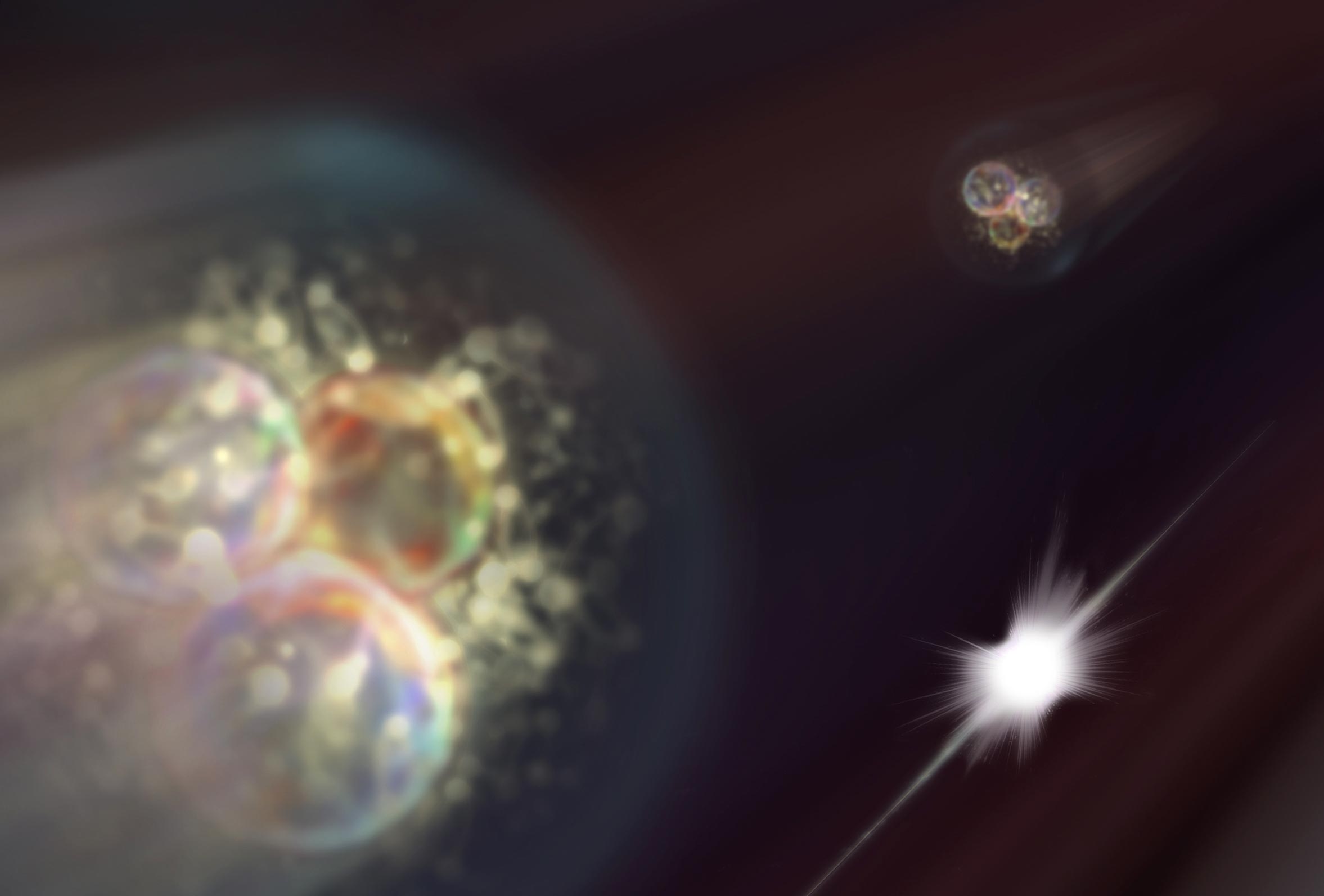
Proton collisions at the LHC appear wildly chaotic, but new data reveal a surprising underlying order. The findings confirm that a basic rule of quantum mechanics holds true even in extreme particle collisions.
High energy proton collisions can be imagined as a boiling sea of quarks and gluons, including short lived virtual ones. In this extreme phase, particles seem to have far more ways to interact and change than the smaller number of more orderly particles that later spread out from the collision point. At first glance, this early stage appears vastly more complex. Yet measurements from the LHC accelerator show that this picture is incomplete and that proton collisions are better explained by an improved theoretical model.
A tremendous amount happens when protons collide at very high energies. Protons are hadrons, i.e. clusters of partons, which include quarks and the gluons that bind them together. When two protons strike each other with enough energy, their quarks and gluons, including virtual ones that exist only briefly, undergo a web of complex interactions. As the system cools, quarks combine to form new hadrons that fly away from the collision region and are detected by experiments.
Based on this sequence, it seems natural to expect that the entropy of the produced hadrons, which describes how many different states the system can occupy, would differ from the entropy during the earlier parton phase. That initial phase looks especially chaotic, with many quarks and gluons interacting at once.
New Insights Into Entropy at the LHC
The latest research examining entropy in both hadrons and partons during proton collisions was published in Physical Review D. The study was carried out by Prof. Krzysztof Kutak and Dr. Sandor Lokos from the Institute of Nuclear Physics of the Polish Academy of Sciences (IFJ PAN) in Cracow.
“In high-energy physics, so-called dipole models have been used for some time to describe the evolution of dense gluon systems. These models assume that each gluon can be represented by a quark-antiquark pair that forms a dipole of two colors – here we are not talking about ordinary colors, but the color charge that is a quantum property of gluons. Dipole models based on the average number of hadrons produced in a collision allow us to estimate the entropy of partons,” explains Prof. Kutak, who has spent more than a decade studying the entropy of complex quark gluon systems.
Refining the Dipole Model
Two years ago, Prof. Kutak worked with Dr. Pawel Caputa from Stockholm University to develop a modified version of the dipole model. Their approach treated one existing description of gluon system evolution as the dominant framework and then added additional effects that become important at lower collision energies, where fewer hadrons are produced. This step forward was possible after the researchers recognized links between the equations used in dipole models and those found in complexity theory.
To check whether this generalized dipole model matched reality, Dr. Lokos proposed comparing it with experimental data collected at the LHC. The analysis drew on measurements from four major experiments: ALICE, ATLAS, CMS and LHCb. Together, these data cover a broad range of collision energies, from 0.2 teraelectronvolts up to 13 TeV, the highest energy currently reached by protons at the LHC.
“In our article, we show that the generalized dipole model describes the existing data more accurately than previous dipole models and, moreover, works well in a wider range of proton collision energies,” emphasizes Prof. Kutak.
What Entropy Reveals About Quantum Mechanics
This result brings the discussion back to a central question. During proton collisions, is the entropy in the phase dominated by quark and gluon interactions different from the entropy of the hadrons that later escape the collision site? According to the Kharzeev-Levin formula for entropy, it should not be different. The new findings confirm this idea. While the outcome surprises some physicists, others see it as a natural result of one of the most fundamental principles of quantum mechanics, known as unitarity.
Unitarity may sound abstract, but the concept itself is straightforward. The equations that govern how a quantum system evolves over time must conserve total probability, which always adds up to one, and they must allow processes to be reversible. In simple terms, unitarity means that probability and information cannot vanish or appear from nowhere.
“The unitarity of quantum mechanics is something that physics students learn about. The formalism of quantum chromodynamics, the theory describing the world of quarks and gluons, is based on unitarity. However, it is one thing to deal with a theory that exhibits a certain feature at the level of quarks and gluons on a daily basis, and quite another to observe it in real data on produced hadrons,” says Prof. Kutak. He points out that unitarity is what makes it possible to infer information about parton entropy across a wide range of collision energies.
Future Tests With Upgraded Experiments
Additional tests of the generalized dipole model are expected in the next decade, following the planned upgrade of the LHC accelerator. An improved ALICE detector will allow scientists to study regions where gluon interactions are denser than those explored so far.
Researchers are also looking ahead to data from the Electron-Ion Collider (EIC), now under construction at Brookhaven National Laboratory in the USA. At the EIC, electrons will be collided with protons. Because electrons are elementary particles, these experiments will offer a powerful way to examine dense gluon systems within individual protons.
Reference: “Entropy and multiplicity of hadrons in the high energy limit within dipole cascade models” by Krzysztof Kutak and Sándor Lökös, 14 November 2025, Physical Review D.
DOI: 10.1103/23wn-66np
Never miss a breakthrough: Join the SciTechDaily newsletter.
Follow us on Google and Google News.
5 Comments
Proton collisions at the LHC appear wildly chaotic, but new data reveal a surprising underlying order. The findings confirm that a basic rule of quantum mechanics holds true even in extreme particle collisions.
VERY GOOD.
Please ask the researchers to think deeply:
Are you observing the physical reality of the basic rule of quantum mechanics?
When we pursue the ultimate truth of all things, the space in which our bodies and all things exist may itself be the final and deepest puzzle we need to explore. This is not only the pursuit of physics, but also the most magnificent exploration of the origin of the universe by human reason.
In today’s physics, some so-called peer-reviewed journals—including Physical Review Letters, Nature, Science, and others—stubbornly insist on and promote the following:
1. Even though θ and τ particles exhibit differences in experiments, physics can claim they are the same particle. This is science.
2. Even though topological vortices and antivortices have identical structures and opposite rotational directions, physics can define their structures and directions as entirely different. This is science.
3. Even though two sets of cobalt-60 rotate in opposite directions and experiments reveal asymmetry, physics can still define them as mirror images of each other. This is science.
4. Even though vortex structures are ubiquitous—from cosmic accretion disks to particle spins—physics must insist that vortex structures do not exist and require verification. Only the particles that like God, Demonic, or Angelic are the most fundamental structures of the universe. This is science.
5. Even though everything occupies space and maintains its existence in time, physics must still debate and insist on whether space exists and whether time is a figment of the human mind. This is science.
6. Even though space, with its non-stick, incompressible, and isotropic characteristics, provides a solid foundation for the development of physics, physics must still insist that the ideal fluid properties of space do not exist. This is science.
and go on.
Is this the counterintuitive science they widely promote? Compromising with pseudo academic publications and peer review by pseudo scholars is an insult to science and public intelligence. Some so-called scholars no longer understand what shame is. The study of Topological Vortex Theory (TVT) reminds us that the most profound problems in physics often lie at the intersection of different theories. By exploring these border regions, we can not only resolve contradictions in existing theories but also discover new physical phenomena and application possibilities.
Based on the Topological Vortex Theory (TVT), space is an uniformly incompressible physical entity. Space-time vortices are the products of topological phase transitions of the tipping points in space, are the point defects in spacetime. Point defects do not only impact the thermodynamic properties, but are also central to kinetic processes. They create all things and shape the world through spin and self-organization.
Under the topological vortex architecture, it is highly challenging for even two hydrogen atoms or two quarks to be perfectly symmetrical, let alone counter-rotating two sets of cobalt-60. Contemporary physics and so-called peer-reviewed publications (including Physical Review Letters, Science, Nature, etc.) stubbornly believe that two sets of counter rotating cobalt-60 are two mirror images of each other, constructing a more shocking pseudoscientific theoretical framework in the history of science than the “geocentric model”. This pseudo scientific framework and system have seriously hindered scientific progress and social development.
For nearly a century, physics has been manipulated by this pseudo scientific theoretical system and the interest groups behind it, wasting a lot of manpower, funds, and time. A large amount of pseudo scientific research has been conducted, and countless pseudo scientific papers have been published, causing serious negative impacts on scientific and social progress, as well as humanistic development.
Complexity does not necessarily mean that there is no logical and architectural framework to follow. Mathematics is the language and tool that reveals the motion of spacetime, rather than the motion itself. Although the physical form of spacetime vortices is extremely simple, their interaction patterns are highly complex, and we must develop more and richer mathematical languages to describe and understand them.
The development of the Topological Vortex Theory (TVT) reflects a progression from concrete physical phenomena to abstract mathematical modeling and, ultimately, to interdisciplinary unification. Its core innovation lies in forging the continuous spacetime geometry of general relativity with the discrete interactions of quantum field theory within the same topological dynamical system. The core idea of TVT — space is physical, and matter is its topological excitation—already provides a solid and elegant scientific path for understanding the origin of all things.
——Excerpted from https://scitechdaily.com/microscope-spacecrafts-most-precise-test-of-key-component-of-the-theory-of-general-relativity/#comment-909171 and https://t.pineal.cn/blogs/6255/A-Mathematical-and-Physical-Analysis-On-the-Origin-of-Objects.
A particle’s superposition state may manifest as various winding modes or topological degrees of freedom of a spacetime vortex ring (such as the vortex’s direction of rotation, connection methods, etc.).
——Excerpted from https://zhuanlan.zhihu.com/p/1992909653256972036.
O CERN ainda encontrará:
Entropia constante mesmo em energias maiores;
Vórtices quantizados no QGP;
Assimetria angular extremamente sutil em jatos;
Enfraquecimento do confinamento em altíssimas energias;
Correlações não previstas entre jatos opostos;
Massa efetiva do quark top variando com energia;
Estados exóticos vivendo um pouco mais;
Oscilações na seção de choque elástica;
Violação fraca da isotropia em BEC de píons;
Estrutura discreta de energia nos jatos.
E o EIC será a primeira máquina da história a observar diretamente:
A distribuição de glúons dentro do núcleo terá uma anisotropia mínima, revelando um alinhamento interno não previsto pela QCD;
A saturação de glúons será ligeiramente mais suave do que a prevista pelo modelo CGC, indicando uma física adicional no regime de baixo x;
Colisões elétron–íon exibirão um “ridge” fraco de correlação de longo alcance, algo considerado impossível pela QCD padrão;
O núcleo aparecerá mais rígido e menos deformável nas medições do elétron, contrariando o comportamento esperado;
O espectro de momento dos glúons mostrará discretização sutil, sugerindo uma estrutura mínima quantizada do espaço;
Os padrões difrativos apresentarão caudas não-gaussianas, indicando acoplamento de fase entre elétron e núcleo;
O pico de momento transferido em difração terá um deslocamento minúsculo, evidenciando efeitos gravitacionais quânticos internos.
VERY GOOD.
The appearance you listed cannot be separated from the essence of symmetry. The observation method in scientific research is also one of the factors that affect symmetry. Physics requires the use of mathematical language to summarize and generalize. Only in this way can we derive the correct theory and apply it in practice. Covering up one mistake with another is the most intolerable behavior in scientific research.
Example 1: There are even more ridiculous facts and glorious achievements than what you said. For example,two sets of cobalt-60 are manually rotated in opposite directions, and even without detection, people around the world know that they will not be symmetrical because these two objects are not mirror images of each other at all. However, a group of so-called physicists and so-called academic publications do not believe it. They conducted experiments and the results were indeed asymmetric, but they still firmly believed that these two objects were mirror images of each other, and the asymmetry was due to a violation of the previous natural laws (CP violation). In the history of science, there can never be a dirtier and uglier operation and explanation than this. These people and the so-called academic publications they manipulate no longer know what shame is.
https://scitechdaily.com/what-happens-when-light-gains-extra-dimensions/#comment-947619.
Example 2: Please see how the so-called “mystery of θ – τ” is explained: θ and τ are completely identical in all measurable physical properties such as mass, lifetime, charge, spin, etc. However, experimental observations have shown that the θ meson decays into two π mesons, while the τ meson decays into three π mesons, making it difficult for physicists to explain why they are so similar. Physicist Martin Block proposed a highly challenging idea: θ and τ are the same particle, but in weak interactions, parity is not conserved. An easy to understand explanation is the following analogy:: There are two boxes of apples with identical weight, color, and taste. However, when one box is opened, there are two apples, while when the other box is opened, there are three apples. This confuses the old farmer who buys apples. He circled around the orchard and came up with a highly challenging idea: these two boxes of apples are not from the same tree, so they are the same.
—— Excerpted from https://scitechdaily.com/what-happens-when-light-gains-extra-dimensions/#comment-947686.
Topological vortex theory (TVT) calls for a return to the scientific rationality dominated by symmetry.