

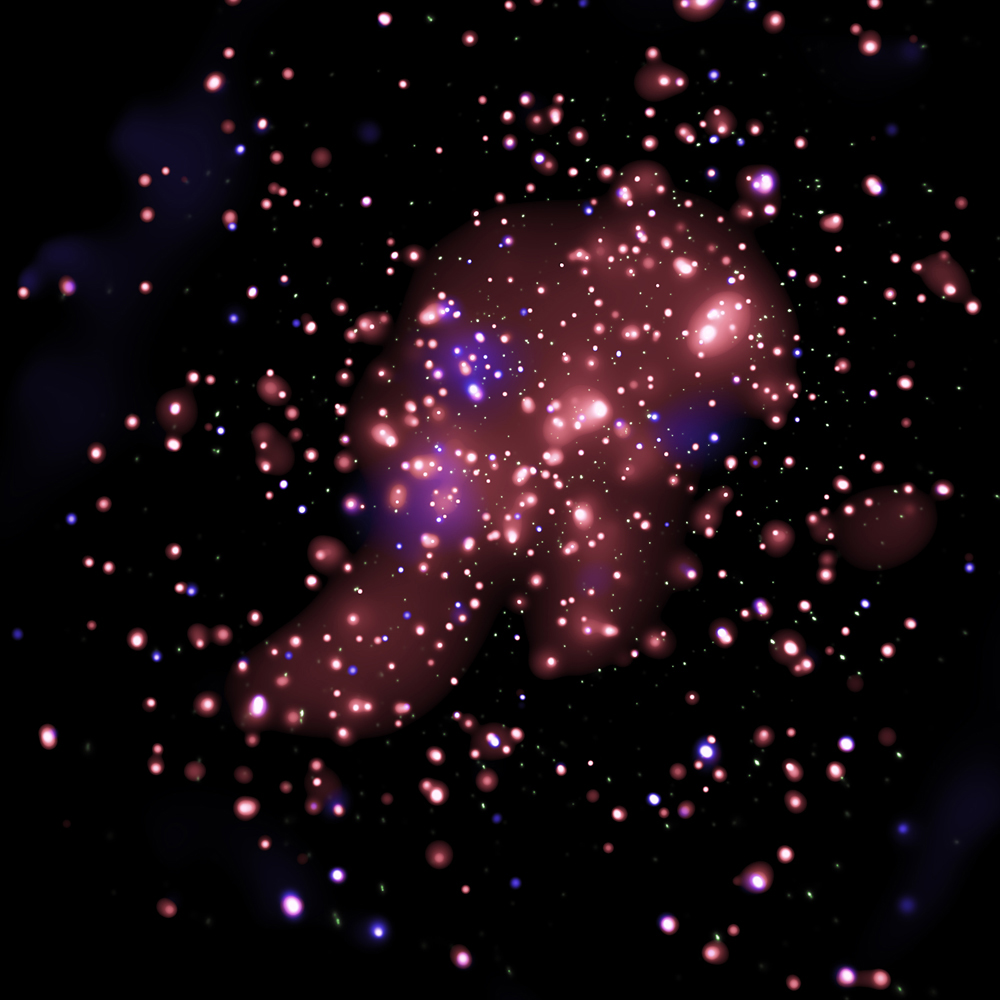
Astronomers think that our Sun was born in a stellar cluster about 4.6 billion years ago that quickly dispersed. Chandra’s image of the stellar cluster NGC 6231 helps provide an accurate census of the stars that reside there. X-rays from Chandra were used to identify Sun-like stars in NGC 6231 that were previously missed. The Chandra image shows the inner region of NGC 6231 where red, green, and blue represent low, medium, and high-energy X-rays.
In some ways, star clusters are like giant families with thousands of stellar siblings. These stars come from the same origins – a common cloud of gas and dust – and are bound to one another by gravity. Astronomers think that our Sun was born in a star cluster about 4.6 billion years ago that quickly dispersed.
By studying young star clusters, astronomers hope to learn more about how stars – including our Sun – are born. NGC 6231, located about 5,200 light years from Earth, is an ideal testbed for studying a stellar cluster at a critical stage of its evolution: not long after star formation has stopped.
The discovery of NGC 6231 is attributed to Giovanni Battista Hodierna, an Italian mathematician and priest who published observations of the cluster in 1654. Sky watchers today can find the star cluster to the southwest of the tail of the constellation Scorpius.
NASA’s Chandra X-ray Observatory has been used to identify the young Sun-like stars in NGC 6231, which have, until recently, been hiding in plain sight. Young star clusters like NGC 6231 are found in the band of the Milky Way on the sky. As a result, interloping stars lying in front of or behind NGC 6231 greatly outnumber the stars in the cluster. These stars will generally be much older than those in NGC 6231, so members of the cluster can be identified by selecting signs of stellar youth.
Young stars stand out to Chandra because they have strong magnetic activity that heats their outer atmosphere to tens of millions of degrees Celsius and causes them to emit X-rays. Infrared measurements assist in verifying that an X-ray source is a young star and in inferring the star’s properties.
This Chandra X-ray image of NGC 6231 shows a close-up of the inner region of the cluster. Chandra can detect a range of X-ray light, which has been split into three bands to create this image. Red, green, and blue represent the lower, medium, and high-energy X-rays. The brightest X-ray emission is white.
The Chandra data, combined with infrared data from the Visible and Infrared Survey Telescope for Astronomy (VISTA) Variables in the Vía Lactéa survey has provided the best census of young stars in NGC 6231 available. An infrared image from NASA’s Wide-field Infrared Survey explorer is shown on the left.
There are an estimated 5,700 to 7,500 young stars in NGC 6231 in the Chandra field of view, about twice the number of stars in the well-known Orion star cluster. The stars in NGC 6231 are slightly older (3.2 million years on average) than those in Orion (2.5 million years old). However, NGC 6231 is much larger in volume, and therefore the number density of its stars, that is, their proximity to one another, is much lower, by a factor of about 30. These differences enable scientists to study the diversity of properties for star clusters during the first few million years of their life.
Chandra studies of this and other young star clusters, have allowed astronomers to build up a sample from which cluster evolution can be studied. These clusters come from dozens of star-forming regions, but NGC 6231 adds a crucial piece to this puzzle because it shows how a cluster looks after the end of star formation. A comparison of the ages, sizes, and masses of clusters in this sample implies that NGC 6231 has expanded from a more compact initial state, but it has not expanded sufficiently fast for its stars to break free from the cluster’s gravitational pull. Astronomers are not sure what will happen next: will it remain held together by gravity? Or will its constituents one day disperse as our Sun’s ancestral cluster once did?
Nearby star-forming regions frequently contain multiple star clusters, most of which are individually less massive than NGC 6231. The simple structure of NGC 6231, along with its relatively high mass, suggests that NGC 6231 was built up by mergers of several star clusters early its lifetime, a process known as “hierarchical cluster assembly”.
Two papers describing recent studies of NGC 6231, both led by Michael Kuhn while at the Universidad de Valparaíso in Chile, have been published and are available online.
NASA’s Marshall Space Flight Center in Huntsville, Alabama, manages the Chandra program for NASA’s Science Mission Directorate in Washington. The Smithsonian Astrophysical Observatory in Cambridge, Massachusetts, controls Chandra’s science and flight operations.
References:
“The Structure of the Young Star Cluster NGC 6231. I. Stellar Population” by Michael A. Kuhn, Nicolás Medina, Konstantin V. Getman, Eric D. Feigelson, Mariusz Gromadzki, Jordanka Borissova and Radostin Kurtev, 4 August 2017, The Astrophysical Journal.
DOI:10.3847/1538-3881/aa76e8
“The Structure of the Young Star Cluster NGC 6231. II. Structure, Formation, and Fate” by Michael A. Kuhn, Konstantin V. Getman, Eric D. Feigelson, Alison Sills, Mariusz Gromadzki, Nicolás Medina, Jordanka Borissova and Radostin Kurtev, 8 November 2017, The Astrophysical Journal.
DOI: 10.3847/1538-3881/aa9177
Never miss a breakthrough: Join the SciTechDaily newsletter.
Follow us on Google and Google News.