
Cumberland is testing whether its abandoned coal mines can become a town-wide geothermal network that supports redevelopment, economic growth, and lower emissions.
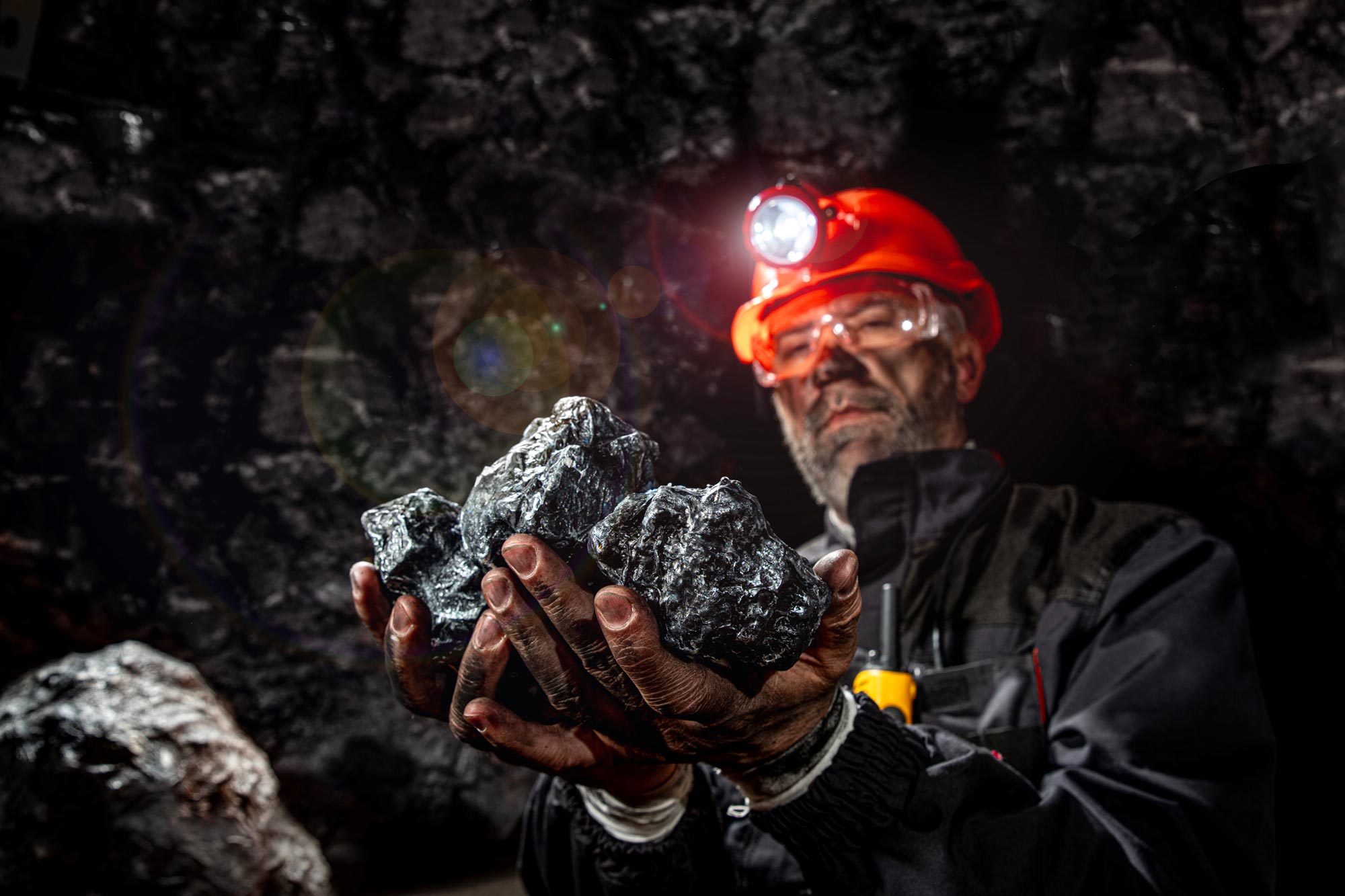
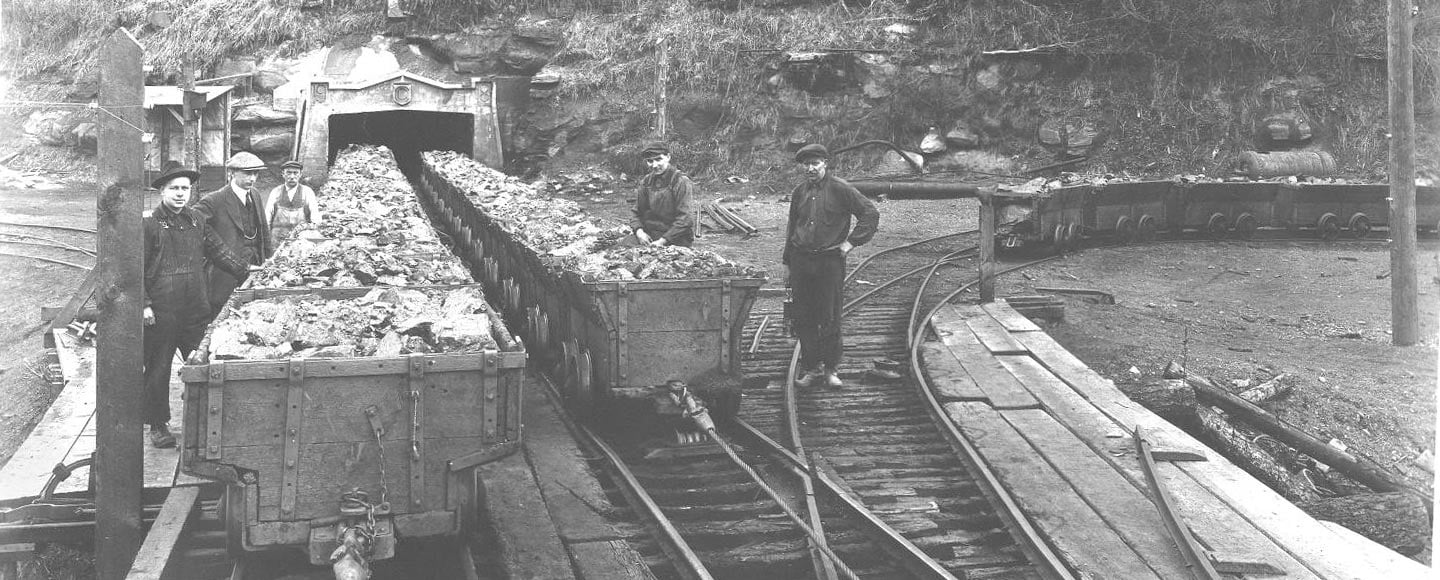
Cumberland, B.C. was built on coal mining—both literally and practically. For more than 80 years, the industry shaped the village’s economy and identity, employing thousands of workers and exporting millions of tonnes of coal. When the mines closed, they left behind vast underground workings and a community searching for a new economic direction.
Today, Cumberland is looking beneath its streets for that next chapter. In partnership with the University of Victoria-led Accelerating Community Energy Transformation (ACET) initiative, the village is exploring how its abandoned mine network could anchor a shift to clean energy.
At the center of the effort is the Cumberland District Energy project. Researchers are studying whether water that has collected in the old mine shafts and tunnels can be used as a geothermal resource to heat and cool local buildings.
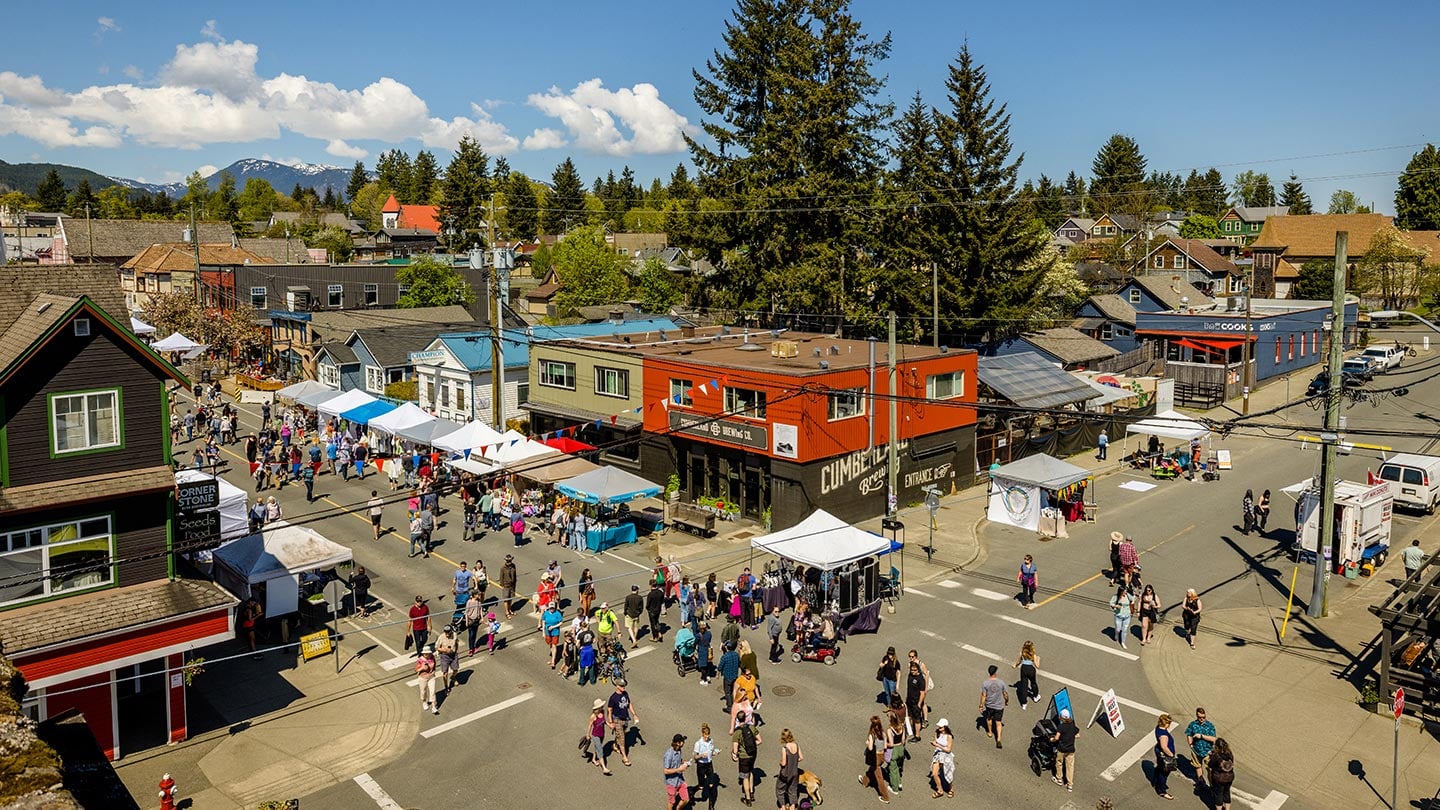
Mayor Vickey Brown views the proposal as part of a broader reinvention. Cumberland is already known for outdoor recreation, drawing mountain bikers and nature enthusiasts. She believes the geothermal plan could strengthen its identity as a destination rooted in sustainability, while also changing how residents and visitors think about the village’s industrial past.
“This is a way to highlight the history of Cumberland and bring it into a sustainable-future, clean-energy ethos,” she says. “It’s something that old Cumberland can be proud of, because we’re using the waste of that old resource to transition to cleaner energy.”
An old asset, a new opportunity for clean energy
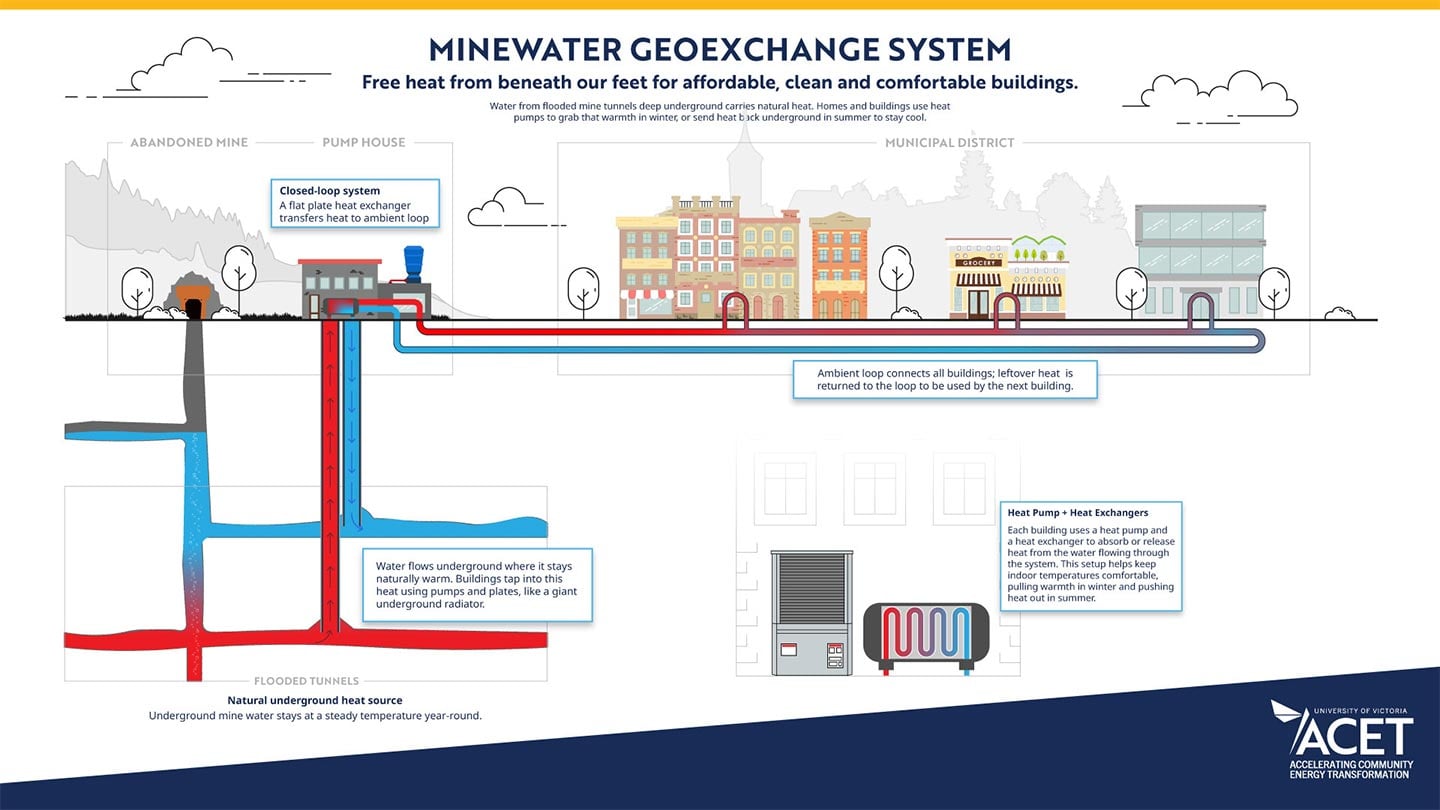
The concept relies on a basic temperature principle. According to ACET community energy planner and project lead Zachary Gould, water trapped underground in the former mines remains cooler than surface air during summer and warmer during winter. Heat pumps could harness this steady underground temperature to provide building heating and cooling at relatively low cost and with near zero carbon emissions.
“[The Cumberland District Energy project] is technically a very large ground-source heat exchanger,” explains Emily Smejkal, a fellow at the Victoria-based Cascade Institute who focuses on geothermal systems.
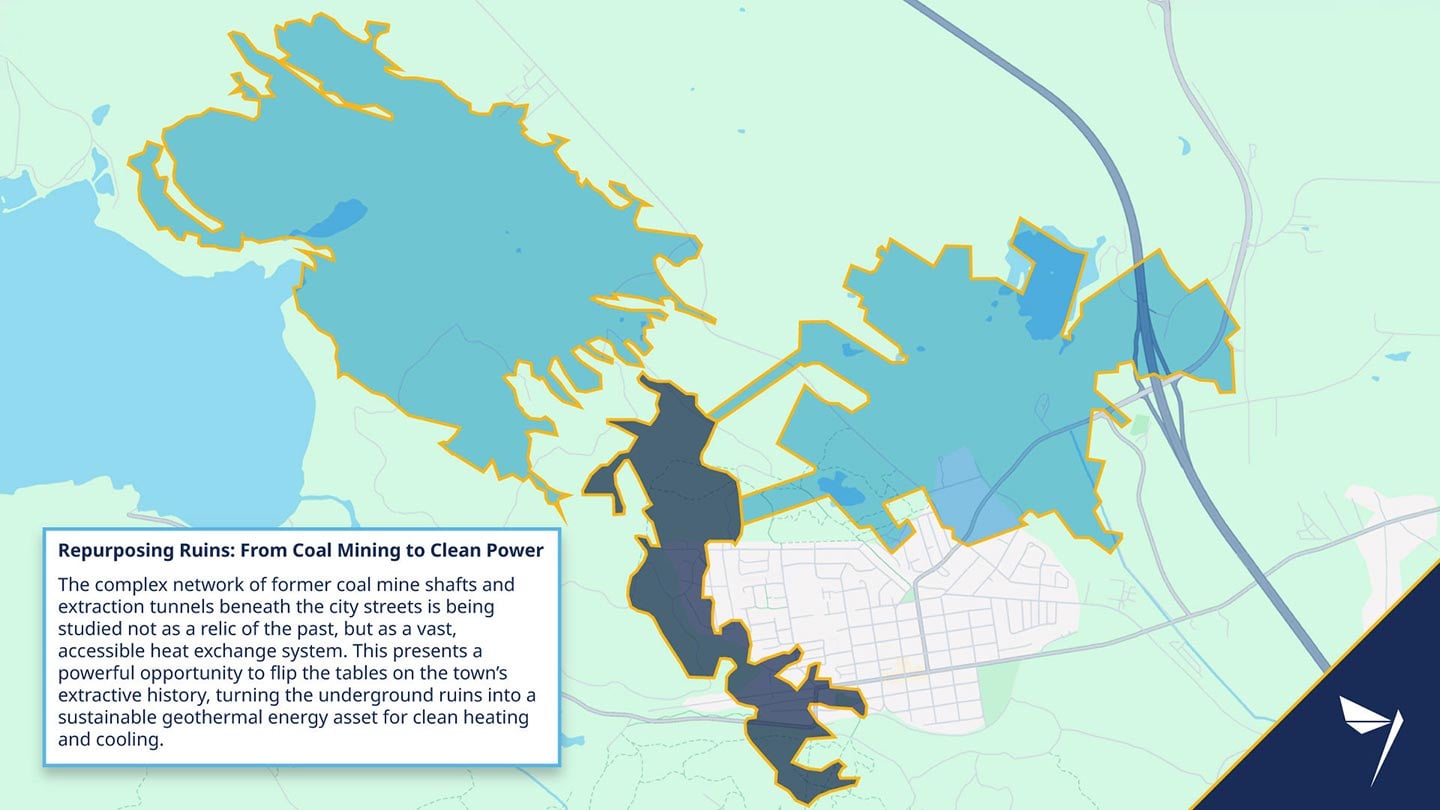
Because mine tunnels extend beneath much of the village, the resource could potentially serve a large portion of the community. Geologists have mapped the extensive underground network to evaluate its suitability for long-term energy use.
Initial modeling is focused on a proposed redevelopment of a civic precinct that could include a community center, municipal offices, and affordable housing, along with a nearby industrial area closer to Comox Lake.
“It’s been a big motivation to think about this energy system in the context of how we can reduce the costs of critical infrastructure and provide critical amenities for community members,” Gould says.
“But it’s not just an energy system,” he adds. “It’s an opportunity to look at resource extraction in a new way in a village that was built on extractive principles. This project could turn those ruins of extraction, so to speak, into an opportunity and a shared community asset.”
Mining was historically the core of Cumberland community
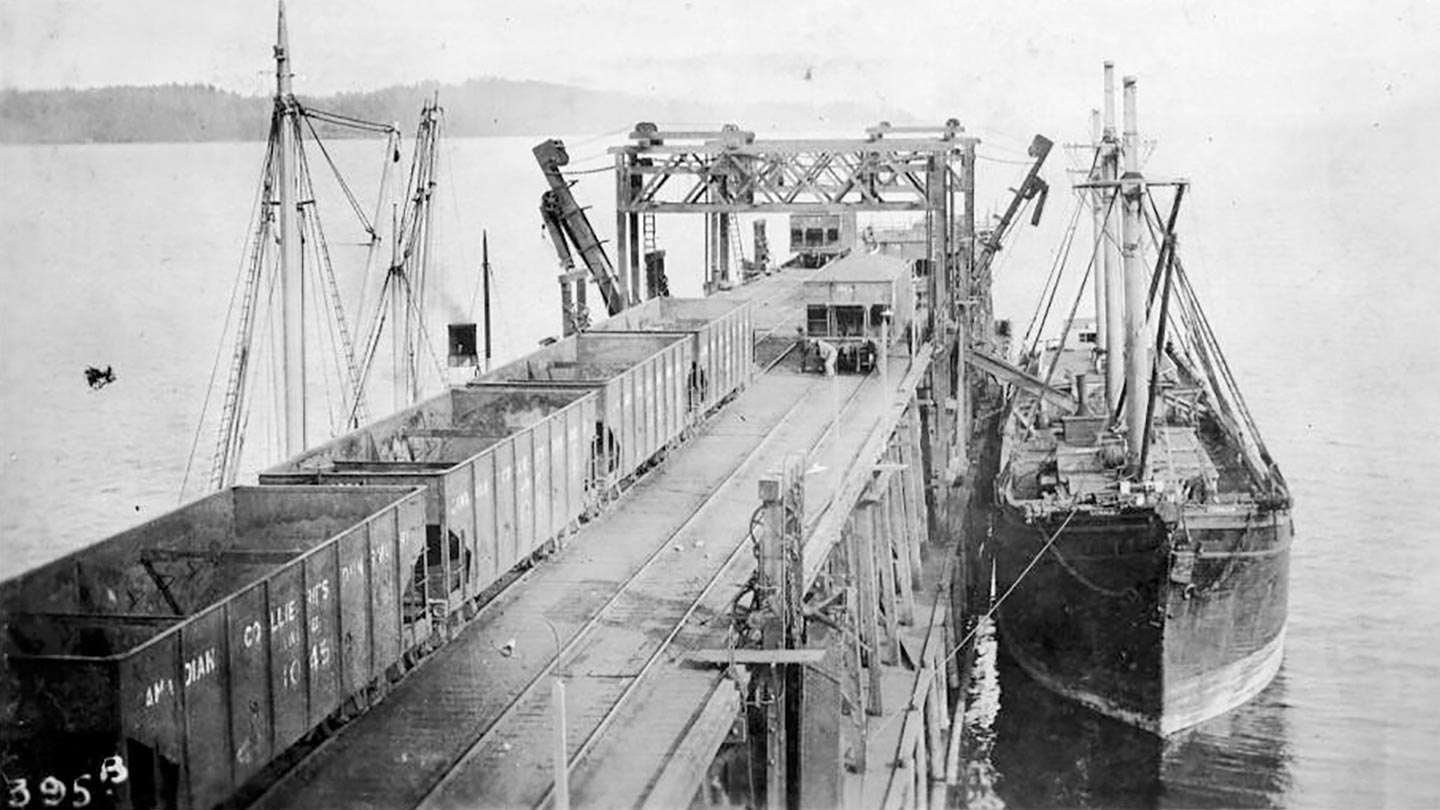
Coal once defined Cumberland’s economy. From 1888, when the first mine opened, until the late 1960s, about 16 million tonnes of bituminous coal were extracted from the Comox Valley, says Dawn Copeman, a historian with the Cumberland Museum and Archives. Coal left the region through a wharf at Union Bay, destined for international markets. It powered steamships, heated homes, and supplied smelters producing lead and zinc.
Mining also carried serious human and environmental costs. Working conditions were dangerous, many miners were injured or killed, and the burning of coal contributed to climate change.
Copeman notes that using abandoned mines for geothermal energy does not erase this history, but it reframes it.
After a 2011 proposal for a new coal mine near Union Bay faced significant opposition, the current geothermal plan represents a different path.
“Being able to use something that’s already there for heating, I think it’s positive,” she says.
‘It’s about reimagining these old relics of industry’
The idea for geothermal energy began locally. More than a century after the first mine opened, geologists living in the region began discussing the methane produced by former mines and considering alternative uses for the underground infrastructure. Cory MacNeill, a Cumberland geologist, says conversations shifted toward whether mine water could be used for heating and cooling.
Unlike deep geothermal systems that require drilling far into the Earth to reach high temperature water, Cumberland’s approach would use shallower mine water to moderate seasonal temperature extremes.
MacNeill points to similar projects in Nanaimo, B.C., and in Springhill, N.S., another former mining town that has repurposed its underground tunnels for geothermal heating.
“It’s about reimagining these old resources and relics of industry,” he says. “It’s really powerful to look at all of this mining and look at ways that we can benefit from it from a more environmental standpoint.”
Highlighting the past while building a sustainable future
Mayor Brown became more engaged after attending one of the geologists’ discussions. She was aware of geothermal systems elsewhere, including at Vancouver Island University and in Nova Scotia, but an ACET webinar for municipal leaders helped connect the idea to a concrete opportunity.
“They said, ‘We’re looking for projects to work with municipalities.’ And I thought, ‘I have a project.’”
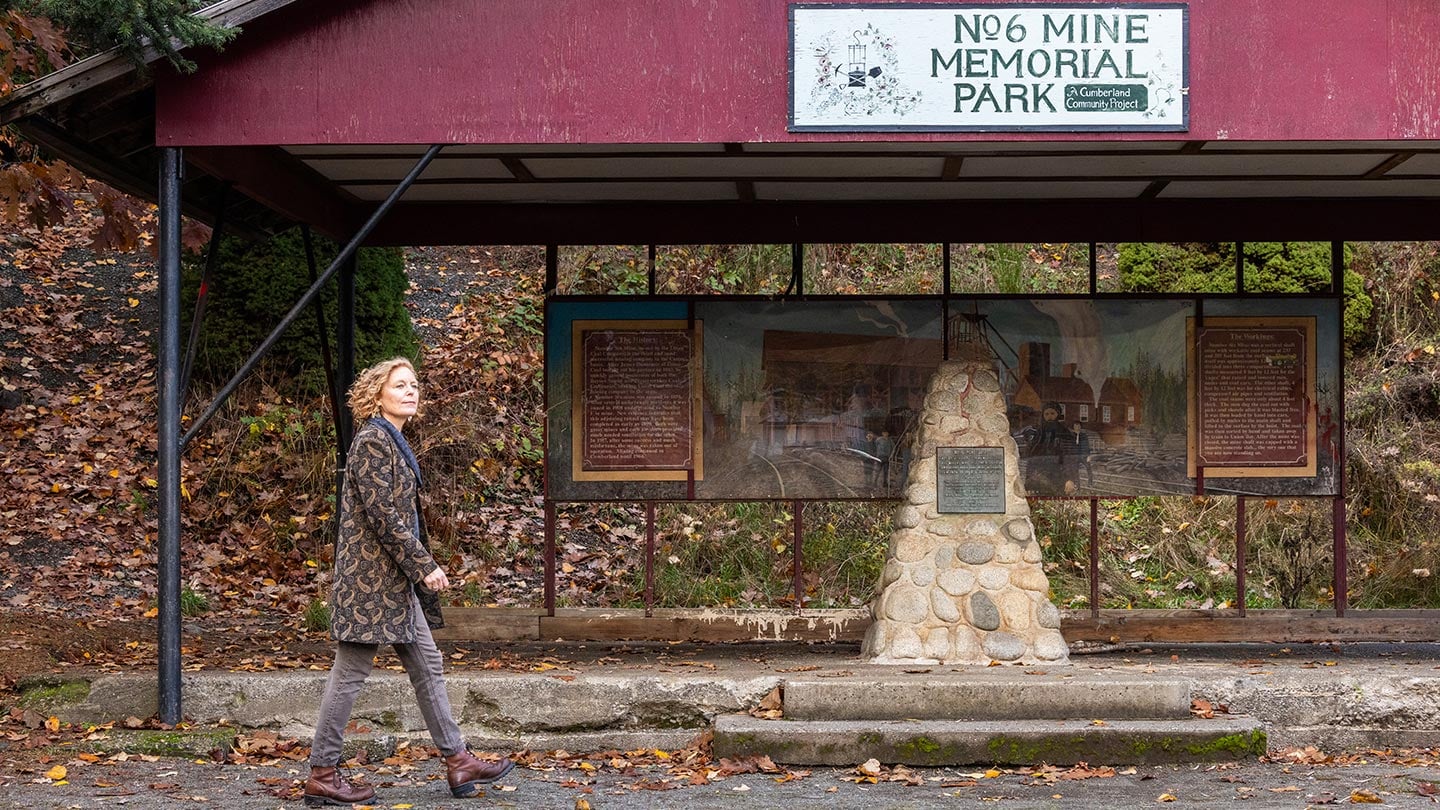
Two municipal blocks, including the village office, council chambers, public works facilities, and a recreation center, sit above the former No. 6 mine.
“I thought we could use this project as a way to figure out whether or not we could use geothermal for heating and cooling of the buildings because we want to redevelop the block,” she says.
With a population of about 4,800, Cumberland does not have its own engineering department to carry out complex feasibility studies. Brown says ACET provides the academic expertise and capacity to conduct business case analysis and geothermal exploration.
If an initial pilot project proves technically and economically viable, the system could expand across what Copeman describes as the “vast labyrinth” of tunnels beneath the town.
Brown believes that affordable, low-carbon heating and cooling could make industrial land more attractive, especially for businesses such as greenhouses and food processors that rely heavily on heat. New enterprises could create jobs and strengthen the local tax base, helping ensure long-term community resilience.
“We haven’t always worked very well with natural systems,” Brown says. “But I think this is a model of using the tools and resources you have in place to look after the needs of your community. And I think that’s far more resilient than the way we’ve done it in the past.”
Never miss a breakthrough: Join the SciTechDaily newsletter.
Follow us on Google and Google News.
4 Comments
thanks fro this
This has been talked about for years. Durham University were researching into it in the Durham coalfield over 30 years ago.
If you can just get 1/3 of the people in Victoria to operate a stair-stepper to pump the water to get the temperature difference in one place, yeah you can extract some power and defoul the equipment.
This seems amazing and hopeful to me! Why have we not heard more about it, and how is developing access to clean energy not viewed as a considerable investment opportunity? There must be quite a few exhausted coal mines in the British Isles alone which are wasting land and could be investigated for possible development for clean energy?