

Applying a small voltage to the walls of algae-growing tanks can prevent cloudy buildup and allow more photosynthesis to happen.
Algae grown in transparent tanks or tubes supplied with carbon dioxide can convert the greenhouse gas into other compounds, such as food supplements or fuels. But the process leads to a buildup of algae on the surfaces that clouds them and reduces efficiency, requiring laborious cleanout procedures every couple of weeks.
MIT researchers have come up with a simple and inexpensive technology that could substantially limit this fouling, potentially allowing for a much more efficient and economical way of converting the unwanted greenhouse gas into useful products.
The key is to coat the transparent containers with a material that can hold an electrostatic charge, and then applying a very small voltage to that layer. The system has worked well in lab-scale tests, and with further development might be applied to commercial production within a few years.
The findings were reported on April 13, 2023, in the journal Advanced Functional Materials, in a paper by recent MIT graduate Victor Leon PhD ’23, professor of mechanical engineering Kripa Varanasi, former postdoc Baptiste Blanc, and undergraduate student Sophia Sonnert.
No matter how successful efforts to reduce or eliminate carbon emissions may be, there will still be excess greenhouse gases that will remain in the atmosphere for centuries to come, continuing to affect global climate, Varanasi points out. “There’s already a lot of carbon dioxide there, so we have to look at negative emissions technologies as well,” he says, referring to ways of removing the greenhouse gas from the air or oceans, or from their sources before they get released into the air in the first place.
When people think of biological approaches to carbon dioxide reduction, the first thought is usually of planting or protecting trees, which are indeed a crucial “sink” for atmospheric carbon. But there are others. “Marine algae account for about 50 percent of global carbon dioxide absorbed today on Earth,” Varanasi says. These algae grow anywhere from 10 to 50 times more quickly than land-based plants, and they can be grown in ponds or tanks that take up only a tenth of the land footprint of terrestrial plants.
What’s more, the algae themselves can then be a useful product. “These algae are rich in proteins, vitamins and other nutrients,” Varanasi says, noting they could produce far more nutritional output per unit of land used than some traditional agricultural crops.
If attached to the flue gas output of a coal or gas power plant, algae could not only thrive on the carbon dioxide as a nutrient source, but some of the microalgae species could also consume the associated nitrogen and sulfur oxides present in these emissions. “For every two or three kilograms of CO2, a kilogram of algae could be produced, and these could be used as biofuels, or for Omega-3, or food,” Varanasi says.
Omega-3 fatty acids are a widely used food supplement, as they are an essential part of cell membranes and other tissues but cannot be made by the body and must be obtained from food. “Omega 3 is particularly attractive because it’s also a much higher-value product,” Varanasi says.
Most algae grown commercially are cultivated in shallow ponds, while others are grown in transparent tubes called photobioreactors. The tubes can produce seven to 10 times greater yields than ponds for a given amount of land, but they face a major problem: The algae tend to build up on the transparent surfaces, requiring frequent shutdowns of the whole production system for cleaning, which can take as long as the productive part of the cycle, thus cutting overall output in half and adding to operational costs.
The fouling also limits the design of the system. The tubes can’t be too small because the fouling would begin to block the flow of water through the bioreactor and require higher pumping rates.
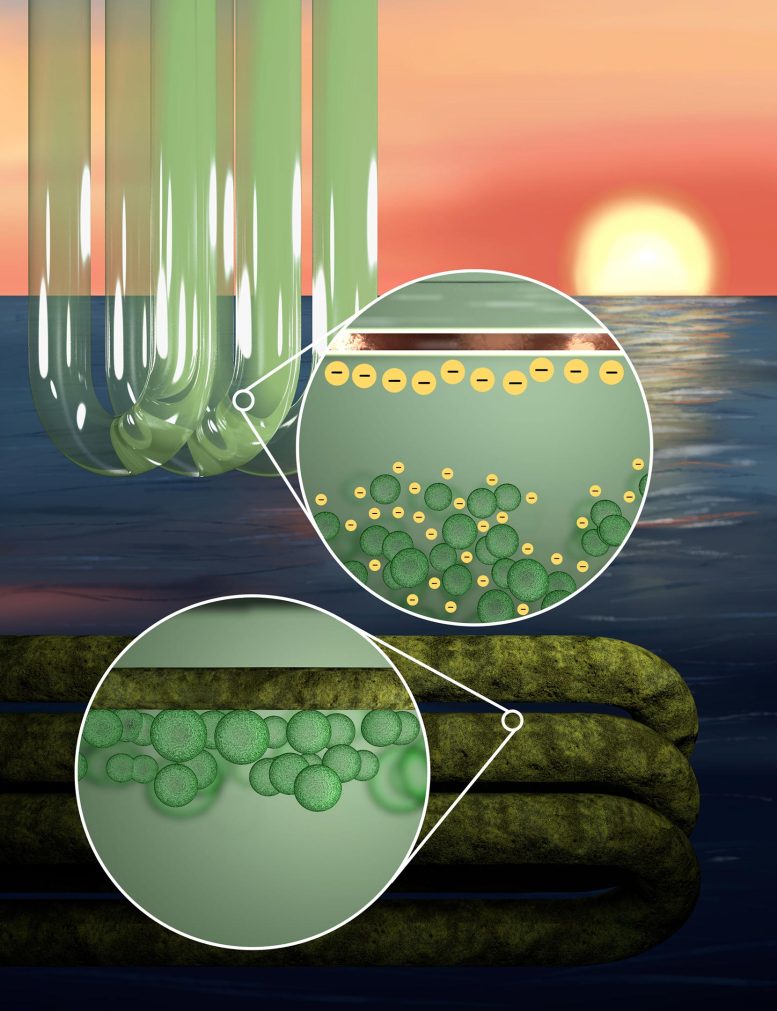
Varanasi and his team decided to try to use a natural characteristic of the algae cells to defend against fouling. Because the cells naturally carry a small negative electric charge on their membrane surface, the team figured that electrostatic repulsion could be used to push them away.
Harnessing Electrostatic Repulsion
The idea was to create a negative charge on the vessel walls, such that the electric field forces the algae cells away from the walls. To create such an electric field requires a high-performance dielectric material, which is an electrical insulator with a high “permittivity” that can produce a large change in surface charge with a smaller voltage.
“What people have done before with applying voltage [to bioreactors] has been with conductive surfaces,” Leon explains, “but what we’re doing here is specifically with nonconductive surfaces.”
He adds: “If it’s conductive, then you pass current and you’re kind of shocking the cells. What we’re trying to do is pure electrostatic repulsion, so the surface would be negative and the cell is negative so you get repulsion. Another way to describe it is like a force field, whereas before the cells were touching the surface and getting shocked.”
Advanced Dielectric Materials
The team worked with two different dielectric materials, silicon dioxide — essentially glass — and hafnia (hafnium oxide), both of which turned out to be far more efficient at minimizing fouling than conventional plastics used to make photobioreactors. The material can be applied in a coating that is vanishingly thin, just 10 to 20 nanometers (billionths of a meter) thick, so very little would be needed to coat a full photobioreactor system.
“What we are excited about here is that we are able to show that purely from electrostatic interactions, we are able to control cell adhesion,” Varanasi says. “It’s almost like an on-off switch, to be able to do this.”
Additionally, Leon says, “Since we’re using this electrostatic force, we don’t really expect it to be cell-specific, and we think there’s potential for applying it with other cells than just algae. In future work, we’d like to try using it with mammalian cells, bacteria, yeast, and so on.” It could also be used with other valuable types of algae, such as spirulina, that are widely used as food supplements.
The same system could be used to either repel or attract cells by just reversing the voltage, depending on the particular application. Instead of algae, a similar setup might be used with human cells to produce artificial organs by producing a scaffold that could be charged to attract the cells into the right configuration, Varanasi suggests.
“Our study basically solves this major problem of biofouling, which has been a bottleneck for photobioreactors,” he says. “With this technology, we can now really achieve the full potential” of such systems, although further development will be needed to scale up to practical, commercial systems.
As for how soon this could be ready for widespread deployment, he says, “I don’t see why not in three years’ timeframe, if we get the right resources to be able to take this work forward.”
Reference: “Externally Tunable, Low Power Electrostatic Control of Cell Adhesion with Nanometric High-k Dielectric Films” by Victor J. Leon, Baptiste Blanc, Sophia D. Sonnert and Kripa K. Varanasi, 13 April 2023, Advanced Functional Materials.
DOI: 10.1002/adfm.202300732
The study was supported by energy company Eni S.p.A., through the MIT Energy Initiative.
Never miss a breakthrough: Join the SciTechDaily newsletter.
Follow us on Google and Google News.