
Close Menu
    Facebook X (Twitter) Instagram
    SciTechDaily
    • Biology
    • Chemistry
    • Earth
    • Health
    • Physics
    • Science
    • Space
    • Technology
    Facebook X (Twitter) Pinterest YouTube RSS
    SciTechDaily
    Home»Technology»Computer Scientists Set New Record for Cryptographic Challenge
    Technology

    Computer Scientists Set New Record for Cryptographic Challenge

    By University of California, San DiegoApril 21, 2020No Comments3 Mins Read
    Facebook Twitter Pinterest Telegram LinkedIn WhatsApp Email Reddit
    Share
    Facebook Twitter LinkedIn Pinterest Telegram Email Reddit
    Cryptographic Challenge Record
    The team of computer scientists from France and the United States set a new record by factoring the largest integer of this form to date, the RSA-250 cryptographic challenge.

    An international team of computer scientists has set a new record for integer factorization, one of the most important computational problems underlying the security of nearly all public-key cryptography currently used today.

    Public-key cryptography is used for a number of applications including encrypting sensitive and confidential data and digital signatures. In public-key cryptography, keys that protect data come in pairs, one public, and one private. The security of the encryption or digital signature relies on the assumption that it’s impossible to compute the private key from the public key.
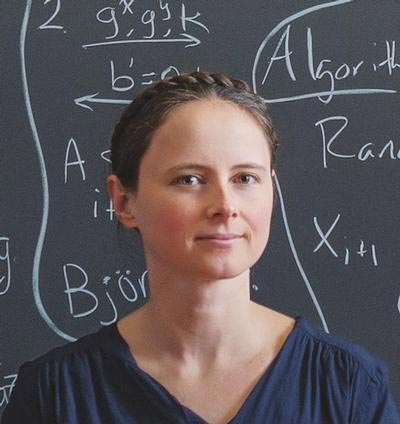
    Nadia Heninger
    Nadia Heninger, a professor of computer science at the University of California San Diego, and a member of the research team. Credit: UCSD

    One of the most commonly used public-key cryptographic algorithms for both encryption and digital signatures is the RSA cryptosystem, invented in 1977.  It’s named for its inventors Rivest, Shamir, and Adleman. Its security is based on the fact that it is believed to be difficult to factor large integers of a specific form.

    To encourage research into integer factorization, the “RSA Factoring Challenges” were created in 1991. These challenges consisted of challenge integers of varying sizes, named for the number of integer digits. 

    The team of computer scientists from France and the United States set a new record by factoring the largest integer of this form to date, the RSA-250 cryptographic challenge. This integer is the product of two prime numbers, each with 125 decimal digits. In total, it took 2700 years of running powerful computer cores to carry out the computation, which was done on tens of thousands of machines around the world over the course of a few months. 

    The key broken with this record computation is smaller than keys that would typically be used in practice by modern cryptographic applications: it has 829 binary bits, where current practice dictates that RSA keys should be at least 2048 binary bits long. Researchers use these types of computations to choose key strength recommendations that will remain secure for the foreseeable future.

    “Achieving computational records regularly is necessary to update cryptographic security parameters and key size recommendations,” said Nadia Heninger, a professor of computer science at the University of California San Diego, and a member of the research team. 

    The same team set the previous integer factoring record back in December 2019, when they factored the RSA-240 challenge, a 795-bit integer.

    The researchers carried out this computation using CADO-NFS, which is free software developed by the team at INRIA Nancy.  They used a number of computer clusters, including research group, university, and national research clusters in France, Germany, and UC San Diego. 

    The team was composed of Aurore Guillevic, Paul Zimmermann, and Emmanuel Thomé of Inria Nancy, France; Pierrick Gaudry of CNRS Nancy, France; Nadia Heninger of the University of California San Diego; and Fabrice Boudot of the University of Limoges, France.

    Never miss a breakthrough: Join the SciTechDaily newsletter.
    Follow us on Google and Google News.

    Computer Science Cryptography UCSD
    Share. Facebook Twitter Pinterest LinkedIn Email Reddit

    Related Articles

    Unlocking the Brain’s Secret: The Next Leap in AI With Neuromorphic Computing

    Reimagining Memory: New Research Reveals That Superconducting Loops Mimic the Brain

    Unlocking AI’s Black Box: New Formula Explains How They Detect Relevant Patterns

    The Million Dollar Problem That Could Break Cryptography

    Computer Scientists Create Fake Videos That Fool State-of-the-Art Deepfake Detectors

    New Approach Uses Mathematics to Improve Automated Security Monitoring

    Mathematical Framework Formalizes Loop Perforation Technique

    “Inexact” Computer Chip, 15 Times More Efficient than Today’s Technology

    Calculating the Total Capacity of a Data Network

    Leave A Reply Cancel Reply

    • Facebook
    • Twitter
    • Pinterest
    • YouTube

    Don't Miss a Discovery

    Subscribe for the Latest in Science & Tech!

    Trending News

    Scientists May Have Discovered How To Heal Damaged Kidneys

    Interstellar Visitor 3I/ATLAS Is Bursting With an Unexpected Chemical

    Scientists Just Found All 5 Genetic “Letters” of DNA and RNA on an Asteroid

    The 4,000-Year-Old City That Defied History’s Rules on Wealth and Power

    The World’s Biggest Population Fear Has Flipped – and It Could Change Everything

    This “Fake” Pill Improved Memory and Physical Performance in Just 3 Weeks

    Scientists Say Frequent Ejaculation May Improve Sperm Quality and Fertility

    Scientists Have Found “The Heaven Sword” After Years of Looking

    Follow SciTechDaily
    • Facebook
    • Twitter
    • YouTube
    • Pinterest
    • Newsletter
    • RSS
    SciTech News
    • Biology News
    • Chemistry News
    • Earth News
    • Health News
    • Physics News
    • Science News
    • Space News
    • Technology News
    Recent Posts
    • Watch What Happened When a Lost Elephant Calf Returned to Her Family
    • 17,000 Brain Scans Reveal Surprising Ethnic Differences in Alzheimer’s Biology
    • New Autism Treatment Strategy Restores Key Brain Receptor Function
    • Younger Generations Are Aging Faster – and It May Be Fueling a Surge in Cancer
    • Scientists Turn Ordinary Sunlight Into UV Light in Major Energy Breakthrough
    Copyright © 1998 - 2026 SciTechDaily. All Rights Reserved.
    • Science News
    • About
    • Contact
    • Editorial Board
    • Privacy Policy
    • Terms of Use

    Type above and press Enter to search. Press Esc to cancel.