
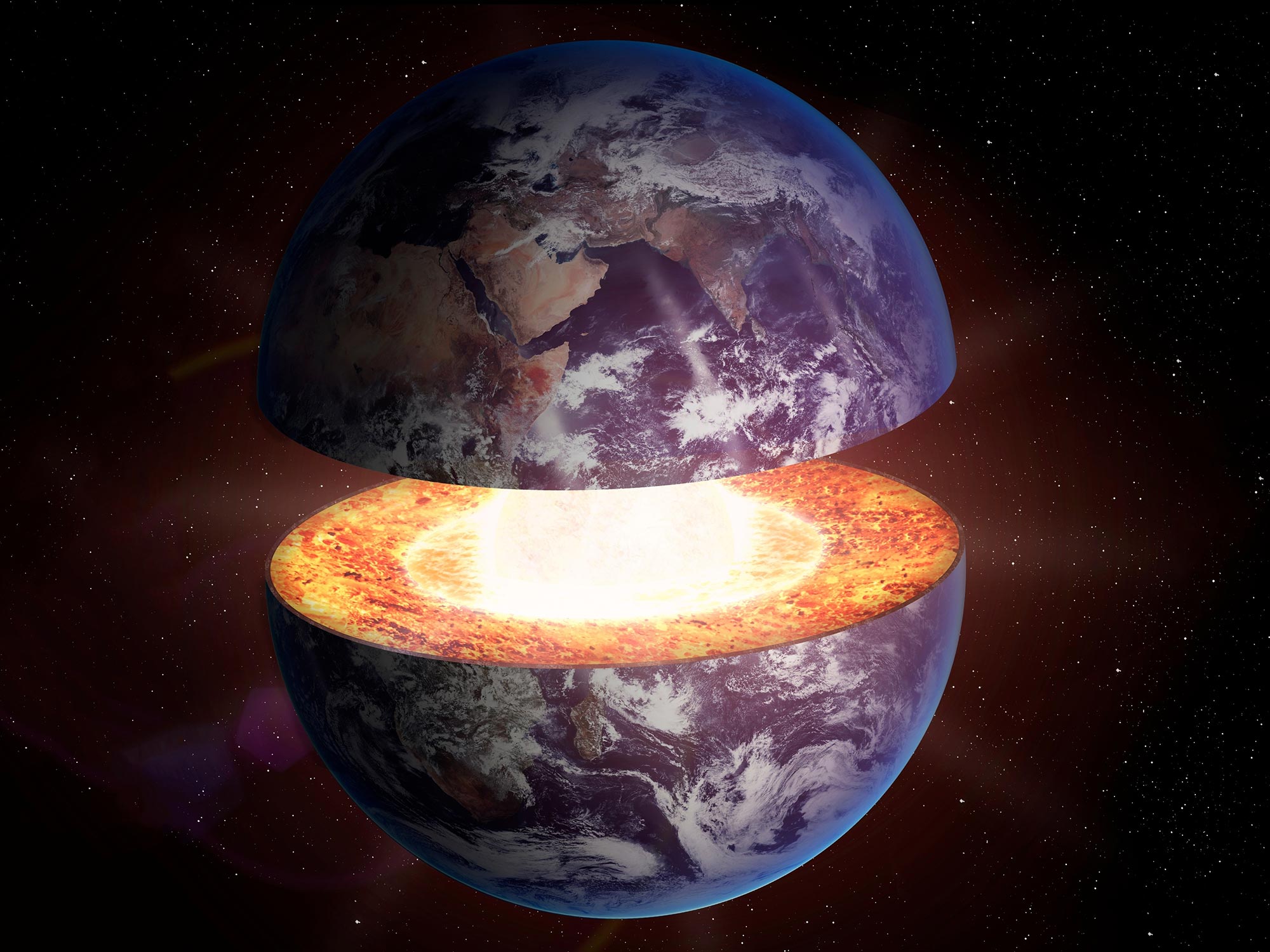
How core-mantle differentiation influenced the distribution of volatile elements on Earth.
Imagine Earth’s history as a mystery novel, with one of its greatest unresolved questions being: Where did all the nitrogen go? Scientists have long observed that Earth’s rocky outer layer, the mantle, contains far less nitrogen than expected when compared to other volatile elements like carbon and water. Even more puzzling, the carbon-to-nitrogen (C/N) and argon-to-nitrogen (³⁶Ar/N) ratios in the bulk silicate Earth (BSE)—which includes all of Earth except its metallic core—are significantly higher than those found in meteorites believed to have delivered these elements during Earth’s formation.
For decades, this “missing nitrogen” problem has baffled researchers. Now, a new study published in Earth and Planetary Science Letters may offer an answer: nitrogen didn’t disappear, it sank deep into the planet in a cosmic game of hide-and-seek.
To uncover this mystery, scientists turned the clock back 4.6 billion years, to a time when Earth was a molten, fiery sphere covered by a magma ocean more than a thousand kilometers deep. During this era, heavy elements like iron sank toward the center to form the core, while lighter materials floated upward and solidified into the silicate mantle.
This process, known as core-mantle differentiation, created the planet’s layered structure. But the story wasn’t just about metals and minerals—volatile elements such as nitrogen, carbon, and argon were also in motion. Where these elements ended up—whether trapped in the core, dissolved in the mantle, or lost to space—helped shape the Earth’s current structure and chemical makeup.
The nitrogen paradox in earth’s mantle
Nitrogen is particularly enigmatic. While it makes up 78% of the atmosphere today, the total amount in the Earth’s entire rocky mantle is shockingly low—just 1 to 5 parts per million. Carbon and argon are far more abundant relative to nitrogen than in the meteorites that likely delivered these elements.
Scientists have proposed many hypotheses: Maybe nitrogen escaped into space, or perhaps it was never delivered in large amounts. But a team of researchers from Geodynamics Research Center, Ehime University in Japan asked a different question: what if the Earth’s core stole most of the nitrogen?
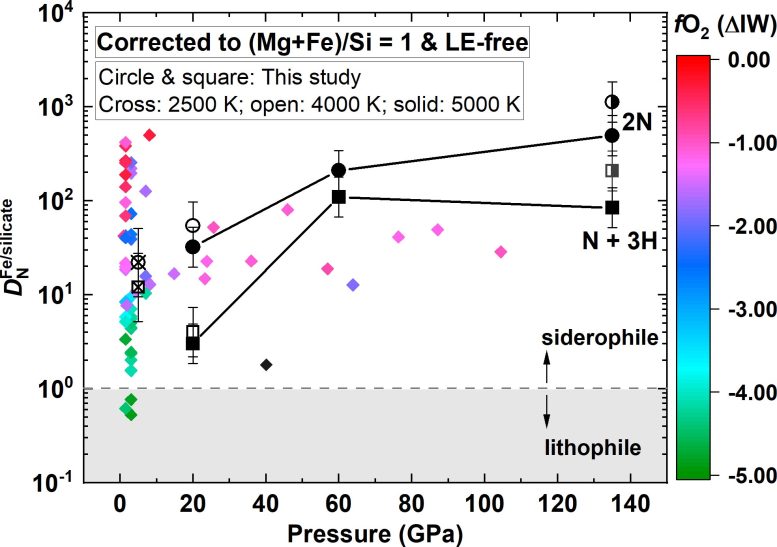
To test this idea, the scientists recreated the extreme conditions of Earth’s early magma ocean using “supercomputers”. They simulated how nitrogen behaves when squeezed at pressures up to 1.35 million times the pressure at the surface (135 GPa) and heated to 5000 K—conditions found thousands of kilometers deep in a young, molten planet.
Using a quantum mechanical method called ab initio molecular dynamics combined with the thermodynamic integration method based on statistical physics, which calculates atomic interactions from fundamental physics principles, they tracked nitrogen’s preferences: did it bond with the iron-rich core or dissolve into the silicate mantle?
Nitrogen prefers the core under intense conditions
The results were striking. Under the intense heat and pressure of a deep magma ocean, nitrogen became a “metal lover.” At 60 GPa, nitrogen was over 100 times more likely to join the core than stay in the mantle after its solidification. As pressure increased, this preference grew—but not in a straight line. Instead, the relationship was curved. This nonlinear effect had never been clearly shown before and helps explain why earlier experiments produced conflicting results.
But why does nitrogen behave this way? The simulations revealed a microscopic mechanism. In the molten silicate of magma ocean, nitrogen atoms initially bonded with themselves or hydrogen atoms like ammonium ions (NH4+). But under increasing pressures, they broke apart. Nitrogen instead bonded with silicon atoms, integrating into the silicate network as nitride ions (N³⁻). Meanwhile, in the metallic core, nitrogen slipped into gaps between iron atoms, behaving more like a neutral atom. This behavior caused the more nitrogen to abandon the molten silicate for the core’s embrace.

The study didn’t stop at nitrogen. Combing through previous studies, Huang and Tsuchiya found that carbon, while somewhat siderophile (metal-loving), was less than nitrogen under deep magma ocean conditions. Argon, an inert element, didn’t care for metals at all. This hierarchy—nitrogen > carbon > argon in core preference—may solve two mysteries.
Modeling early earth’s volatile inventory
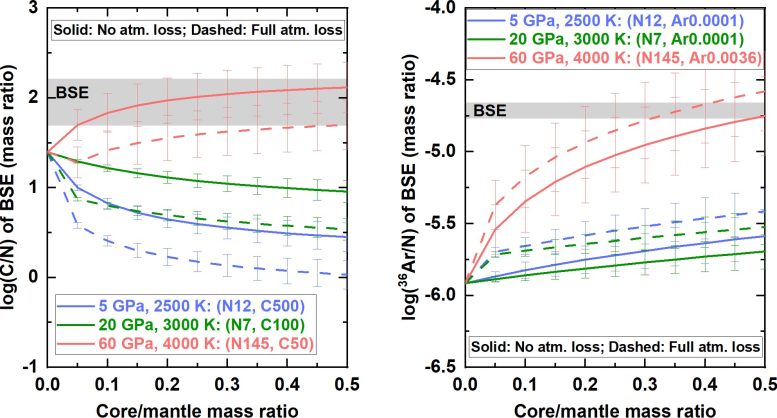
To quantify this, the researchers built a model of Earth’s accretion 4.6 billion years ago. Suppose Earth gained volatiles from carbonaceous chondrites, meteorites with compositions similar to the early solar system. Delivering just 5–10% of Earth’s mass from these rocks would supply enough nitrogen, carbon, and argon. If the core formation happened in a deep magma ocean (e.g., 60 GPa), over 80% of nitrogen would sink into the core, leaving the mantle with 1–7 ppm—matching observations. Carbon, less eager to leave, would stay in the mantle, creating the observed high C/N ratio. Argon, rejected by both the core and mantle, would be disproportionately concentrated in the atmosphere, explaining the high 36Ar/N of the BSE.
This discovery reshapes our understanding of Earth’s volatile origins. For years, scientists debated whether Earth’s weird ratios meant it accreted unusual meteorites or lost nitrogen to space. This study argues for a simpler story: Earth’s volatiles came from carbonaceous chondrites, but their fates were sealed by the extreme physics of the core formation. The differentiation depth mattered most—shallow magma oceans could not produce the observed ratios, but deep ones perfectly replicate Earth’s volatile fingerprint. This further links to an argument that the distinct volatile ratios of the BSE compared to chondrites may reflect different accretion times rather than different sources.
Conditions for life set by core-mantle separation
This core formation process has determined how much nitrogen was retained in the BSE, one of the prerequisites for the abundance of bioessential elements in the Earth’s atmosphere and rocky layers. Despite the fact that it took Earth a long time to become habitable, the conditions essential for life may have been set billions of years ago when the core and mantle separated.
In the end, Earth’s nitrogen was not lost. It has been hiding in plain sight, locked away in the core for billions of years. This discovery reminds us that our planet’s history is written not just in rocks and fossils, but in the cryptic preferences of atoms under unimaginable pressures.
Reference: “Nitrogen-carbon-argon features of the silicate Earth established by deep core-mantle differentiation” by Shengxuan Huang and Taku Tsuchiya, 6 March 2025, Earth and Planetary Science Letters.
DOI: 10.1016/j.epsl.2025.119291
Funding: Japan Society for the Promotion of Science
Never miss a breakthrough: Join the SciTechDaily newsletter.
Follow us on Google and Google News.