
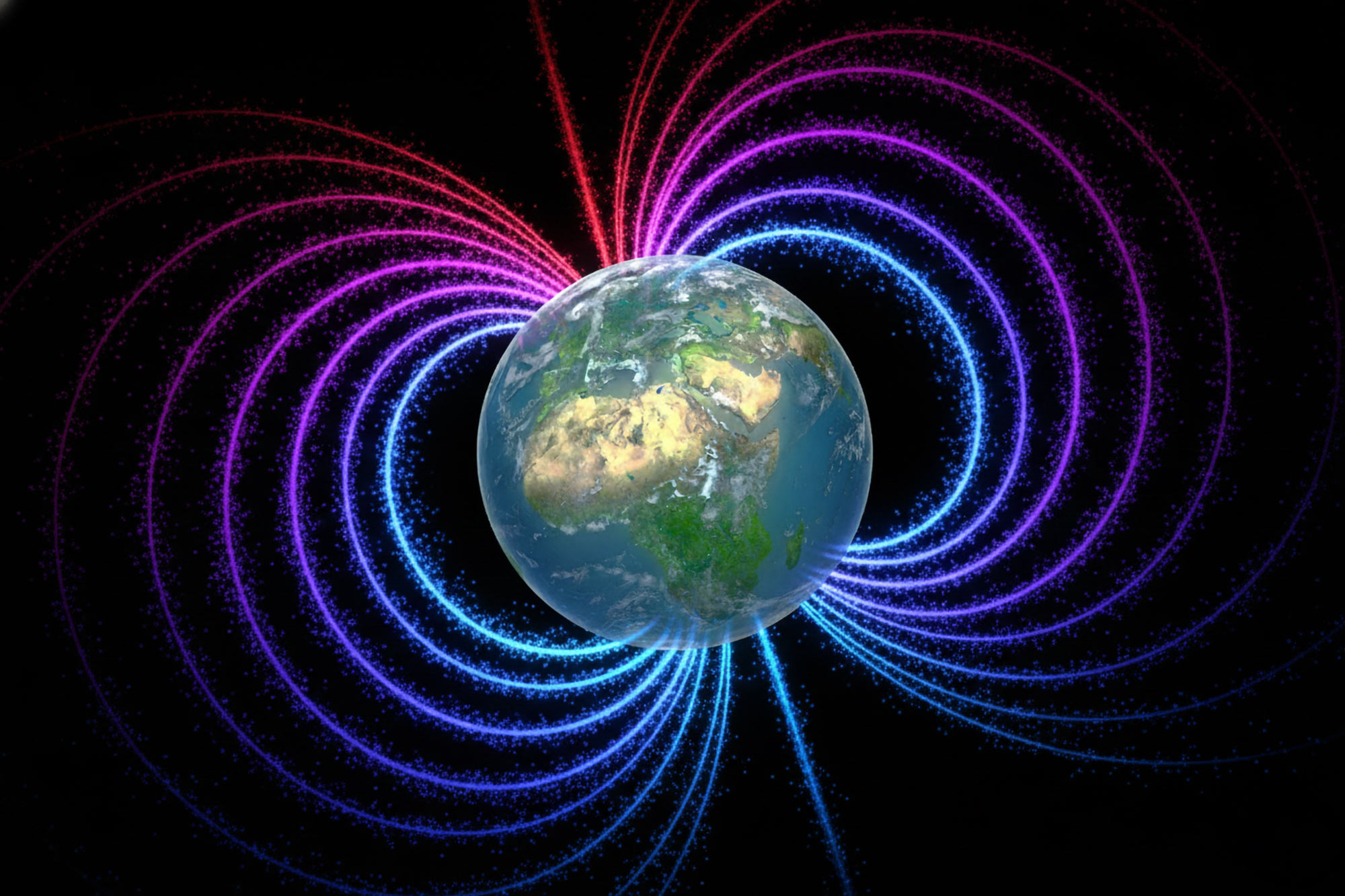
Shielded from most of Earth’s magnetic field, fruit flies with faulty mitochondria lived about 20% longer, but their physical performance declined.
Life on Earth has always operated within a constant, invisible background. The planet’s magnetic field continuously passes through every living cell, yet biologists still know very little about whether organisms actually need this environmental force to function.
When scientists nearly stripped away that magnetic background in an experiment with fruit flies, they found changes in how the insects’ cells generated energy, how well the flies moved, and how long they lived.
The effects centered on mitochondria, the tiny structures inside cells that produce much of the energy needed for life. Research led by Professor Lisa Chakrabarti and Jacob Reed at the University of Nottingham’s School of Veterinary Medicine & Science found that the flies’ responses depended on the health of this cellular machinery. Removing most of the magnetic field could improve one aspect of their lives while worsening another.
A longer life with a physical cost
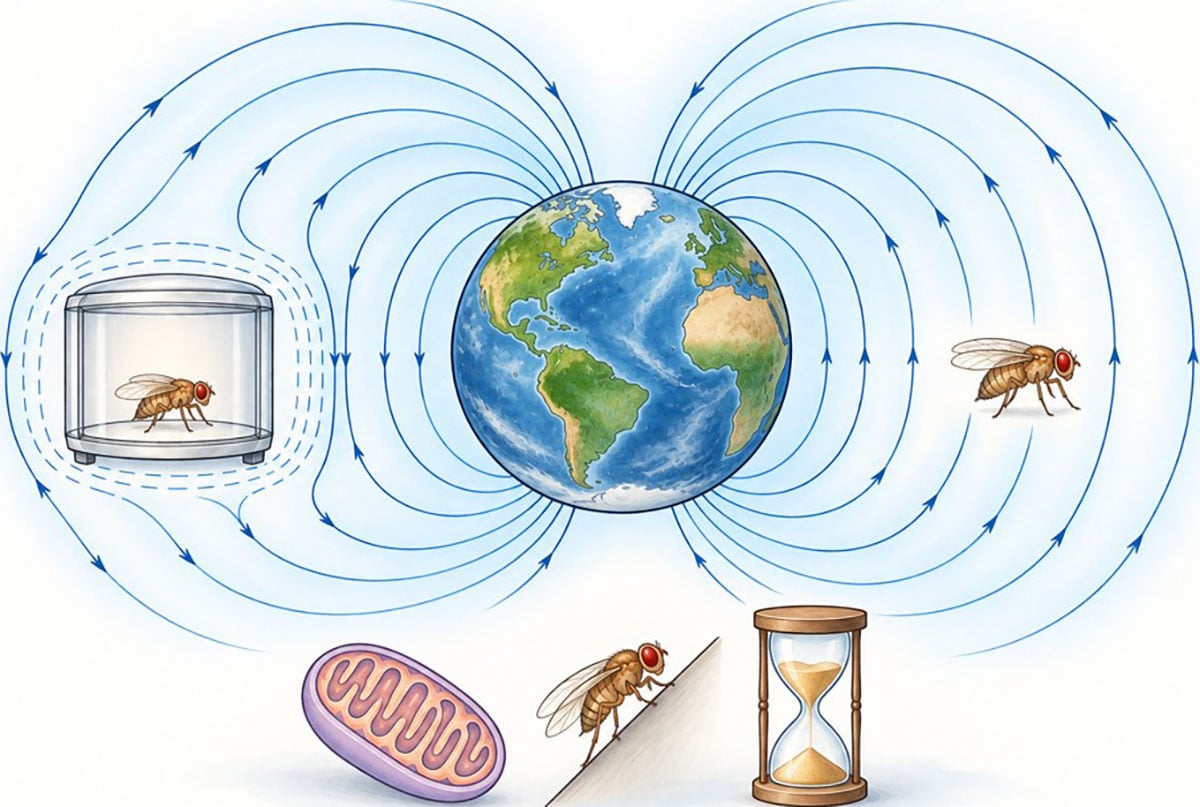
For the study, published in Aging, the team used a specially designed shielding system to reduce the magnetic field surrounding the flies to near zero. They tested healthy flies alongside flies carrying a defect in Pink1, a gene associated with inherited early-onset Parkinson’s disease in humans. Comparing the two groups allowed them to investigate how flies with impaired mitochondrial function responded to the same environmental change.
The Pink1 flies lived about 20% longer under magnetic shielding, but their physical performance declined. Healthy flies showed improved movement along with changes in their health span, or the time spent in good health. The results suggest that an animal’s metabolic state helps determine its response to magnetic field strength, with longer survival and better physical function not necessarily going together.
Magnetic fields do more than guide migration
Doctoral candidate Reed said: “Research in this area is sparse, focusing mainly on how migrating animals sense magnetic fields, or on preparing humans for space travel. Yet we still know very little about why all living organisms need or don’t need a magnetic field to function normally in the first place.”
He continues, “This project brought expertise from physics, engineering, and biology to study fruit flies with novel, highly specialized techniques and equipment; to not only look at physiology but pathology too. It opens a potential new avenue for a non-invasive, mitochondria-targeted approaches that many diseases have been longing for. Hopefully, emphasizing that magnetic fields are fundamental to life beyond certain scientific niches.”
To investigate what was happening inside the cells, the team took high-resolution measurements of mitochondrial respiration, the process through which mitochondria use oxygen to help produce usable energy. They also used highly sensitive quantum sensors that exploit tiny defects within diamonds to detect changes associated with mitochondrial activity.
Reducing the magnetic field altered mitochondrial energy metabolism and levels of superoxide, a highly reactive molecule produced by mitochondria. These measurements linked the changes in the flies’ movement and lifespan to shifts in the cellular processes that supply their energy. They also showed why the effects of magnetic shielding could not be described as uniformly beneficial or harmful.
Has evolution made cells dependent on magnetism?
The findings raise questions about whether Earth’s magnetic field is part of the environment that cells have evolved to function within. Any use of magnetic fields to influence mitochondrial function in aging or neurodegenerative disease remains a prospect for further research.
Chakrabarti said: “We live our entire lives within the Earth’s magnetic field. It passes through our bodies, our cells and every living organism on the planet, yet we know surprisingly little about whether and how this invisible force affects the way our cells work.
“Our results raise the intriguing possibility that the Earth’s magnetic field forms part of the biological environment to which life has adapted throughout evolution. Understanding how cells sense and respond to magnetic fields could ultimately reveal new ways of manipulating mitochondrial function in aging and disease.”
Reference: “Hypomagnetic fields modulate lifespan, physical ability and mitochondrial metabolism in a Pink1 model of neurodegeneration” by Jacob Reed, Mark Fromhold, Nicoleta Moisoi, Melissa Mather and Lisa Chakrabarti, 23 September 2026, Aging.
DOI: 10.18632/aging.206424
Jacob Reed is funded by the Biotechnology and Biological Sciences Research Council (grant number BB/J014508/1).
Never miss a breakthrough: Join the SciTechDaily newsletter.
Follow us on Google and Google News.