

Using atomic force microscopy, scientists found that cysteines in collagen IV form bonds that help it resist heat and refold, highlighting a key feature of connective tissue.
Researchers at Simon Fraser University (SFU) are gaining new insights into one of collagen’s most puzzling characteristics. In a recent study, physics professor Nancy Forde and postdoctoral researcher Alaa Al-Shaer identified key molecular features that help this structurally unstable protein maintain its form.
Collagen accounts for about 20 percent of the protein in the human body. It provides strength and support to connective tissues like tendons, bones, cartilage, and skin, and serves as a scaffold where cells can grow and function.
Despite its importance, collagen has long baffled scientists. How can a molecule that is unstable at body temperature play such a critical role in maintaining the body’s structure? Understanding this could be vital to improving treatment for collagen-related conditions such as brittle bone disease, Ehlers-Danlos Syndrome, and diabetes.
Unlocking collagen’s mystery using atomic force microscopy
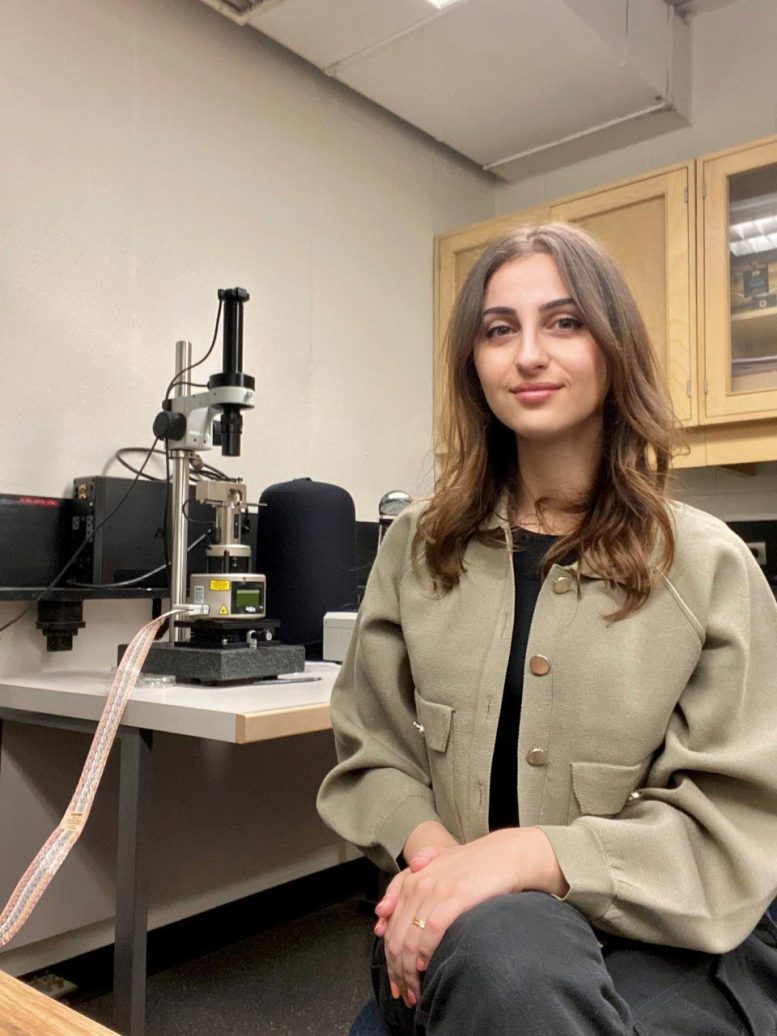
Individual collagen molecules are too small to be seen with conventional light microscopes, so Al-Shaer used a technique called atomic force microscopy (AFM) to capture images of collagen proteins at various temperatures. Forde explains that this method allows researchers to “feel” the surface of molecules, similar to reading Braille or how a needle moves over a record.
In its stable form, collagen has a triple-helix structure made of three strands twisted together like rope or yarn. At higher temperatures, these strands unravel into random coils. Al-Shaer captured hundreds of images to track this unfolding process and observed that, in some cases, the proteins could fold back together when cooled.
How cysteine bonds enhance collagen stability
She found that amino acids present in collagen IV called cysteines can form bonds between individual strands that can “staple” them together. Where these staples exist, collagen IV resisted unravelling when heated and was more likely to repair itself as it cooled. Collagens without these bonds fell apart more easily and were not able to reassemble when cooled.
When she searched protein sequence databases for similar cysteines in other species, Al-Shaer found that this chemical staple is very common in collagen IV from other multicellular life forms, including some species that first evolved very long ago. “This indicates these cysteines have an important functional role,” Forde explains, “since if they had mutated to something else and done just as good a job, we’d expect to see other amino acids at these positions.”
A first in AFM imaging of collagen folding
“This study was the first time we have used AFM imaging to study the stability of collagen at different temperatures and map the folding and unfolding pathways. We think this is incredibly promising for answering future questions for the field,” says Forde.
Forde notes that many previous studies on collagen stability have used short strands of synthetic peptides. “It is hard to know how well lessons learned in these small peptide studies translate into effects within the full-length collagen proteins, whose sequences are far more complex,” she says. AFM can help verify or challenge those results.
Forde notes that multiple graduate and undergraduate students have helped to advance her lab’s work on collagen, and her team is looking forward to further developing these techniques to answer many other questions.
“We would like to look at mutated or otherwise chemically altered collagens that are associated with disease and aging, in order to understand the mechanism of disease better,” she says. “And I want to continue working with amazing students in SFU’s Faculty of Science to make these discoveries!”
Reference: “Decoding collagen’s thermally induced unfolding and refolding pathways” by Alaa Al-Shaer and Nancy R. Forde, 13 May 2025, Proceedings of the National Academy of Sciences.
DOI: 10.1073/pnas.2420308122
Never miss a breakthrough: Join the SciTechDaily newsletter.
Follow us on Google and Google News.