

Close Menu
    Facebook X (Twitter) Instagram
    SciTechDaily
    • Biology
    • Chemistry
    • Earth
    • Health
    • Physics
    • Science
    • Space
    • Technology
    Facebook X (Twitter) Pinterest YouTube RSS
    SciTechDaily
    Home»Technology»Debunking the Myth: Is Deep Learning Necessary for Artificial Intelligence?
    Technology

    Debunking the Myth: Is Deep Learning Necessary for Artificial Intelligence?

    By Bar-Ilan UniversityApril 20, 2023No Comments3 Mins Read
    Facebook Twitter Pinterest Telegram LinkedIn WhatsApp Email Reddit
    Share
    Facebook Twitter LinkedIn Pinterest Telegram Email Reddit
    Neural Network Tree Deep Learning Concept
    Recent research demonstrates that brain-inspired shallow feedforward networks can efficiently learn non-trivial classification tasks with reduced computational complexity, compared to deep learning architectures. It showed that shallow architectures can achieve the same classification success rates as deep learning architectures, but with less complexity. Efficient learning on shallow architectures is connected to efficient dendritic tree learning, which incorporates findings from earlier experimental research on sub-dendritic adaptation and anisotropic properties of neurons. This discovery suggests the potential for the development of unique hardware for fast and efficient shallow learning, while reducing energy consumption. (Representation of a deep learning neural network tree.)

    Deep learning appears to be a key magical ingredient for the realization of many artificial intelligence tasks. However, these tasks can be efficiently realized by the use of simpler shallow architectures.

    Shallow feedforward networks can efficiently learn non-trivial classification tasks with reduced computational complexity compared to deep learning architectures, according to research published in Scientific Reports. This finding may direct the development of unique, energy-efficient hardware for shallow learning.

    The earliest artificial neural network, the Perceptron, was introduced approximately 65 years ago and consisted of just one layer.  However, to address solutions for more complex classification tasks, more advanced neural network architectures consisting of numerous feedforward (consecutive) layers were later introduced. This is the essential component of the current implementation of deep learning algorithms. It improves the performance of analytical and physical tasks without human intervention, and lies behind everyday automation products such as the emerging technologies for self-driving cars and autonomous chatbots.
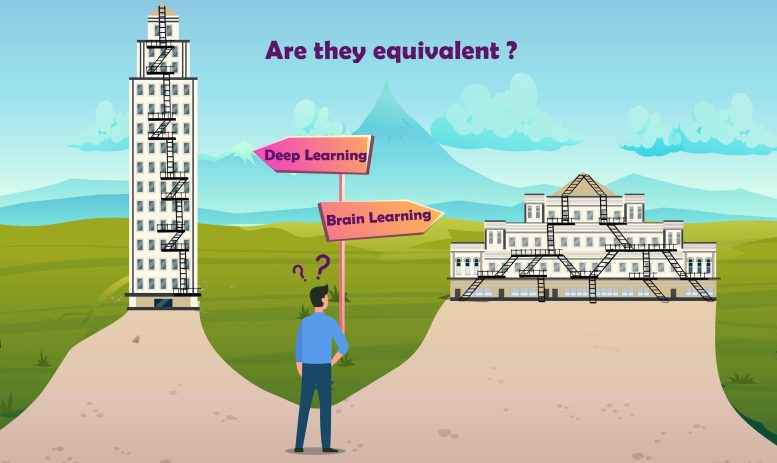
    Deep Machine Learning vs. Shallow Brain Learning
    Scheme of Deep Machine Learning consisting of many layers (left) vs. Shallow Brain Learning consisting of a few layers with enlarged width (right). Credit: Prof. Ido Kanter, Bar-Ilan University

    The key question driving new research published today (April 20) in the journal Scientific Reports is whether efficient learning of non-trivial classification tasks can be achieved using brain-inspired shallow feedforward networks, while potentially requiring less computational complexity. “A positive answer questions the need for deep learning architectures, and might direct the development of unique hardware for the efficient and fast implementation of shallow learning,” said Prof. Ido Kanter, of Bar-Ilan’s Department of Physics and Gonda (Goldschmied) Multidisciplinary Brain Research Center, who led the research. “Additionally, it would demonstrate how brain-inspired shallow learning has advanced computational capability with reduced complexity and energy consumption.”

    “We’ve shown that efficient learning on an artificial shallow architecture can achieve the same classification success rates that previously were achieved by deep learning architectures consisting of many layers and filters, but with less computational complexity,” said Yarden Tzach, a PhD student and contributor to this work.  “However, the efficient realization of shallow architectures requires a shift in the properties of advanced GPU technology, and future dedicated hardware developments,” he added.

    The efficient learning on brain-inspired shallow architectures goes hand in hand with efficient dendritic tree learning which is based on previous experimental research by Prof. Kanter on sub-dendritic adaptation using neuronal cultures, together with other anisotropic properties of neurons, like different spike waveforms, refractory periods and maximal transmission rates (see video above on dendritic learning.)

    For years brain dynamics and machine learning development were researched independently, however recently brain dynamics has been revealed as a source for new types of efficient artificial intelligence.

    Reference: “Efficient shallow learning as an alternative to deep learning” by Yuval Meir, Ofek Tevet, Yarden Tzach, Shiri Hodassman, Ronit D. Gross and Ido Kanter, 20 April 2023, Scientific Reports.
    DOI: 10.1038/s41598-023-32559-8

    Never miss a breakthrough: Join the SciTechDaily newsletter.
    Follow us on Google and Google News.

    Artificial Intelligence Bar-Ilan University Machine Learning
    Share. Facebook Twitter Pinterest LinkedIn Email Reddit

    Related Articles

    How Does AI Work? Researchers Reveal the Mechanism Underlying Successful Machine Learning

    How Can the Human Brain Compete With Artificial Intelligence?

    Smarter AI: Choosing the Best Path to Optimal Deep Learning

    Building a New Type of Efficient Artificial Intelligence Inspired by the Brain

    New AI System Identifies Personality Traits from Eye Movements

    New Artificial Intelligence Device Identifies Objects at the Speed of Light

    Machine-Learning Models Capture Subtle Variations in Facial Expressions

    ‘Deep Learning’ Algorithm Brings New Tools to Astronomy

    Machine-Learning System Uses Physics to Identify Habitable Planets

    Leave A Reply Cancel Reply

    • Facebook
    • Twitter
    • Pinterest
    • YouTube

    Don't Miss a Discovery

    Subscribe for the Latest in Science & Tech!

    Trending News

    Artificial Sweeteners May Harm Future Generations, Study Suggests

    Splashdown! NASA Artemis II Returns From Record-Breaking Moon Mission

    What If Consciousness Exists Beyond Your Brain

    Scientists Finally Crack the 100-Million-Year Evolutionary Mystery of Squid and Cuttlefish

    Beyond “Safe Levels”: Study Challenges What We Know About Pesticides and Cancer

    Researchers Have Found a Dietary Compound That Increases Longevity

    Scientists Baffled by Bizarre “Living Fossil” From 275 Million Years Ago

    Your IQ at 23 Could Predict Your Wealth at 27, Study Finds

    Follow SciTechDaily
    • Facebook
    • Twitter
    • YouTube
    • Pinterest
    • Newsletter
    • RSS
    SciTech News
    • Biology News
    • Chemistry News
    • Earth News
    • Health News
    • Physics News
    • Science News
    • Space News
    • Technology News
    Recent Posts
    • Researchers Expose Hidden Chemistry of “Ore-Forming” Elements in Biology
    • Geologists Reveal the Americas Collided Earlier Than We Thought
    • 20x Difference: Study Reveals True Source of Airborne Microplastics
    • Scientists Uncover Hidden Force Powering Yellowstone’s Supervolcano
    • This Metal Melts in Your Hand – and Scientists Just Discovered Something Strange
    Copyright © 1998 - 2026 SciTechDaily. All Rights Reserved.
    • Science News
    • About
    • Contact
    • Editorial Board
    • Privacy Policy
    • Terms of Use

    Type above and press Enter to search. Press Esc to cancel.