
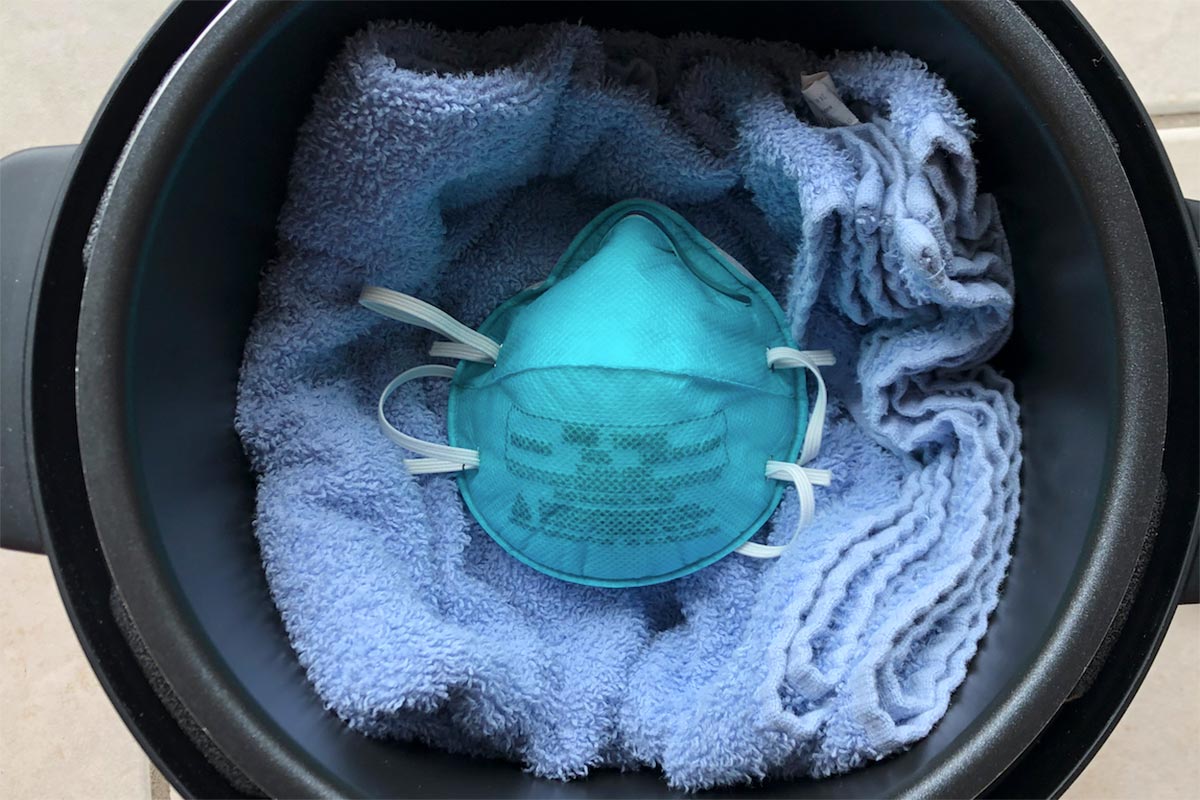
Owners of electric multicookers may be able to add another use to its list of functions, a new study suggests: sanitization of N95 respirator masks.
The University of Illinois, Urbana-Champaign study found that 50 minutes of dry heat in an electric cooker, such as a rice cooker or Instant Pot, decontaminated N95 respirators inside and out while maintaining their filtration and fit. This could enable wearers to safely reuse limited supplies of the respirators, originally intended to be one-time-use items.
Led by civil and environmental engineering professors Thanh “Helen” Nguyen and Vishal Verma, the researchers published their findings in the journal Environmental Science and Technology Letters.
N95 respirator masks are the gold standard of personal protective equipment that protect the wearer against airborne droplets and particles, such as the coronavirus that causes COVID-19.

“A cloth mask or surgical mask protects others from droplets the wearer might expel, but a respirator mask protects the wearer by filtering out smaller particles that might carry the virus,” Nguyen said.
High demand during the COVID-19 pandemic has created severe shortages for health care providers and other essential workers, prompting a search for creative approaches to sanitization.
“There are many different ways to sterilize something, but most of them will destroy the filtration or the fit of an N95 respirator,” Verma said. “Any sanitation method would need to decontaminate all surfaces of the respirator, but equally important is maintaining the filtration efficacy and the fit of the respirator to the face of the wearer. Otherwise, it will not offer the right protection.”
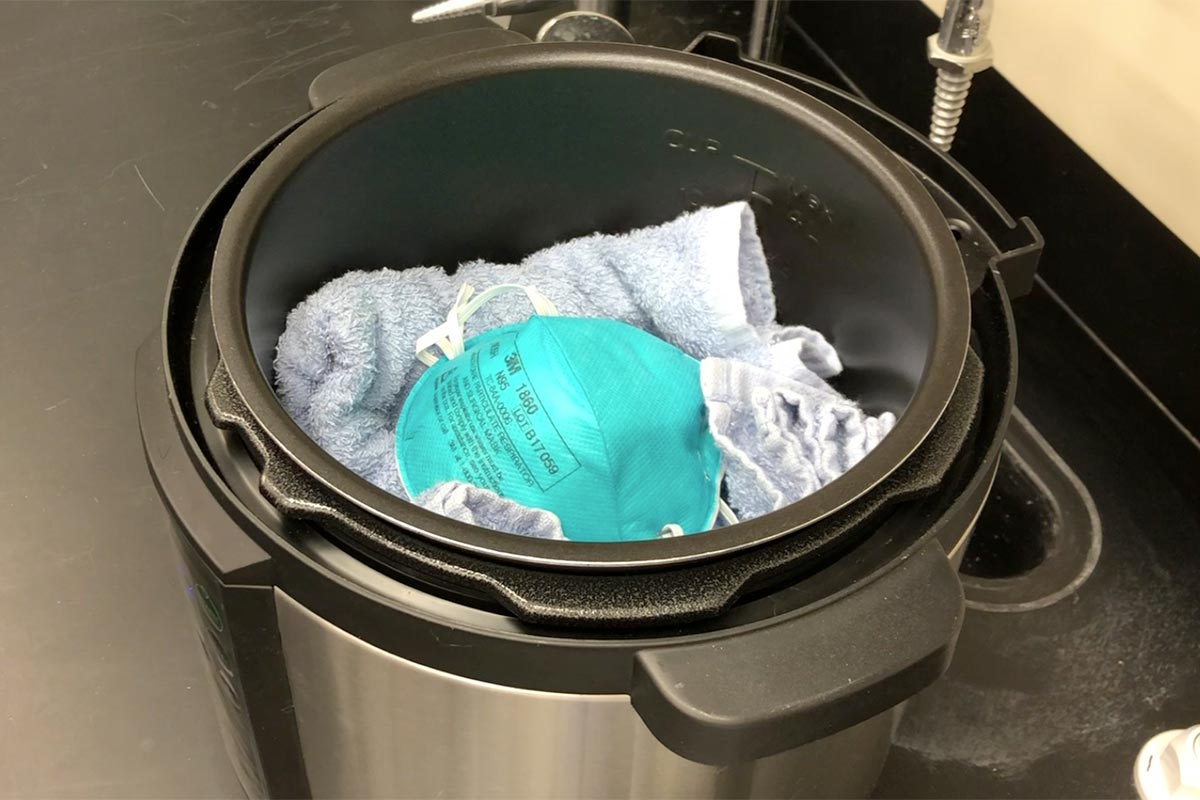
The researchers hypothesized that dry heat might be a method to meet all three criteria – decontamination, filtration and fit – without requiring special preparation or leaving any chemical residue. They also wanted to find a method that would be widely accessible for people at home. They decided to test an electric cooker, a type of device many people have in their pantries.
They verified that one cooking cycle, which maintains the contents of the cooker at around 100 degrees Celsius or 212 Fahrenheit for 50 minutes, decontaminated the masks, inside and out, from four different classes of virus, including a coronavirus – and did so more effectively than ultraviolet light. Then, they tested the filtration and fit.
“We built a chamber in my aerosol-testing lab specifically to look at the filtration of the N95 respirators, and measured particles going through it,” Verma said. “The respirators maintained their filtration capacity of more than 95% and kept their fit, still properly seated on the wearer’s face, even after 20 cycles of decontamination in the electric cooker.”
The researchers created a video (embedded below) demonstrating the method. They note that the heat must be dry heat – no water added to the cooker, the temperature should be maintained at 100 degrees Celsius for 50 minutes and a small towel should cover the bottom of the cooker to keep any part of the respirator from coming into direct contact with the heating element. However, multiple masks can be stacked to fit inside the cooker at the same time, Nguyen said.
The researchers see potential for the electric-cooker method to be useful for health care workers and first responders, especially those in smaller clinics or hospitals that do not have access to large-scale heat sanitization equipment. In addition, it may be useful for others who may have an N95 respirator at home – for example, from a pre-pandemic home-improvement project – and wish to reuse it, Nguyen said.
Reference: “Dry Heat as a Decontamination Method for N95 Respirator Reuse” by Chamteut Oh, Elbashir Araud, Joseph V. Puthussery, Hezi Bai, Gemma G. Clark, Leyi Wang, Vishal Verma and Thanh H. Nguyen, 15 July 2020, Environmental Science & Technology Letters.
DOI: 10.1021/acs.estlett.0c00534
The Environmental Protection Agency and the U.S. Department of Agriculture supported this work.
Never miss a breakthrough: Join the SciTechDaily newsletter.
Follow us on Google and Google News.
2 Comments
Three cheers and a big thank you for figuring out something we should have figured out a LOOOONG time ago!
Why do you have music playing during the video,