
Close Menu
    Facebook X (Twitter) Instagram
    SciTechDaily
    • Biology
    • Chemistry
    • Earth
    • Health
    • Physics
    • Science
    • Space
    • Technology
    Facebook X (Twitter) Pinterest YouTube RSS
    SciTechDaily
    Home»Health»New COVID-19 Saliva Test Invented: Portable, Affordable, Accurate, and Fast
    Health

    New COVID-19 Saliva Test Invented: Portable, Affordable, Accurate, and Fast

    By University of Illinois at Urbana-ChampaignMay 18, 20211 Comment4 Mins Read
    Facebook Twitter Pinterest Telegram LinkedIn WhatsApp Email Reddit
    Share
    Facebook Twitter LinkedIn Pinterest Telegram Email Reddit
    Saliva Test
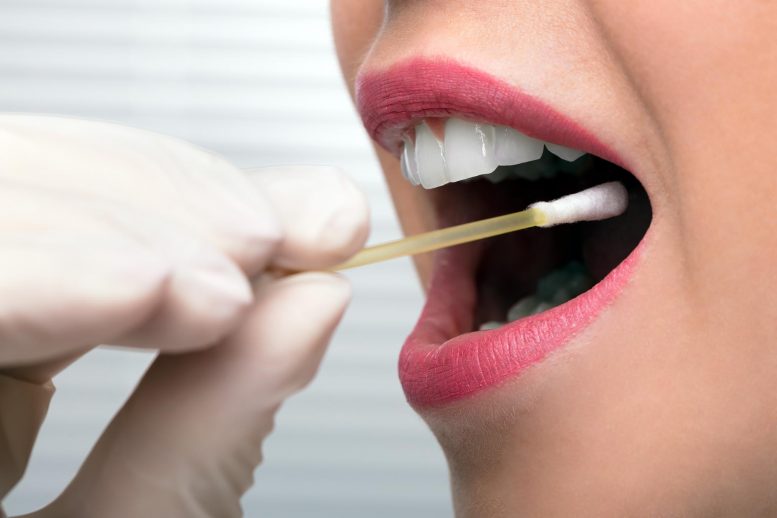
    A new coronavirus test can get accurate results from a saliva sample in less than 30 minutes.

    A new 30-minute, saliva-based test detects COVID-19 with lab-level accuracy—no swabs or expert required.

    A new coronavirus test can get accurate results from a saliva sample in less than 30 minutes, researchers report in the journal Nature Communications. Many of the components of the hand-held device used in this technology can be 3D-printed, and the test can detect as little as one viral particle per 1-microliter drop of fluid.

    “We developed a rapid, highly sensitive, and accurate assay, and a portable, battery-powered device for COVID-19 testing that can be used anywhere at any time,” said University of Illinois Urbana-Champaign chemical and biomolecular engineering professor Huimin Zhao, who led the research. Though it is still in the prototype stage, the device is estimated to cost less than $78 and the reagents and other materials needed for testing would amount to $6-$7 per test, the researchers found.

    Current coronavirus testing technologies are complex, expensive, time-consuming, and require bulky equipment and expert analysts, whereas the new device can be operated by anyone with minimal training who is careful when loading samples, Zhao said.

    UIUC COVID-19 Test Research Team
    The research team included, from front left, Stephan Lane, manager of the Illinois Biological Foundry for Advanced Biomanufacturing; graduate student Guanhua (Daniel) Xun; Huimin Zhao, the Steven L. Miller Chair of chemical and biomolecular engineering, and a professor of chemistry, biochemistry, biophysics, and bioengineering. In back, from left, electrical and computer engineering undergraduate student Vassily Petrov; and mechanical science and engineering undergraduate student Brandon Pepa, who recently graduated. Credit: Photo by L. Brian Stauffer

    CRISPR-Inspired Enzyme System Detects Viral Genes

    The innovation was made possible by the recent discovery in Zhao’s laboratory of a system for making artificial restriction enzymes that can be programmed to recognize and cleave specific genes in an organism’s genome. In the new device, these enzymes carry DNA guides that tag the viral genes of interest. The enzyme cleaves the genes, which have been tagged with a dye that fluoresces only after the genes are cut. The resulting fluorescence signals that those genes are present — a positive test result.

    The new technology, called Scalable and Portable Testing, does away with the complicated process of heating and cooling each sample to get results, as many current testing protocols require. SPOT also can detect multiple genes per sample, making it more accurate than single-gene tests, which can yield incorrect or inconclusive results. Another advantage is that it utilizes saliva, which is easier to collect and less invasive than a nasal swab.

    The research team tested SPOT using 104 clinical saliva samples. They found that it accurately identified 28 out of 30 SARS-CoV-2-positive samples and 73 of 74 SARS-CoV-2-negative samples.

    “Based on the data reported in the literature, the accuracy of our test is comparable to or better than other SARS-CoV-2 tests,” Zhao said.

    Proven Accuracy Across Multiple Viruses

    The researchers also tested SPOT with samples containing — or lacking — the influenza virus, the new coronavirus, and three other human coronaviruses. It accurately identified samples containing the new coronavirus, whether or not other viruses were present in the sample.

    “We are interested in exploring this technology for detection of other diseases as well,” Zhao said. “One key advantage to this technology is its multiplexing capability, so in principle, we can detect many viruses simultaneously using the same device.”

    Reference: “A rapid, accurate, scalable, and portable testing system for COVID-19 diagnosis” by Guanhua Xun, Stephan Thomas Lane, Vassily Andrew Petrov, Brandon Elliott Pepa and Huimin Zhao, 18 May 2021, Nature Communications.
    DOI: 10.1038/s41467-021-23185-x

    The SPOT system also may be useful for detecting genetic markers of certain types of cancer in saliva, he said.

    Zhao also is a U. of I. professor of bioengineering, of chemistry, and of biomedical and translational sciences in the Carle Illinois College of Medicine. He is a faculty member in the Carl R. Woese Institute for Genomic Biology, which, together with the Steven L. Miller Chair Endowment, supports this research.

    Never miss a breakthrough: Join the SciTechDaily newsletter.
    Follow us on Google and Google News.

    COVID-19 Infectious Diseases Popular Public Health University of Illinois at Urbana-Champaign
    Share. Facebook Twitter Pinterest LinkedIn Email Reddit

    Related Articles

    Winter Is Coming and the COVID-19 Pandemic Is About To Get Worse

    Easy, Efficient Way to Sanitize N95 Masks Using an Electric Multi-Cooker [Video]

    Evidence Shows Cloth Masks May Help Against COVID-19 – Especially Those With Several Layers of Cotton Cloth

    Scientists Test Best Fabric Choices for Making a Homemade COVID Mask

    Vitamin D Determines Severity in COVID-19: Researchers Urge Government to Change Advice

    How COVID-19 Kills: New Study Explains the Mechanisms of the New Coronavirus

    Vitamin D Linked to Low Coronavirus Death Rate

    How Effective Are Cloth Masks Against Coronavirus? [Video]

    Key Insights on How Coronavirus Spreads From Chinese Megacity of Shenzhen

    1 Comment

    1. Gerald Brennan on May 18, 2021 3:51 am

      Every week or so there is another miracle Covid-19 tester that emerges and no one is using any of them. Odd, no?

      Reply
    Leave A Reply Cancel Reply

    • Facebook
    • Twitter
    • Pinterest
    • YouTube

    Don't Miss a Discovery

    Subscribe for the Latest in Science & Tech!

    Trending News

    First-of-Its-Kind Discovery: Homer’s Iliad Found Embedded in a 1,600-Year-Old Egyptian Mummy

    Beyond Inflammation: Scientists Uncover New Cause of Persistent Rheumatoid Arthritis

    A Simple Molecule Could Unlock Safer, Easier Weight Loss

    Scientists Just Built a Quantum Battery That Charges Almost Instantly

    Researchers Unveil Groundbreaking Sustainable Solution to Vitamin B12 Deficiency

    Millions of People Have Osteopenia Without Realizing It – Here’s What You Need To Know

    Researchers Discover Boosting a Single Protein Helps the Brain Fight Alzheimer’s

    World-First Study Reveals Human Hearts Can Regenerate After a Heart Attack

    Follow SciTechDaily
    • Facebook
    • Twitter
    • YouTube
    • Pinterest
    • Newsletter
    • RSS
    SciTech News
    • Biology News
    • Chemistry News
    • Earth News
    • Health News
    • Physics News
    • Science News
    • Space News
    • Technology News
    Recent Posts
    • NASA Powers Down Voyager 1 Instrument As It Fights To Survive Deep Space
    • Physicists Propose Strange Experiment Where Time Goes Quantum
    • Scientists Flip Immune System “Switch,” Uncover Surprising Path To Stop Gut Inflammation
    • Magnesium Magic: New Drug Melts Fat Even on a High-Fat, High-Sugar Diet
    • Weight-Loss Drugs Like Ozempic May Come With an Unexpected Cost
    Copyright © 1998 - 2026 SciTechDaily. All Rights Reserved.
    • Science News
    • About
    • Contact
    • Editorial Board
    • Privacy Policy
    • Terms of Use

    Type above and press Enter to search. Press Esc to cancel.