
Explore the Universe With Virtual Reality Using Powerful, Open-Source Software VIRUP
Have you ever wanted to explore outer-space? Now you can, without leaving Earth, thanks to powerful, open-source beta software VIRUP that builds – in real-time – a virtual universe based on the most detailed contemporary astrophysical and cosmological data.
You’re floating in space, just above the Earth. The International Space Station is an arm’s length away. You twist your head around only to see the moon, a tiny circle, far off in the distance. You can’t help but think that this is probably what an astronaut would see during a space-walk.
This is the beginning of a journey into outer-space, in a virtual environment developed by EPFL scientists.
Now, for the very first time, you can enter the most comprehensive virtual universe based on the latest astrophysical and cosmological data, thanks to powerful, open-source software developed at EPFL’s Laboratory of Astrophysics (LASTRO). The software is called VIRUP, for Virtual Reality Universe Project, and a first beta version is being released today.
“You can navigate through the most detailed map of the universe from the comfort of your own home,” explains Jean-Paul Kneib, director of LASTRO. “It’s the chance to travel through space, through time, and discover the universe.”
The VIRUP challenge: visualizing terabytes of data at once
Astronomers and astrophysicists are collecting data about billions of celestial objects in the night sky with the help of telescopes here on Earth and in space. There are already decades of observational data. Even greater amounts of data are expected in the near future.
In order to get visual representations of the vast amounts of data, like a movie, it’s standard practice to pre-render specific sequences. But what about creating a visual representation of the data in real-time, as if you were there, an observer at an arbitrary point in space and time? This is what astrophysicist Yves Revaz of LASTRO set out to do with the VIRUP, with the help of LASTRO software engineer Florian Cabot, and it meant rendering terabytes of data at 90 frames per second. The latter constraint is imposed by the virtual reality environment, for a fully immersive and smooth experience.
“Visualization of astrophysical data is much more accessible than showing graphs and figures, it helps to develop intuition of complex phenomena,” explains Revaz. “VIRUP is precisely a way of making all of our astrophysical data accessible to everyone, and this will become even more important as we build bigger telescopes like the Square Kilometer Array that will generate tremendous amounts of data.”
Astrophysical, cosmological data and simulations
For the moment, VIRUP can already visualize data from over 8 databases bundled together. The Sloan Digital Sky Survey consists of over 50 million galaxies and 300 million objects in general. The Gaia data of the Milky Way Galaxy consists of 1.5 billion light sources. The Planck mission involves a satellite which measures the universe’s first light after the Big Bang called the cosmic microwave background radiation. There’s also the Open Exoplanet Catalog which aggregates various sources of exoplanet data. Other databases include a repertoire of over 3000 satellites orbiting the Earth, as well as various skins and textures to render the objects.
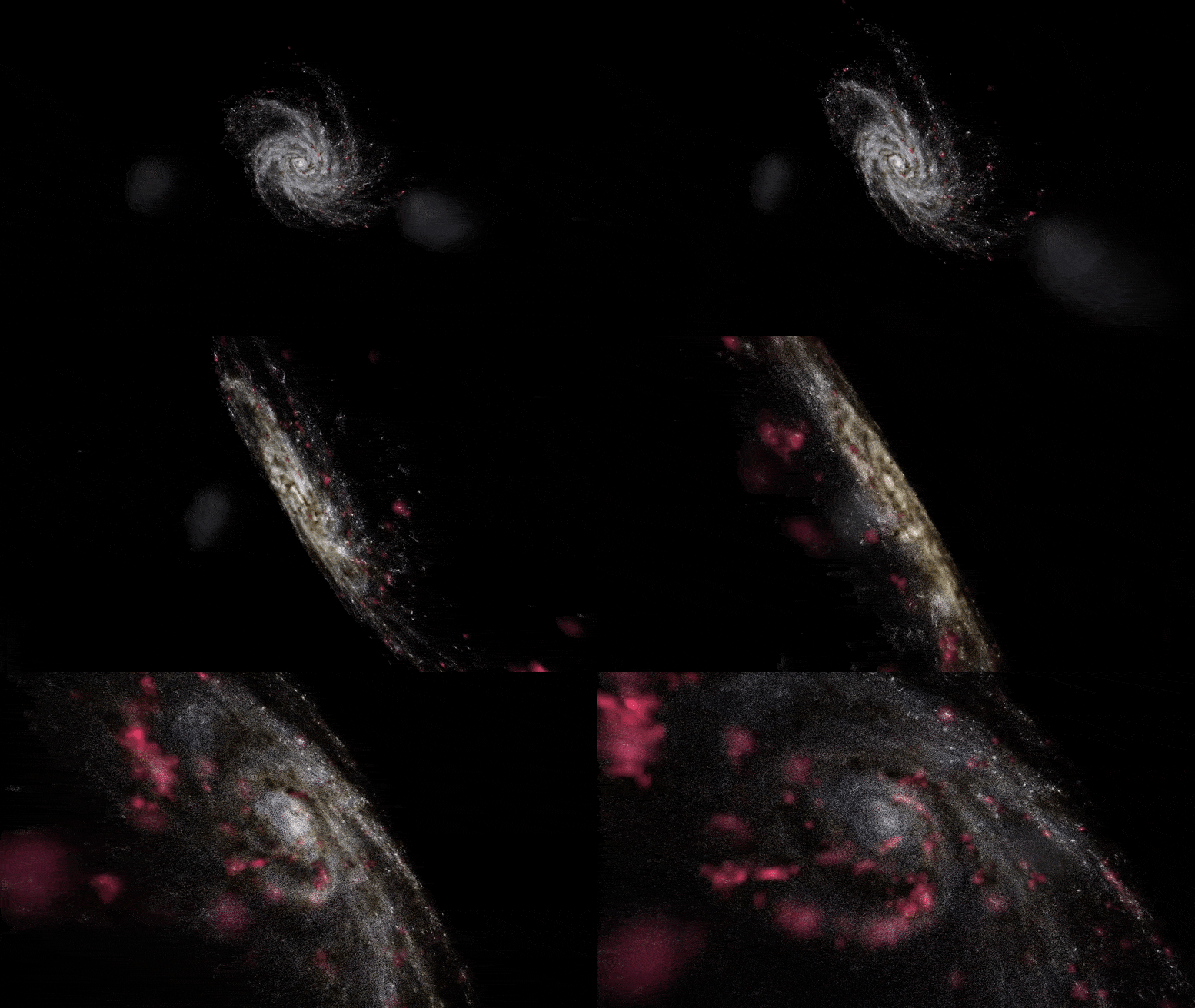
VIRUP also renders data sets of contemporary and scientifically robust simulations based on research. You can watch the Milky Way Galaxy and its future collision with the Andromeda galaxy, our galactic neighbor also known as M31. You can also see huge portions of the cosmic web – the filamentary large-scale structures that extend across the universe – coming into existence over billions of years, based on simulations from a data set called IllustrisTNG which consists of 30 billion simulated particles. A major challenge is ensuring smooth transition from one database to the next.
“We considered using existing graphics engines for visualizing the data, but in the end, I developed one specifically for the project. It’s flexible, we can add more data as it becomes available, and it’s tailored to astronomy,” explains Cabot. “For this first release of VIRUP, I have focused on rendering static data, so interacting with the data is still a bit rough and the rendering of simulations can’t yet happen in real-time for example.”
Of course, it’s only possible to navigate through the data and simulations imported into VIRUP. You can visit the 4,500 discovered exoplanets so far, for instance, but the way they look are artist impressions inferred from observation. You can also navigate through the 50 million galaxies measured so far by the Sloan Digital Sky Survey, but the actual data has limited resolution and this limits how much detail can be shown in its virtual representation. That being said, there is still a tremendous amount of data that can be explored with the help of VIRUP. Some of the next steps could be to include databases of objects in our solar system like all of the asteroids, or various other objects in the galaxy like nebulae and pulsars.
Flexible immersive virtual environment
For the fully immersive, 3D, 360 experience, you’d need a pair of VR glasses and a computer for running the VIRUP engine, plus storage space to store a selection of astrophysical and cosmological data.
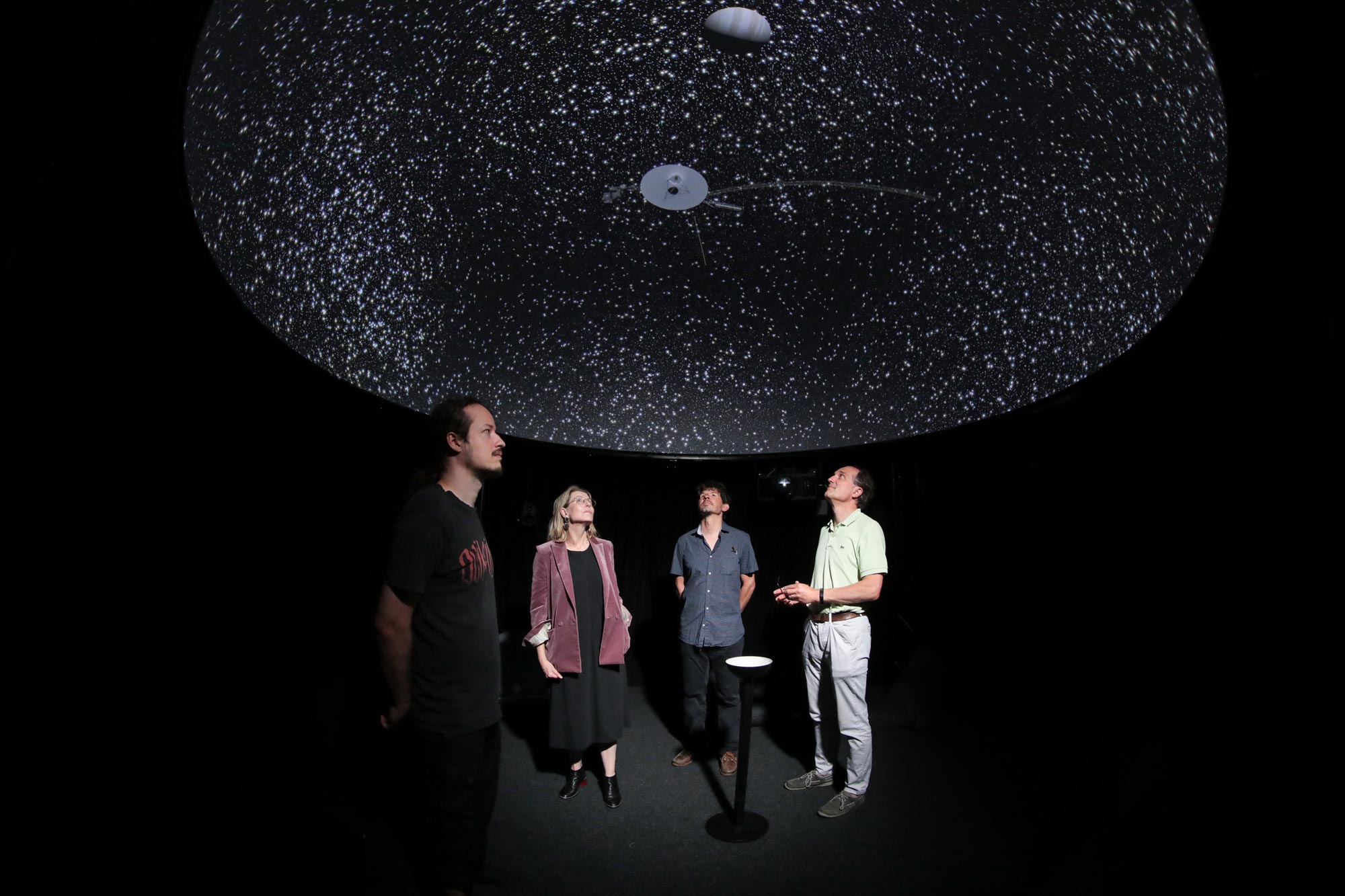
VIRUP is also capable of building a virtual universe in other VR environments, like a dome which is especially useful for venues like planetariums, panoramas, caves, and half-caves. The open-software’s transition from the rather personal and isolated experience of VR goggles to the collective, theatrical experience offered by domes and caves, became possible thanks to a collaboration between LASTRO scientists and researchers at EPFL’s Laboratory for Experimental Museology (eM+), and funded by EPFL seed funding for fostering interdisciplinary projects.
“It’s about data discovery. The immersive system means that you can embody the data which has a profound effect on how you actually perceive the data,” says artist Sarah Kenderdine who leads eM+.
A journey though the universe – a short movie
With the release of VIRUP comes a short movie entitled “Archaeology of Light”, (embedded above) one possible journey through the virtual universe made possible thanks to the open software.
The 20 minute movie starts from Earth, and charts out a voyage throughout the various scales of the universe, from our solar system, to the Milky Way, all the way to the cosmic web and the relic light of the Big Bang.
If you’re impatient to see the movie, you can watch it in 2D (above), in 360° (below) and in stereo 180° (bottom) on YouTube. If you have access to a VR environment, you can immerse yourself in “Archaeology of Light”.
For the dome experience, the movie will be showcased at EPFL’s next exhibit, Cosmos Archaeology: Explorations in Space and Time, which opens on 21 April 2022 at EPFL Pavilions. A preliminary version of the movie was shown at the Synra Dome of the Science Museum of Tokyo in September, thanks to support from the Swiss Embassy in Tokyo. VIRUP will be presented this month at an exhibit, in Dubai, as part of EPFL’s Virtual Space Tour.
Funding: EPFL Seed Funding. Agora Grant.
Never miss a breakthrough: Join the SciTechDaily newsletter.
Follow us on Google and Google News.