
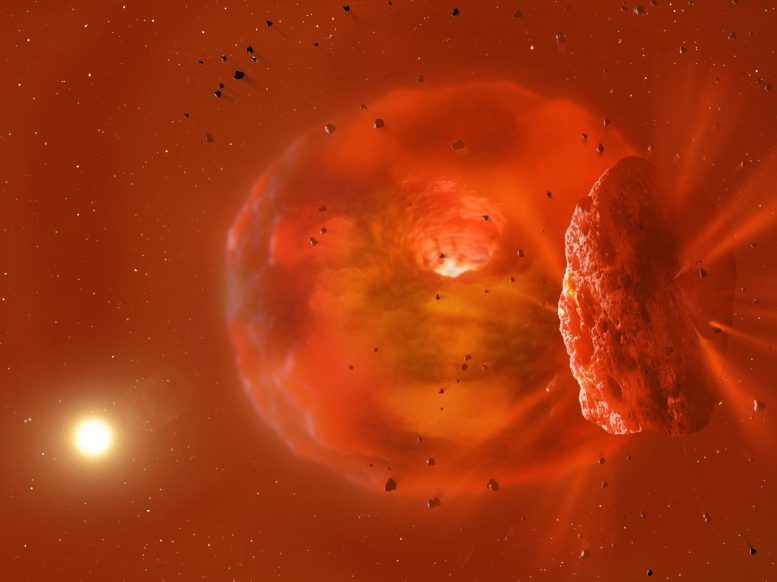
Afterglow of an explosive collision between giant planets may have been detected in a far-off star system.
The afterglow of a massive collision between two giant planets may have been detected for the first time. The wreckage of the collision could eventually cool and form an entirely new planet. If the observation is confirmed, it provides an amazing opportunity to watch the birth of a new world in real-time and open a window into how planets form.
Anomalies in Starlight
In December 2021, astronomers watching an otherwise unremarkable sun-like star saw it begin to flicker. For a few months, the visible light (the light we can see with our eyes) from this star continued to change. At times it would almost disappear, before returning to its previous brightness.
The star, which sits roughly 1,800 light years from Earth, was given the identifier ASASSN-21qj, after the ASASN-SN astronomy survey that first observed the star’s dimming.
Seeing stars dim like this is not uncommon. It’s generally attributed to material passing between the star and Earth. ASASSN-21qj may just have been added to a growing list of similar observations had it not been for an amateur astronomer, Arttu Sainio. Sainio pointed out on social media that some two and a half years before the star’s light was seen to fade, the emission of infrared light coming from its location rose by roughly 4%.
Infrared light is most strongly emitted by objects at relatively high temperatures of a few hundred degrees Celsius. This posed the questions: were these two observations related and, if so, what the heck was going on around ASASSN-21qj?
Planetary Cataclysm
Publishing our findings in Nature, we propose that both sets of observations could be explained by a cataclysmic collision between two planets. Giant impacts, as such collisions are known, are thought to be common in the final stages of the formation of planets. They dictate the final sizes, compositions, and thermal states of planets and mould the orbits of objects in those planetary systems.
In our solar system, giant impacts are thought to be responsible for the odd tilt of Uranus, the high density of Mercury, and the existence of Earth’s Moon. However, until now, we had little direct evidence of giant impacts ongoing in the galaxy.
Implications of the Collision
In order to explain the observations, a collision would have needed to release more energy in the first few hours after impact than would be emitted from the star. Material from the colliding bodies would have been superheated and melted, vaporized, or both.
The impact would have formed a hot, glowing mass of material hundreds of times larger than the original planets. The infrared brightening of ASASSN-21qj was observed by NASA’s WISE space telescope. WISE only looks at the star every 300 days or so, and probably missed the initial flash of light from the impact.
However, the expanded planetary body produced by the impact will take a long time, perhaps millions of years, to cool and shrink to something we might recognize as a new planet. Initially, when this “post-impact body” was at its greatest extent, the light emitted from it could still be as high as several percent of emission from the star. Such a body could have produced the infrared brightening that we saw.
The impact would also have ejected great plumes of debris into a range of different orbits around the star. A fraction of this debris would have been vaporized by the shock of the impact, later condensing to form clouds of tiny ice and rock crystals. Over time, some of this clumpy cloud of material passed between ASASSN-21qj and Earth, blocking out a fraction of the visible light from the star and producing the erratic dimming.
Deriving Insights From the Collision
If our interpretation of the events is correct, studying this star system could help us understand a key mechanism of planet formation. Even from the limited set of observations we have so far, we have learned some very interesting things.
Firstly, to emit the amount of energy observed, the post-impact body must have been many hundreds of times the size of Earth. To create a body that large, the planets that collided must each have been several times the mass of Earth – possibly as large as the “ice giant” planets Uranus and Neptune.
Secondly, we estimate the temperature of the post-impact body to be around 700°C. For the temperature to be that low, the colliding bodies could not have been entirely made of rock and metal.
Ice Giants
The outer regions of at least one of the planets must have contained elements with low boiling temperatures, such as in water. We therefore think that we have seen a collision between two Neptune-like worlds that are rich in ice.
The delay that was seen between the emission of infrared light and the observation of debris crossing the star suggests that the collision took place quite far away from the star – further away than the Earth is from the Sun. Such a system, in which there are ice giants far from the star, is more similar to our solar system than to many of the tightly packed planetary systems astronomers often observe around other stars.
The most exciting aspect of this is that we can continue to watch the system evolve for many decades and test our conclusions. Future observations, using telescopes such as NASA’s JWST, will determine the sizes and compositions of particles in the debris cloud, identify the chemistry of the upper layers of the post-impact body and track how this hot mass of debris cools down. We may even see new moons emerge.
These observations can inform our theories, helping us understand how giant impacts shape planetary systems. So far the only examples we’ve had are the echoes of impacts in our own solar system. We will now be able to watch the birth of a new planet in real-time.
Written by:
- Simon Lock – NERC Research Fellow, School of Earth Sciences, University of Bristol
- Matthew Kenworthy – Associate professor in Astronomy, Leiden University
- Zoe Leinhardt – Associate Professor, School of Physics, University of Bristol
Adapted from an article originally published in The Conversation.
Never miss a breakthrough: Join the SciTechDaily newsletter.
Follow us on Google and Google News.