
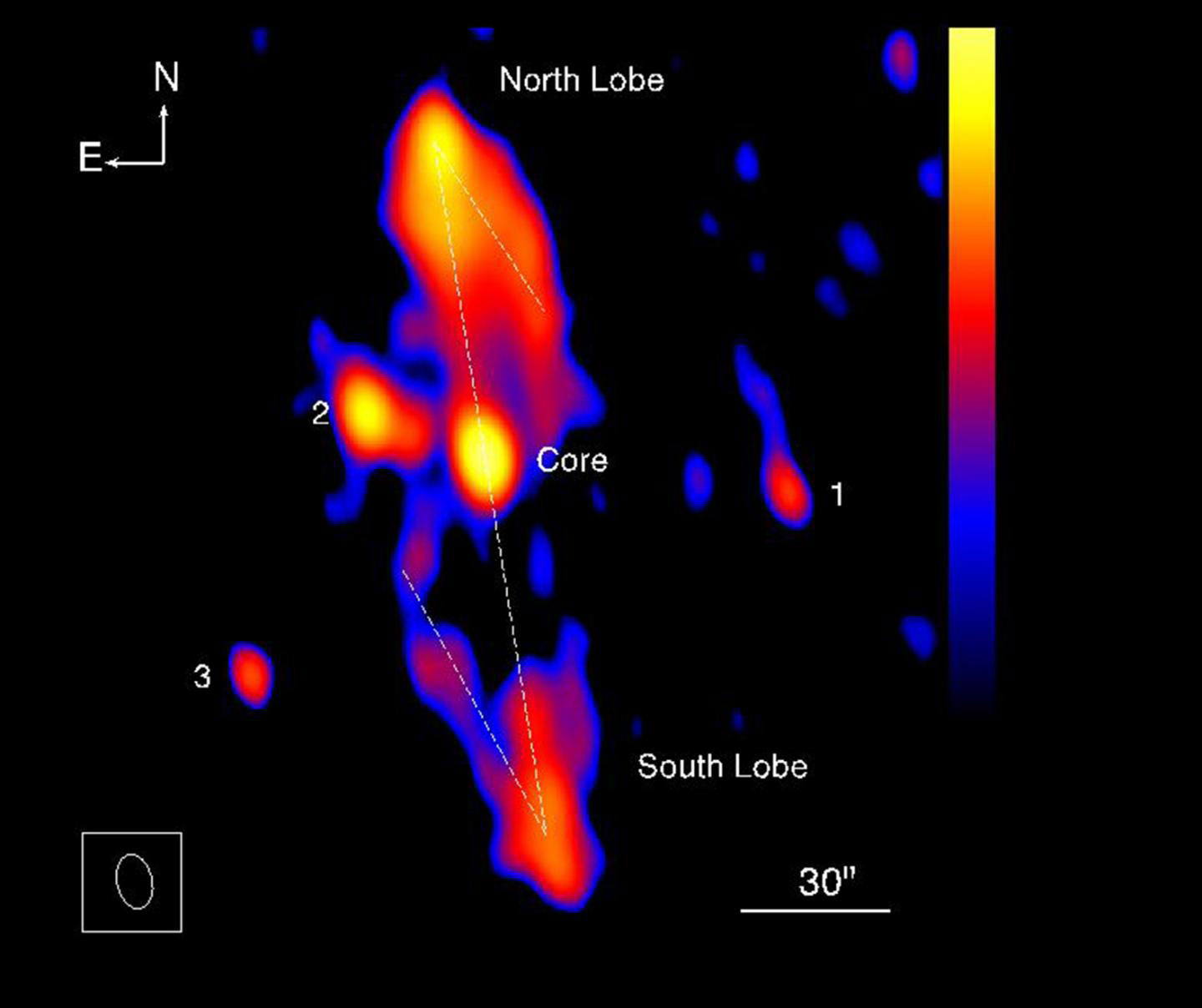
Researchers of the Group “Fuentes de Alta Energía de la Galaxia” of the UJA, in collaboration with researchers from the University of Barcelona and its Institute of Cosmos Sciences, have discovered for the first time a Z-shaped structure in a microquasar, a small-scale version of a radio galaxy. This discovery, published by the scientific journal Nature Communications, has interesting consequences for some of these radio galaxies that have been assumed to date as gravitational wave emitters.
“Gravitational waves are vibrations in space-time, the material from which the universe is made”, explains Pedro Luis Luque, co-author of the article and head of the UJA group. In this sense, he insists that “when these waves are caused by the fusion of black holes that are too far away from each other, we are not able to distinguish them individually, and they form a kind of gravitational wave background noise that joins the one caused by the Big Bang itself, so that their detection would allow us to obtain information from both the first instants of creation and the formation and nature of black holes.”
In order to know if it will be possible to observe this background of gravitational waves in the Universe, it is necessary to quantify their intensity. One way to do this is to study the contribution of so-called winged radio galaxies, distant galaxies that emit high-speed particle jets whose morphology resembles a gigantic X or Z when observed in radio waves. “It was believed that these large structures found in winged radio galaxies were mainly due to a previous fusion of two super-massive black holes and, therefore, these types of astronomical objects have been considered important contributors to the gravitational wave bottom,” says Josep Martí, first author of the article and professor of Astronomy and Astrophysics at the UJA. However, the study shows that this does not have to be the case and supports another alternative explanation for black-hole fusion.
“The behavior of both astronomical objects, microquasars, and radio galaxies, follows the same physical laws, so it is possible to study the first ones, which evolution is much faster, are relatively small, and are found in our Milky Way, to extrapolate the results by analogy to the distant and massive radio galaxies. It’s something similar to what engineers do when they work with scale models in a wind tunnel,” claims Pedro Luis Luque.
Given that in microquasars we know with certainty that they have never hosted two black holes, but only one that captures matter from their fellow star, the Z-shape observed by the authors in one of them, called GRS 1758-258, cannot be due to the fusion mechanism, and its morphology can be explained by means of simply hydrodynamic interactions in the surrounding medium, where the jets ejected by the microquasar change their direction whenever they collide with the surrounding material.
Extrapolating this result to the case of winged radio galaxies, we can infer that a good number of them would obtain their characteristic shape in the same way as the microquasar, and not through the fusion of two black holes, as it was thought. In light of this result, the melting rate of supermassive black holes in the Universe needs to be reviewed downward since the presence of winged structures does not guarantee that they have been a source of gravitational waves in the past. In this way, the gravitational wave bottom level would be weaker than what it was previously estimated,” points out Josep Martí.
In order to achieve this outstanding result, the authors of the article recently had to perform observations with one of the sets of most sensitive radio telescopes in the world, the Jansky Very Large Array located in New Mexico (EE.UU.) and combine them with all of the observations made over the same microquasar in previous decades. “Only by combining these data it has been possible to reach the necessary sensitivity to perceive the Z shape in GRS 1758-258, and to deduce from them the important implications that it may have, not only in the magnitude of the gravitational wave bottom, but also in other fields of this science such as stellar astrophysics or in the understanding of the formation and evolution of galaxies.” Expands Josep Martí.
Reference: “A galactic microquasar mimicking winged radio galaxies” by Josep Martí, Pedro L. Luque-Escamilla, Valentí Bosch-Ramon and Josep M. Paredes, 24 November 2017, Nature Communications.
DOI: 10.1038/s41467-017-01976-5
Never miss a breakthrough: Join the SciTechDaily newsletter.
Follow us on Google and Google News.