
Webb’s MIRI is now at operating temperature, and its mirrors are nearing optimal cooling. Further adjustments and tests will improve performance.
The Mid-Infrared Instrument (MIRI) on NASA’s James Webb Space Telescope is now cooled by a gaseous helium cryocooler to under 7 kelvins (minus 447 degrees Fahrenheit, or minus 266 degrees Celsius). With the cooler in its final state, the Webb team is operating the MIRI instrument this week as part of seventh and final stage of the telescope alignment. When the instrument is operating, the detectors and electronics produce heat, which is balanced by the cryocooler to keep MIRI at a stable, and very cold, operating temperature. The near-infrared instruments likewise warm up during operations and must disperse heat, albeit this is done passively; heat from the detectors and electronics is radiated into deep space.
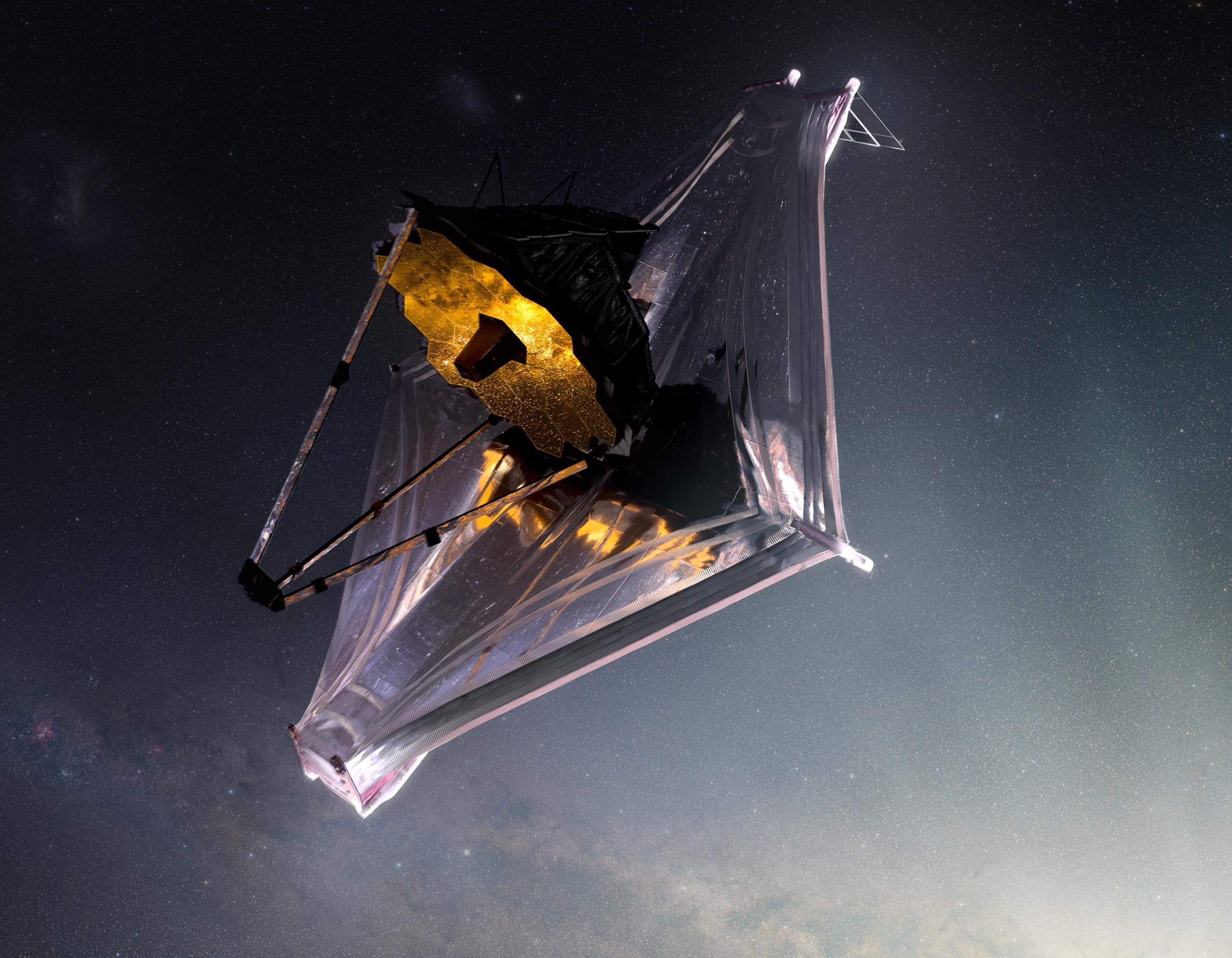
Now that the instruments are at their operating temperatures, the telescope mirrors will also continue cooling down to their final temperatures, but they are not quite there yet. The primary mirror segments and the secondary mirror are made of beryllium (coated with gold). At cryogenic temperatures, beryllium has a long thermal time constant, which means that it takes a long time to cool down or to heat up. The primary mirror segments are still cooling, very slowly.
Beryllium Mirrors and Temperature Stability
The secondary mirror, hanging out on the end of its support structure a long way from any heat sources, is the coldest mirror, currently at 29.4 kelvins (minus 406.8 degrees F). The 18 primary mirror segments range in temperature from 34.4 kelvins (minus 397.8 degrees F) to 54.5 kelvins (minus 361.6 degrees F). An advantage of beryllium mirrors is that they don’t change shape with temperature the way glass mirrors would at these temperatures, so the temperature range does not affect the telescope alignment process.
The Webb Telescope’s sunshield is key to enabling Webb’s science. This feature explains how the sunshield works, and its deployment. Credit: NASA’s Goddard Space Flight Center
Currently, four of the 18 mirror segments are above 50 kelvins: at 52.6, 54.2, 54.4, and 54.5. These four mirror segments emit some mid-infrared light that reaches the MIRI detectors. Since all the mirror temperatures are now below 55 kelvins, it is expected that MIRI will be sensitive enough to perform its planned science, but any additional cooling of these mirrors will only enhance its performance. The Webb team hopes to see the mirrors cool by an additional 0.5 to 2 kelvins.
Pointing Attitude and Sunshield Effect on Mirror Temperatures
When we point the telescope at an astronomical target, the telescope and sunshield move together. The angle that the sunshield presents to the Sun is called the pointing “attitude.” The tiny amount of residual heat that makes its way through the five-layer sunshield to the primary mirror depends on this attitude, and since the mirror segment temperatures change very slowly, their temperatures depend on the attitude averaged over multiple days.
During commissioning, Webb is currently spending most of its time pointed at the ecliptic poles, which is a comparatively hot attitude. During science operations, starting this summer, the telescope will have a much more even distribution of pointings over the sky. The average thermal input to the warmest mirror segments is expected to go down a bit, and the mirrors will cool a bit more.
Later in commissioning, we plan to test the thermal dependence of the mirrors on the attitude. We will point Webb at a hot attitude for several days, and point Webb at a cold attitude for several days, in a process called the thermal slew. This will inform us how long it takes for the mirrors to cool down or heat up when the observatory is at these positions for any given amount of time.
Is Webb at its final temperature? The answer is: almost!
Written by Jonathan Gardner, Webb deputy senior project scientist, NASA’s Goddard Space Flight Center.
Never miss a breakthrough: Join the SciTechDaily newsletter.
Follow us on Google and Google News.