
Close Menu
    Facebook X (Twitter) Instagram
    SciTechDaily
    • Biology
    • Chemistry
    • Earth
    • Health
    • Physics
    • Science
    • Space
    • Technology
    Facebook X (Twitter) Pinterest YouTube RSS
    SciTechDaily
    Home»Space»Hubble Views Spiral Galaxy NGC 1084
    Space

    Hubble Views Spiral Galaxy NGC 1084

    By Hubble Space TelescopeMarch 31, 2014No Comments2 Mins Read
    Facebook Twitter Pinterest Telegram LinkedIn WhatsApp Email Reddit
    Share
    Facebook Twitter LinkedIn Pinterest Telegram Email Reddit
    Hubble Views Galaxy NGC 1084
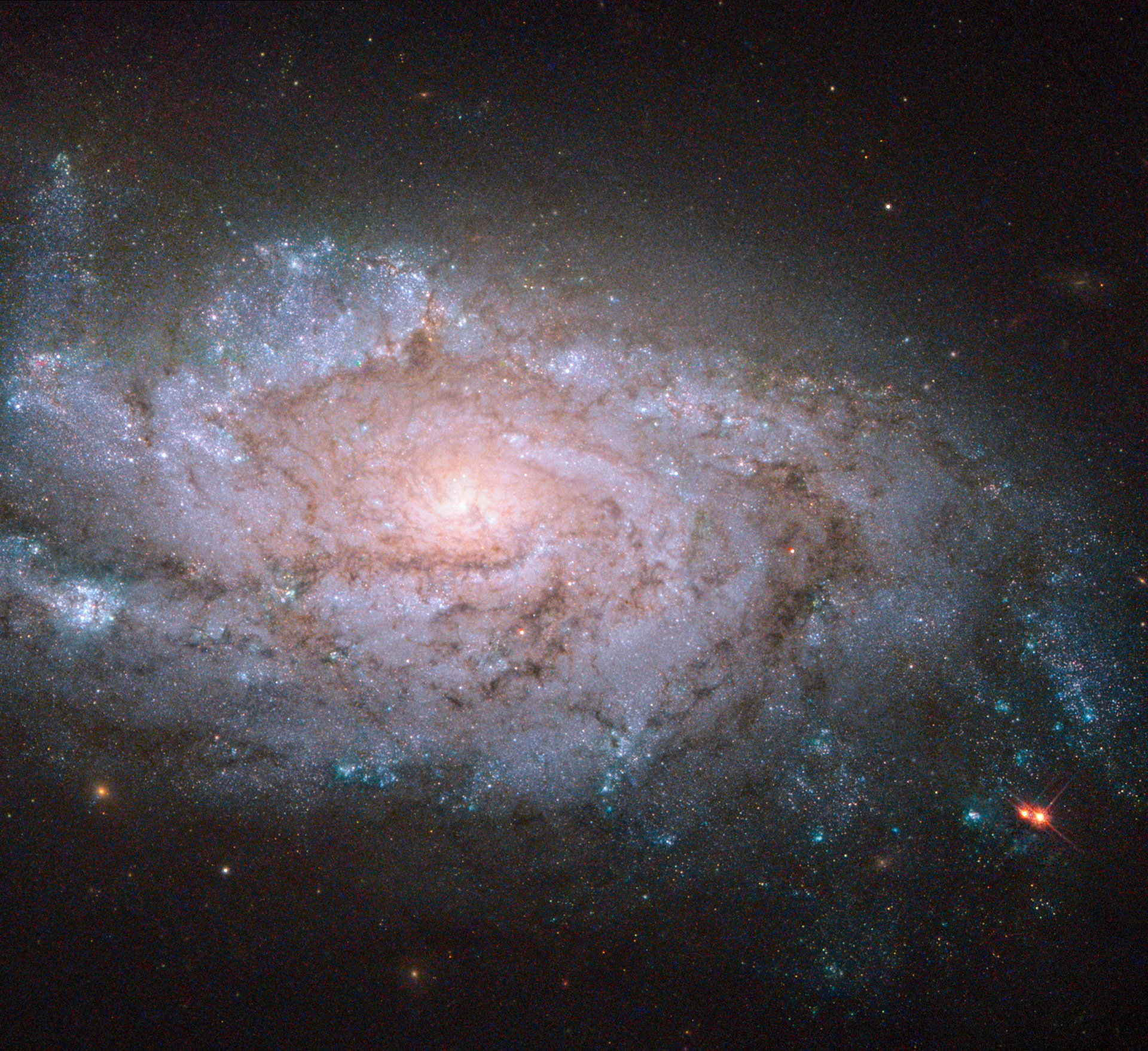
    In galaxy NGC 1084, several supernovae have occurred. Although directly observing these explosions is difficult, astronomers can study the remnants in galaxies like NGC 1084. Credit: NASA, ESA, and S. Smartt (Queen’s University Belfast); Acknowledgement: Brian Campbell

    Released to the public today, this new Hubble image shows spiral galaxy NGC 1084.

    In this new Hubble image, we can see an almost face-on view of the galaxy NGC 1084. At first glance, this galaxy is pretty unoriginal. Like the majority of galaxies that we observe it is a spiral galaxy, and, as with about half of all spirals, it has no bar running through its loosely wound arms. However, although it may seem unremarkable on paper, NGC 1084 is actually a near-perfect example of this type of galaxy — and Hubble has a near-perfect view of it.

    NGC 1084 has hosted several violent events known as supernovae — explosions that occur when massive stars, many times more massive than the Sun, approach their twilight years. As the fusion processes in their cores run out of fuel and come to an end, these stellar giants collapse, blowing off their outer layers in a violent explosion. Supernovae can often briefly outshine an entire galaxy, before then fading away over several weeks or months. Although directly observing one of these explosions is hard to do, in galaxies like NGC 1084 astronomers can find and study the remnants left behind.

    Astronomers have noted five supernova explosions within NGC 1084 over the past half century. These remnants are named after the year in which they took place — 1963P, 1996an, 1998dl, 2009H, and 2012ec.

    The most recent explosion, 2012ec, was detected at the end of NGC 1084’s top right arm in August 2012. It is not visible here as these images were taken in 2001, some eleven years before this supernova exploded. Astronomers at Queen’s University Belfast have managed to use these “before” images to directly identify the star that exploded. It appears to be a red supergiant some 10 to 20 times more massive than the Sun, and quite similar to the well-known star Betelgeuse in Orion.

    A version of this image was entered into the Hubble’s Hidden Treasures image processing competition by Flickr user Brian Campbell (Sinickel).


    Never miss a breakthrough: Join the SciTechDaily newsletter.
    Follow us on Google and Google News.

    Astronomy Hubble Space Telescope
    Share. Facebook Twitter Pinterest LinkedIn Email Reddit

    Related Articles

    A Morphing Spiral Galaxy Amongst Friends

    Hubble Views Magnificent Lopsided Galaxy NGC 2276

    Hubble Captures Fantastic Detail of Eponymous Spiral Galaxy NGC 691

    Spectacular Image Captured by Hubble Shows a Strangely Contorted Spiral Galaxy

    A Distant Spiral in Virgo: Extraordinary Detail Seen in a Galaxy 150 Million Light-Years Away From Earth

    Magnetic Monsters: Hubble Tracks Down Location of Mysterious Radio Signals From Intergalactic Space

    A Menagerie of Galaxies: Hubble Captures a Cluster With Galaxies of All Shapes and Sizes

    How Habitable Are Planets That Orbit Red Dwarfs – The Most Common Type of Stars in the Galaxy?

    Cosmic Silver Lining: Hubble Spots V565 Surrounded by Four Prominent Diffraction Spikes

    Leave A Reply Cancel Reply

    • Facebook
    • Twitter
    • Pinterest
    • YouTube

    Don't Miss a Discovery

    Subscribe for the Latest in Science & Tech!

    Trending News

    Could Low Vitamin D Be Making Your Pain Worse?

    Scientists Discover Once-Weekly Workout That Melts Belly Fat Surprisingly Effectively

    Scientists Just Tested a Thruster Powerful Enough for Human Missions to Mars

    Doctors Say Your Ice Pack Might Be Making Injuries Worse

    Scientists Discover 43-Foot Sea Reptile Twice the Size of a Great White Shark

    Bees and Birds Are Drinking Alcohol From Flowers

    Scientists Discover How Obesity May Trigger Alzheimer’s Disease

    Scientists Confirm Alcohol Causes Widespread Health Damage

    Follow SciTechDaily
    • Facebook
    • Twitter
    • YouTube
    • Pinterest
    • Newsletter
    • RSS
    SciTech News
    • Biology News
    • Chemistry News
    • Earth News
    • Health News
    • Physics News
    • Science News
    • Space News
    • Technology News
    Recent Posts
    • Scientists Create Tiny Chip That Uses Light Instead of Electricity To Process Information
    • New Research Challenges the Idea That Geometry Is Uniquely Human
    • Scientists Discover a Completely Unexpected Way T Cells Kill Cancer
    • Scientists Just Found the Solar System’s Original “Planet Factory”
    • NASA Detects Bizarre Solar Radio Burst That Wouldn’t Stop
    Copyright © 1998 - 2026 SciTechDaily. All Rights Reserved.
    • Science News
    • About
    • Contact
    • Editorial Board
    • Privacy Policy
    • Terms of Use

    Type above and press Enter to search. Press Esc to cancel.