
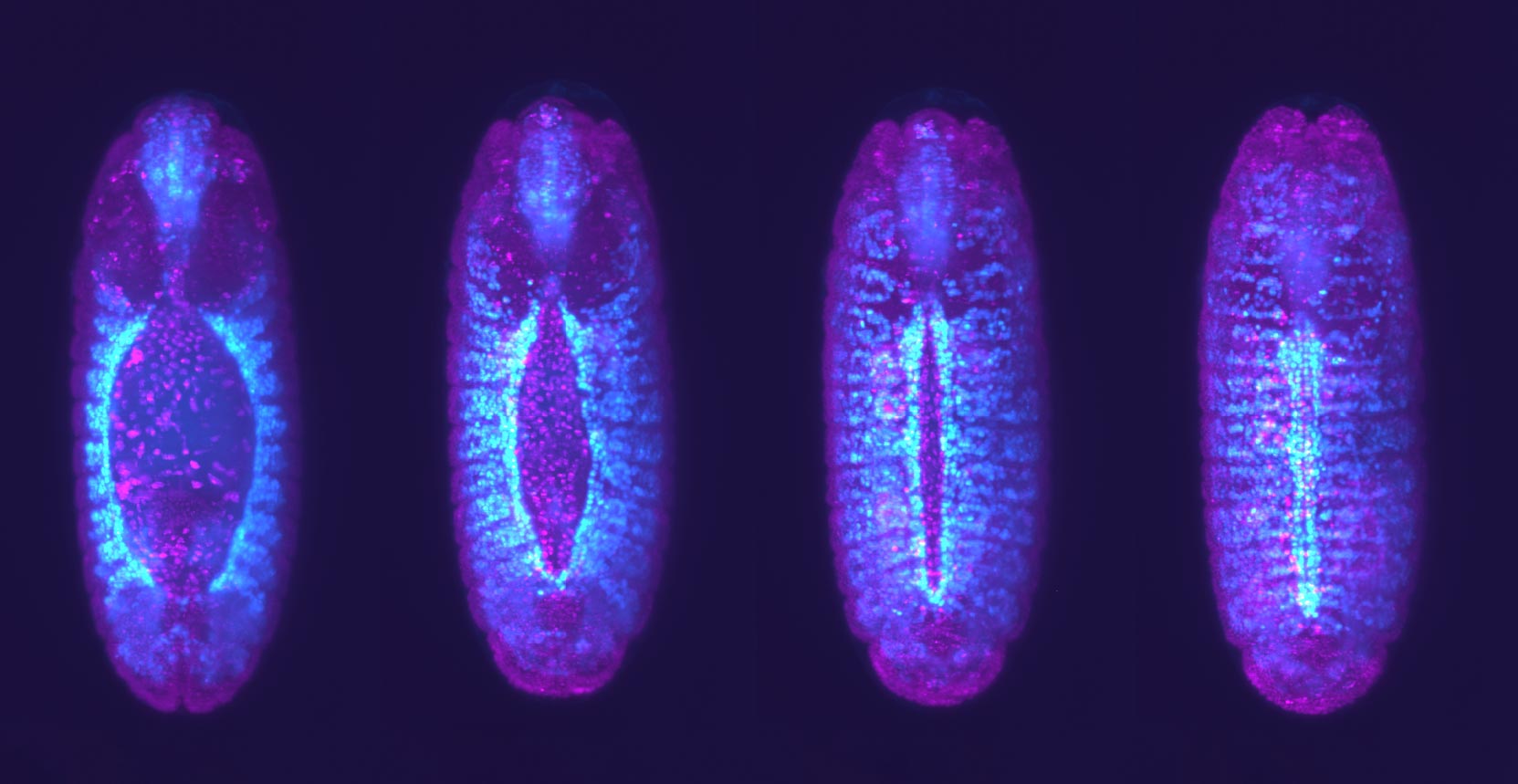
Cells in the developing heart must find the perfect match, much like a game of microscopic speed dating.
Using filopodia, tiny tentacle-like structures, they probe their environment and latch onto potential partners. If they mismatch, proteins step in to separate them, ensuring precise alignment. Researchers modeled this process in fruit flies, uncovering the delicate balance of adhesive energy and elasticity that guides cell organization.
How Developing Heart Cells Find Their Perfect Match
In a developing heart, cells move around, jostling and bumping into each other as they search for their correct position. The stakes are high—pairing with the wrong cell could mean the difference between a properly beating heart and one that doesn’t function correctly. A study published today (March 12) in the Biophysical Journal explores this intricate “matchmaking” process. Researchers created a model to track how heart cells move and interact, helping predict how genetic variations might disrupt heart development in fruit flies.
In both humans and fruit flies, heart tissue forms from two separate regions in the embryo, starting far apart. As development progresses, these cells migrate toward each other and eventually merge into a tube-like structure that becomes the heart. For this process to work, cells must align precisely and pair up correctly.
The Cellular Dance of Finding the Right Partner
“As the cells come together, they jiggle and adjust, and somehow always end up pairing with a heart cell of the same type,” says the lead author, Timothy Saunders of the University of Warwick. This observation inspired the team to explore how cells match up in the first place and how they know when they’ve found the right fit.
Developing heart cells use thin, tentacle-like structures called filopodia to explore their surroundings and latch onto potential partners. Saunders’ earlier research found that proteins generate waves that push mismatched cells apart, giving them another chance to find the correct match.
“It’s basically like cells are speed dating,” says Saunders. “They have just a few moments to determine if they’re a good match, with molecular ‘friends’ ready to pull them apart if they’re not compatible.”
The Science of Stability: How Cells Settle in Place
The researchers found that heart cells seek stability where they remain closest to stillness—like a rolling ball that eventually comes to a stop, known as energy equilibrium in physics. In developing heart cells, this principle applies when cells find a balance between connection forces and their ability to adjust to strain—also known as adhesive energy and elasticity. Based on this observation, the team developed a model that shows how cells can self-organize.
Next, the team tested their model on fruit fly hearts with mutations and misalignments. By calculating the adhesive energy between different cell types and assessing tissue elasticity, the model predicted how cells would match and rearrange.
“Although rare, sometimes the heart tube ends up with one cell on one side when it should have two, or two cells when there should be four,” says Saunders. “We could input these imperfections into the model and run it.” The model produced outcomes that closely mirrored what was observed in real embryos.
Beyond the Heart: Why This Research Matters
The team notes that their model not only enhances our understanding of how cells match and align during heart development but also has broader applications. Similar cell-matching processes are crucial in neuronal connections, wound repair, and facial development, where hiccups can lead to conditions like cleft lip.
“Essentially, we’re putting numbers to biological processes to explain what we observe,” Saunders adds.
Reference: “Interfacial energy constraints are sufficient to align cells over large distances” by Sham Tlili, Murat Shagirov, Shaobo Zhang and Timothy E. Saunders, 12 March 2025, Biophysical Journal.
DOI: 10.1016/j.bpj.2025.02.011
This research was supported by funding from the University of Warwick, EMBO Global Investigator, Singapore Ministry of Education Academic Research Fund, Singapore National Research Foundation Fellowship, HFSP Young Investigator grant, and British Heart Foundation research grant.
Never miss a breakthrough: Join the SciTechDaily newsletter.
Follow us on Google and Google News.