
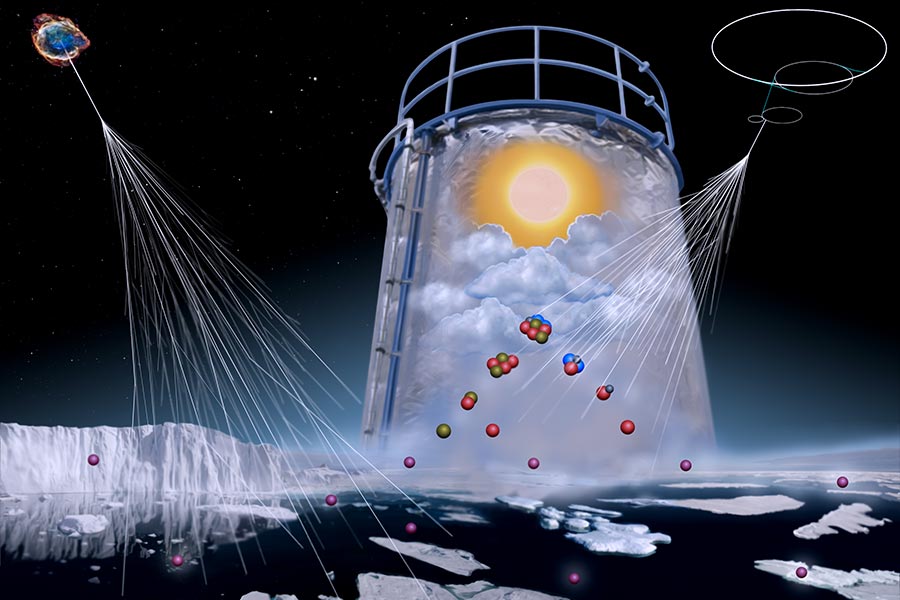
Iodine oxoacids formed from ocean emissions may rival sulfuric acid in driving aerosol formation in clean atmospheres, impacting climate and air quality.
Molecular iodine, a major emission from the ocean, can quickly convert to iodic oxoacids even under weak daylight conditions. These oxoacids lead rapidly to aerosol particles that significantly affect climate and human health.
Iodine-containing vapors that are emitted from oceans are a major source of aerosol particles. “Despite their importance to the climate, the formation of marine particles has been poorly understood,” says Siddharth Iyer, Postdoctoral Researcher in Aerosol Physics Laboratory at Tampere University.
In this research, the formation of aerosol particles form from iodine-containing vapours under marine boundary layer conditions were studied. The experiments were carried out in the ultra-clean CLOUD chamber in CERN, where the nucleation and growth rates as well as the composition of freshly formed particles from iodic oxoacids (iodic acid and iodous acid) were measured.
These vapours derive from photolysis and oxidation of molecular iodine, for which the ocean surface is a major source. The conversion to iodine oxoacids were found to be extremely fast, even under weak daylight conditions. Although iodic acid was identified as the key vapour, a related species – iodous acid – was also found to play an important stabilizing role in the initial steps of neutral (uncharged) particle formation.
“Sulfuric acid is known to be key player in new particle formation, but our results indicate that iodine oxoacid particle formation can compete with sulfuric acid in pristine regions of the atmosphere. This significantly advances our understanding of aerosol formation,” Iyer sums up.
The article Role of iodine oxoacids in atmospheric aerosol nucleation was published in Science.
Reference: “Role of iodine oxoacids in atmospheric aerosol nucleation” by Xu-Cheng He, Yee Jun Tham, Lubna Dada, Mingyi Wang, Henning Finkenzeller, Dominik Stolzenburg, Siddharth Iyer, Mario Simon, Andreas Kürten, Jiali Shen, Birte Rörup, Matti Rissanen, Siegfried Schobesberger, Rima Baalbaki, Dongyu S. Wang, Theodore K. Koenig, Tuija Jokinen, Nina Sarnela, Lisa J. Beck, João Almeida, Stavros Amanatidis, António Amorim, Farnoush Ataei, Andrea Baccarini, Barbara Bertozzi, Federico Bianchi, Sophia Brilke, Lucía Caudillo, Dexian Chen, Randall Chiu, Biwu Chu, António Dias, Aijun Ding, Josef Dommen, Jonathan Duplissy, Imad El Haddad, Loïc Gonzalez Carracedo, Manuel Granzin, Armin Hansel, Martin Heinritzi, Victoria Hofbauer, Heikki Junninen, Juha Kangasluoma, Deniz Kemppainen, Changhyuk Kim, Weimeng Kong, Jordan E. Krechmer, Aleksander Kvashin, Totti Laitinen, Houssni Lamkaddam, Chuan Ping Lee, Katrianne Lehtipalo, Markus Leiminger, Zijun Li, Vladimir Makhmutov, Hanna E. Manninen, Guillaume Marie, Ruby Marten, Serge Mathot, Roy L. Mauldin, Bernhard Mentler, Ottmar Möhler, Tatjana Müller, Wei Nie, Antti Onnela, Tuukka Petäjä, Joschka Pfeifer, Maxim Philippov, Ananth Ranjithkumar, Alfonso Saiz-Lopez, Imre Salma, Wiebke Scholz, Simone Schuchmann, Benjamin Schulze, Gerhard Steiner, Yuri Stozhkov, Christian Tauber, António Tomé, Roseline C. Thakur, Olli Väisänen, Miguel Vazquez-Pufleau, Andrea C. Wagner, Yonghong Wang, Stefan K. Weber, Paul M. Winkler, Yusheng Wu, Mao Xiao, Chao Yan, Qing Ye, Arttu Ylisirniö, Marcel Zauner-Wieczorek, Qiaozhi Zha, Putian Zhou, Richard C. Flagan, Joachim Curtius, Urs Baltensperger, Markku Kulmala, Veli-Matti Kerminen, Theo Kurtén, Neil M. Donahue, Rainer Volkamer, Jasper Kirkby, Douglas R. Worsnop and Mikko Sipilä, 5 February 2021, Science.
DOI: 10.1126/science.abe0298
Never miss a breakthrough: Join the SciTechDaily newsletter.
Follow us on Google and Google News.
1 Comment
This looks like a candidate for the The Guinness Book of World Records as the largest number of authors for a research paper.
There are some who contend that the value of a paper is inversely proportional to the number of authors. After all, it didn’t take 99 scientists to come up with the Theory of Relativity; it only took one. And, it would only take one to discredit it. There is an unhealthy emphasis on consensus in science in recent years.