
Close Menu
    Facebook X (Twitter) Instagram
    SciTechDaily
    • Biology
    • Chemistry
    • Earth
    • Health
    • Physics
    • Science
    • Space
    • Technology
    Facebook X (Twitter) Pinterest YouTube RSS
    SciTechDaily
    Home»Physics»Iron-Platinum Alloy Retains Information at Nanomagnet Sizes
    Physics

    Iron-Platinum Alloy Retains Information at Nanomagnet Sizes

    By UC DavisMay 22, 2013No Comments3 Mins Read
    Facebook Twitter Pinterest Telegram LinkedIn WhatsApp Email Reddit
    Share
    Facebook Twitter LinkedIn Pinterest Telegram Email Reddit
    Iron Platinum Alloy Nanomagnets Could be New Generation Hard Drives
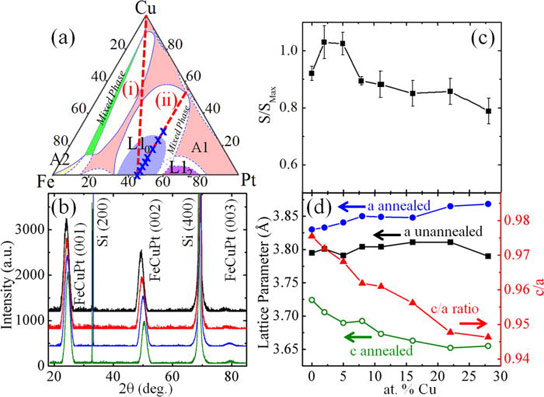
    (a) Phase diagram for ternary alloy FePtCu determined at 600 °C (values shown are at. %, adapted from Ref.17). Sample compositions in this study are indicated by crosses. (b) XRD patterns and (c) normalized order parameter S/SMax for post-annealed films grown by AMS. The at. % Cu in (b) is 0, 5, 11, and 22 from top to bottom, respectively. Error bars in (c) are determined by the standard deviation of I(001)/I(002) and I(003)/I(002). (d) Lattice parameter a for the A1 phase (squares), a (solid circles), and c (open circles) for the L10 phase, as well as the c/a ratio for the latter (triangles). Credit: Dustin A. Gilbert, et al., doi: 10.1063/1.4799651

    An international team of researchers used a method called atomic-scale multilayer sputtering to create iron-platinum alloys with an ordered crystal structure that could be used for the next generation of hard drives.

    Meeting the demand for more data storage in smaller volumes means using materials made up of ever-smaller magnets, or nanomagnets. One promising material for a potential new generation of recording media is an alloy of iron and platinum with an ordered crystal structure. Researchers led by Professor Kai Liu and graduate student Dustin Gilbert at the University of California, Davis, have now found a convenient way to make these alloys and tailor their properties.

    “The relatively convenient synthesis conditions, along with the tunable magnetic properties, make these materials highly desirable for future magnetic recording technologies,” said Liu, a professor of physics. The iron-platinum alloy has the ability to retain information even at extremely small nanomagnet sizes, and it is resistant to heat effects.

    Previous methods for making the iron-platinum alloys with an ordered crystal structure involved high-temperature treatments that would be difficult to integrate into the rest of the manufacturing process, Liu said.

    The researchers, including Liang-Wei Wang and Chih-Huang Lai of the National Tsing Hua University, Taiwan, and Timothy Klemmer and Jan-Ulrich Thiele, of Seagate Technologies in Fremont, used a method called atomic-scale multilayer sputtering to create a material with extremely thin layers of metal, and rapid thermal annealing to convert it into the desirable ordered alloy. They were able to adjust the magnetic properties of the alloy by adding small amounts of copper into particular regions of the alloy.

    A paper describing the work was recently published in the journal Applied Physics Letters and featured in its Research Highlights. The work was supported by the National Science Foundation Materials World Network Program.

    Reference: “Tuning magnetic anisotropy in (001) oriented L10 (Fe1−xCux)55Pt45 films” by Dustin A. Gilbert, Liang-Wei Wang, Timothy J. Klemmer, Jan-Ulrich Thiele, Chih-Huang Lai and Kai Liu, 2 April 2013, Applied Physics Letters.
    DOI: 10.1063/1.4799651

    Never miss a breakthrough: Join the SciTechDaily newsletter.
    Follow us on Google and Google News.

    Materials Science Nanotechnology UC Davis
    Share. Facebook Twitter Pinterest LinkedIn Email Reddit

    Related Articles

    New Phase of Carbon Allows Researchers to Make Diamond Structures at Room Temperature

    Quantum Process Significantly Boosts the Energy That Can Be Harnessed from Sunlight

    Physicists Determine the Three-Dimensional Coordinates of Individual Atoms

    Researchers Developed a Frictional Interface at the Atomic Level

    Cathodoluminescence Used to Probe Metamaterials

    Electron-Cloaking Material May Enable More Efficient Transfer of Electrons

    Ultrashort Pulses of Infrared Light Trigger Changes in Magnetism

    Path to Magnetic Vortex RAM Might be More Difficult Than Previously Assumed

    Electron-Electron Interactions are Critical to Graphene’s Extraordinary Properties

    Leave A Reply Cancel Reply

    • Facebook
    • Twitter
    • Pinterest
    • YouTube

    Don't Miss a Discovery

    Subscribe for the Latest in Science & Tech!

    Trending News

    Why Popular Diabetes Drugs Like Ozempic Don’t Work for Everyone: The “Genetic Glitch”

    Scientists Stunned After Finding Plant Thought Extinct for 60 Years

    Scientists Discover Tiny New Spider That Hunts Prey 6x Its Size

    Natural Component From Licorice Shows Promise for Treating Inflammatory Bowel Disease

    Scientists Warn: Popular Sweetener Linked to Dangerous Metabolic Effects

    Monster Storms on Jupiter Unleash Lightning Beyond Anything on Earth

    Scientists Create “Liquid Gears” That Spin Without Touching

    The Simple Habit That Could Help Prevent Cancer

    Follow SciTechDaily
    • Facebook
    • Twitter
    • YouTube
    • Pinterest
    • Newsletter
    • RSS
    SciTech News
    • Biology News
    • Chemistry News
    • Earth News
    • Health News
    • Physics News
    • Science News
    • Space News
    • Technology News
    Recent Posts
    • Seeing the Invisible: Scientists Develop New Way To Track Particles in 3D
    • The Atomic Gap That Could Cost the Semiconductor Industry Billions
    • Earth’s Secret Advantage: Why Most Alien Worlds May Be Too Dry for Life
    • Ancient Bacteria Turned a DNA System Into a Cell Skeleton
    • Researchers Finally Solve 50-Year-Old Blood Group Mystery
    Copyright © 1998 - 2026 SciTechDaily. All Rights Reserved.
    • Science News
    • About
    • Contact
    • Editorial Board
    • Privacy Policy
    • Terms of Use

    Type above and press Enter to search. Press Esc to cancel.