
Close Menu
    Facebook X (Twitter) Instagram
    SciTechDaily
    • Biology
    • Chemistry
    • Earth
    • Health
    • Physics
    • Science
    • Space
    • Technology
    Facebook X (Twitter) Pinterest YouTube RSS
    SciTechDaily
    Home»Science»Looking Down at Storm From Space, NASA Finds Heavy Rainfall Ringing Major Hurricane Maria’s Eye
    Science

    Looking Down at Storm From Space, NASA Finds Heavy Rainfall Ringing Major Hurricane Maria’s Eye

    By Rob Gutro, NASA’s Goddard Space Flight CenterOctober 2, 20201 Comment4 Mins Read
    Facebook Twitter Pinterest Telegram LinkedIn WhatsApp Email Reddit
    Share
    Facebook Twitter LinkedIn Pinterest Telegram Email Reddit
    Major Hurricane Maria's Eye
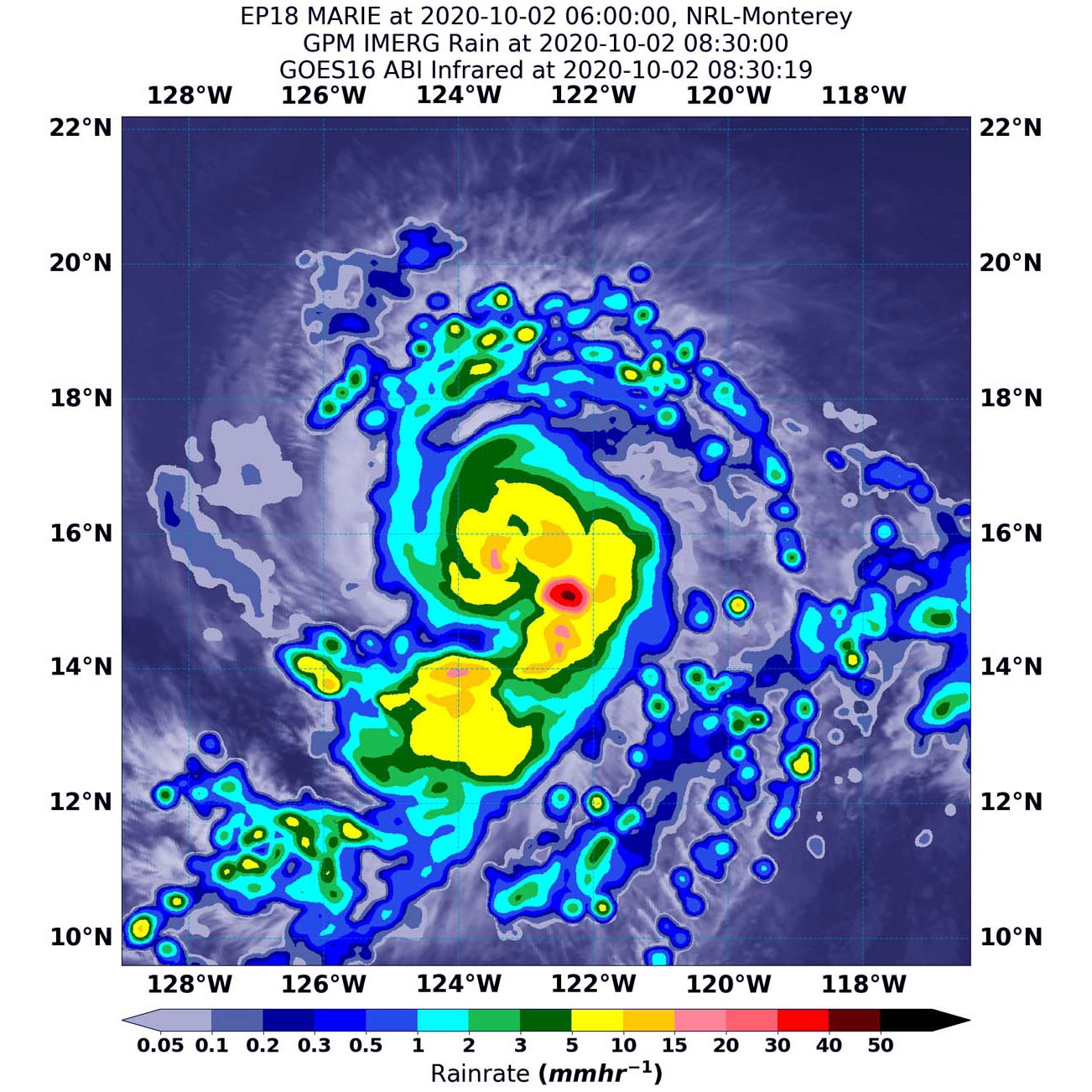
    On October 2 at 4:30 a.m. EDT (0830 UTC), NASA’s IMERG estimated Hurricane Maria was generating as much as 50 mm (2 inches of rain/dark red) around the center of circulation. Rainfall throughout most of the storm was occurring between 3 and 20 mm (0.1 to 0.8 inches/yellow, green, and pink colors) per hour. The rainfall data was overlaid on infrared imagery from NOAA’s GOES-16 satellite. Credit: ASA/NOAA/NRL

    Imagine being able to look down at a storm from orbit in space, and provide data that lets scientists calculate the rate in which rain is falling throughout it. That is what a NASA satellite rainfall product does as it incorporates data from satellites and observations. NASA found very heavy rainfall ringing around the compact eye of Major Hurricane Marie.

    Maria’s Status on October 2

    At 5 a.m. EDT (0900 UTC), NOAA’s National Hurricane Center (NHC) reported Hurricane Marie was a Category 4 storm on the Saffir-Simpson Hurricane Wind Scale. The center of Hurricane Marie was located near latitude 16.2 degrees north and longitude 123.2 degrees west. Fortunately, Marie is far from land areas. It is centered about 980 miles (1,580 km) west-southwest of the southern tip of Baja California, Mexico.

    Marie was moving toward the west-northwest near 15 mph (24 kph). Maximum sustained winds have increased to near 130 mph (215 kph) with higher gusts. Hurricane-force winds extend outward up to 25 miles (35 km) from the center and tropical-storm-force winds extend outward up to 125 miles (205 km). The estimated minimum central pressure is 947 millibars.

    Estimating Maria’s Rainfall Rates from Space

    NASA’s Integrated Multi-satellitE Retrievals for GPM or IMERG, which is a NASA satellite rainfall product, estimated on October 2 at 4:30 a.m. EDT (0830 UTC), Hurricane Maria was generating as much as 50 mm (2 inches) of rain in the eyewall, ringing around the eye. Rainfall throughout most of the storm was occurring between 3 and 20 mm (0.1 to 0.8 inches) per hour.

    At the U.S. Naval Laboratory in Washington, D.C., the IMERG rainfall data was overlaid on infrared imagery from NOAA’s GOES-16 satellite to provide a full picture of the storm.

    What Does IMERG Do?

    This near-real time rainfall estimate comes from the NASA’s IMERG, which combines observations from a fleet of satellites, in near-real time, to provide near-global estimates of precipitation every 30 minutes. By combining NASA precipitation estimates with other data sources, we can gain a greater understanding of major storms that affect our planet.

    Instead, what the IMERG does is “morph” high-quality satellite observations along the direction of the steering winds to deliver information about rain at times and places where such satellite overflights did not occur. Information morphing is particularly important over the majority of the world’s surface that lacks ground-radar coverage. Basically, IMERG fills in the blanks between weather observation stations.

    Marie’s Future

    Additional strengthening is expected today, with weakening forecast to begin on Saturday, October 3. A motion toward the west-northwest or northwest with a gradual decrease in forward speed is expected during the next several days.

    NASA Researches Tropical Cyclones

    Hurricanes/tropical cyclones are the most powerful weather events on Earth. NASA’s expertise in space and scientific exploration contributes to essential services provided to the American people by other federal agencies, such as hurricane weather forecasting.

    For more than five decades, NASA has used the vantage point of space to understand and explore our home planet, improve lives and safeguard our future. NASA brings together technology, science, and unique global Earth observations to provide societal benefits and strengthen our nation. Advancing knowledge of our home planet contributes directly to America’s leadership in space and scientific exploration.

    Never miss a breakthrough: Join the SciTechDaily newsletter.
    Follow us on Google and Google News.

    Hurricane NASA NASA Goddard Space Flight Center Weather
    Share. Facebook Twitter Pinterest LinkedIn Email Reddit

    Related Articles

    NASA Unveils Astonishing Gravity Waves Caused by Hurricane Helene

    Dramatic NASA Satellite Video Examines Hurricane Ida’s Eye in 3D

    NASA’s Aqua Satellite Finds Hurricane Marie Rapidly Intensifying

    NASA Satellite Data Analysis of Rainfall and Rainmaking Capability in Hurricane Sally

    Catastrophic Flooding Possible: NASA Aqua Satellite Eyes Hurricane Sally and Finds Heavy Rain Potential

    Hurricane Nana Caught Making Landfall Under Cover of Night by NASA-NOAA Satellite

    NASA Sees Hanna Strengthen into First Atlantic Hurricane of 2020

    Goddard’s Space Weather Laboratory to Use ‘Ensemble Forecasting’

    NASA’s GISS Releases Data Showing 2011 was Ninth-Warmest Year on Record

    1 Comment

    1. xABBAAA on October 8, 2020 12:54 am

      … Oh my God, this really looks like a spiral galaxy. So, where is a dark matter there, or could this be used to calculate it? View from top, is the same…

      Reply
    Leave A Reply Cancel Reply

    • Facebook
    • Twitter
    • Pinterest
    • YouTube

    Don't Miss a Discovery

    Subscribe for the Latest in Science & Tech!

    Trending News

    Scientists Discover How Coffee Impacts Memory, Mood, and Gut Health

    Why Did the Neanderthals Disappear? Scientists Reveal Humans Had a Hidden Advantage

    Physicists Propose Strange Experiment Where Time Goes Quantum

    Magnesium Magic: New Drug Melts Fat Even on a High-Fat, High-Sugar Diet

    Weight-Loss Drugs Like Ozempic May Come With an Unexpected Cost

    Mezcal “Worm” in a Bottle Mystery: DNA Testing Reveals a Surprise

    New Research Reveals That Your Morning Coffee Activates an Ancient Longevity Switch

    This Is What Makes You Irresistible to Mosquitoes

    Follow SciTechDaily
    • Facebook
    • Twitter
    • YouTube
    • Pinterest
    • Newsletter
    • RSS
    SciTech News
    • Biology News
    • Chemistry News
    • Earth News
    • Health News
    • Physics News
    • Science News
    • Space News
    • Technology News
    Recent Posts
    • Harvard Scientists Reveal Secret Structure Behind How You Smell
    • Scientists Just Discovered the Hidden Trick That Keeps Your Cells Alive
    • This Simple Movement Could Be Secretly Cleaning Your Brain
    • Male Birth Control Breakthrough: Scientists Find Way To Turn Sperm Production Off and Back On
    • A Common Vitamin Could Hold the Key to Treating Fatty Liver Disease
    Copyright © 1998 - 2026 SciTechDaily. All Rights Reserved.
    • Science News
    • About
    • Contact
    • Editorial Board
    • Privacy Policy
    • Terms of Use

    Type above and press Enter to search. Press Esc to cancel.