
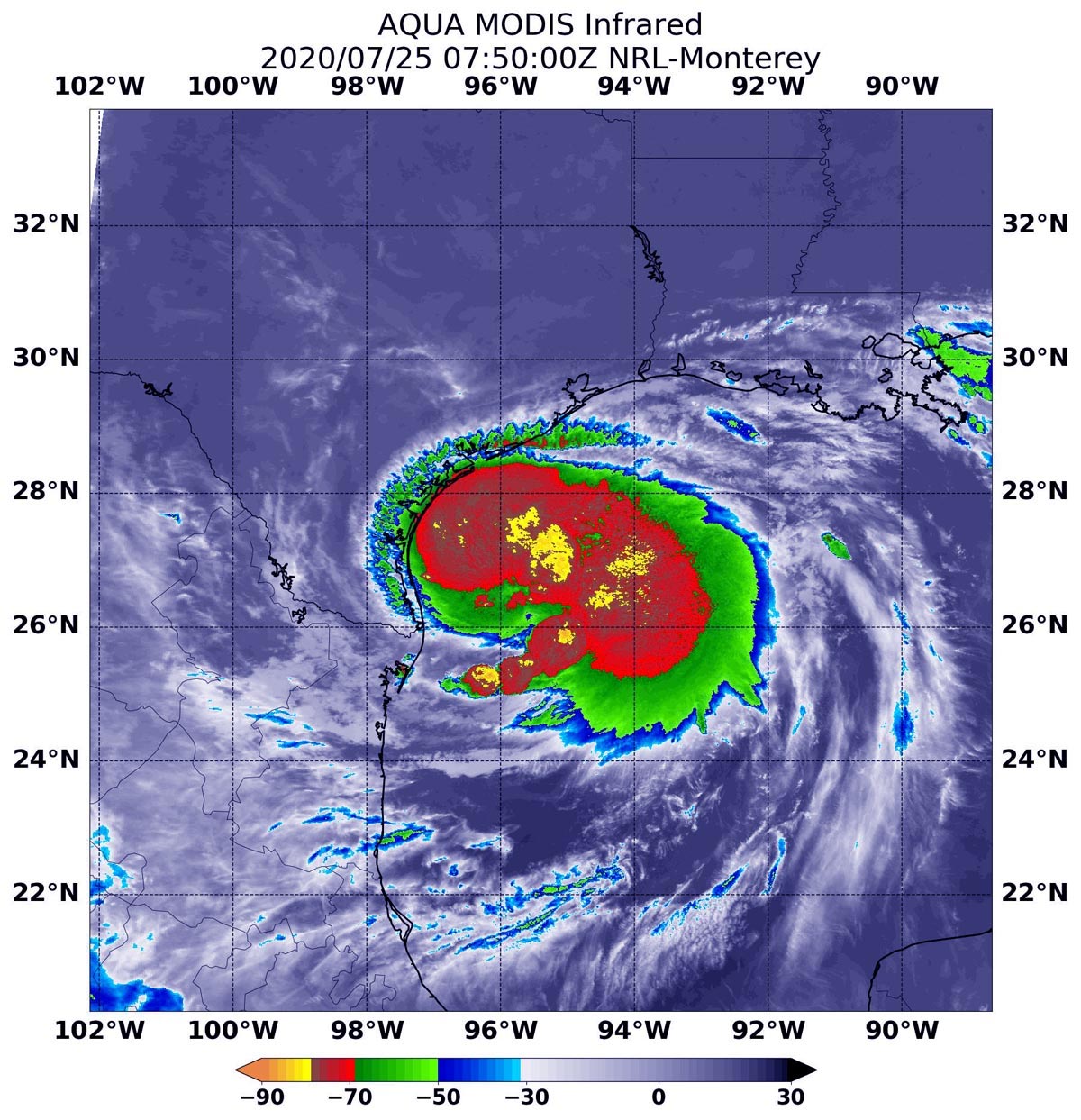
NASA satellite imagery revealed powerful thunderstorms fueled the intensification of Hanna into a hurricane along the Texas coast. Hanna has become the first hurricane of the Atlantic Ocean hurricane season, and triggered warnings along the Texas coast yesterday, July 25, 2020.
Warnings in Effect
The National Hurricane Center posted warnings on July 25 for areas of the Texas coast as Hanna approaches for landfall. A Storm Surge Warning is in effect from Port Mansfield to Sargent, Texas. A Hurricane Warning is in effect from Port Mansfield to Mesquite Bay, Texas.
A Tropical Storm Warning is in effect from Barra el Mezquita, Mexico to Port Mansfield, Texas and for Mesquite Bay to High Island, Texas.
NASA Infrared Data Shows Hanna Strengthened
On July 25 at 3:50 a.m. EDT (0750 UTC), the Moderate Resolution Imaging Spectroradiometer or MODIS instrument that flies aboard NASA’s Aqua satellite used infrared light to analyze the strength of storms within Hanna. MODIS revealed that cloud tops in very powerful thunderstorms around Hanna’s center had become colder since the previous day. That means the uplift in the storm was stronger and pushed the cloud tops higher into the troposphere. Cloud top temperatures in those areas were as cold as minus 80 degrees Fahrenheit (minus 62.2 Celsius), indicating the storm had strengthened. NASA research has found that cloud top temperatures that cold indicate strong storms with the potential to generate heavy rainfall.
Tropical cyclones are made of up hundreds of thunderstorms, and infrared data can show where the strongest storms are located. That is because infrared data provides temperature information, and the strongest thunderstorms that reach highest into the atmosphere have the coldest cloud top temperatures. NASA researches these storms to determine how they rapidly intensify, develop, and behave.
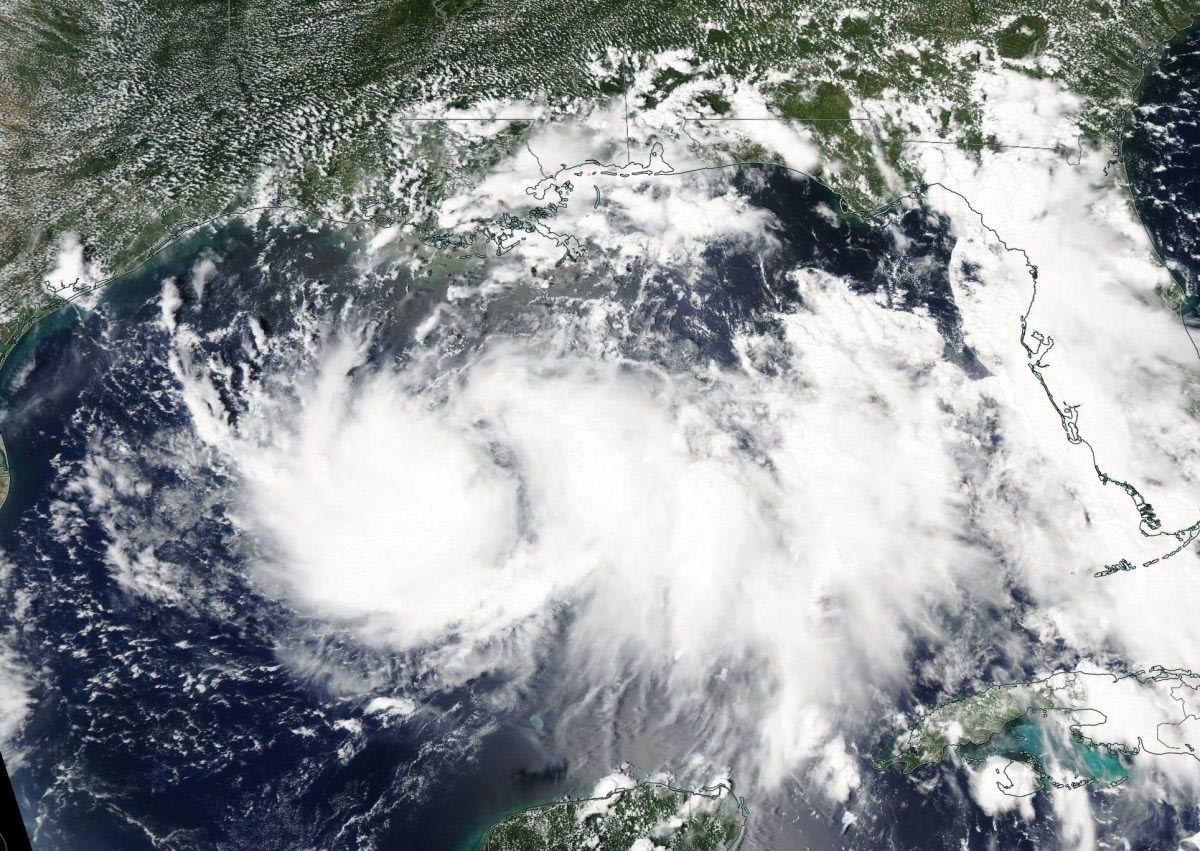
Heavy Rainfall, Storm Surge, Hurricane-force Winds, Isolated Tornadoes
The National Hurricane Center forecast warns about storm surge up to 5 feet in various areas, hurricane conditions, isolated tornadoes, heavy rainfall, flooding, and dangerous ocean swells from Texas to Louisiana.
Infrared imagery from NASA shows the capability of Hurricane Hanna to generate heavy rainfall, and the National Hurricane Center has included that rainfall potential in their forecast. NHC said, “Hanna is expected to produce 6 to 12 inches of rain with isolated maximum totals of 18 inches through Sunday night in south Texas and into the Mexican states of Coahuila, Nuevo Leon, and northern Tamaulipas. This rain may result in life-threatening flash flooding, rapid rises on small streams, and isolated minor to moderate river flooding in south Texas.”
Hanna’s Status on Saturday, July 25
At 8 a.m. EDT (1200 UTC), the center of Hurricane Hanna was located by reconnaissance aircraft and NOAA Doppler weather radars near latitude 27.1 degrees north and longitude 96.0 degrees west. Hanna is just 90 miles (150 km) east-northeast of Port Mansfield, Texas. Hanna is moving toward the west near 9 mph (15 km), and this motion should continue through this morning. A gradual turn toward the west-southwest is expected by tonight and that motion should continue through Sunday.
Data from the reconnaissance aircraft and Doppler weather radars indicate that maximum sustained winds have increased to near 75 mph (120 kph) with higher gusts. Data from the NOAA Hurricane Hunter aircraft indicate that the minimum central pressure is 982 millibars.
Additional strengthening is forecast before Hanna makes landfall later today. Rapid weakening is expected after Hanna moves inland. On the forecast track, the center of Hanna should make landfall along the Texas coast within the hurricane warning area this afternoon or early this evening.
Typhoons/hurricanes are the most powerful weather events on Earth. NASA’s expertise in space and scientific exploration contributes to essential services provided to the American people by other federal agencies, such as hurricane weather forecasting.
Never miss a breakthrough: Join the SciTechDaily newsletter.
Follow us on Google and Google News.