
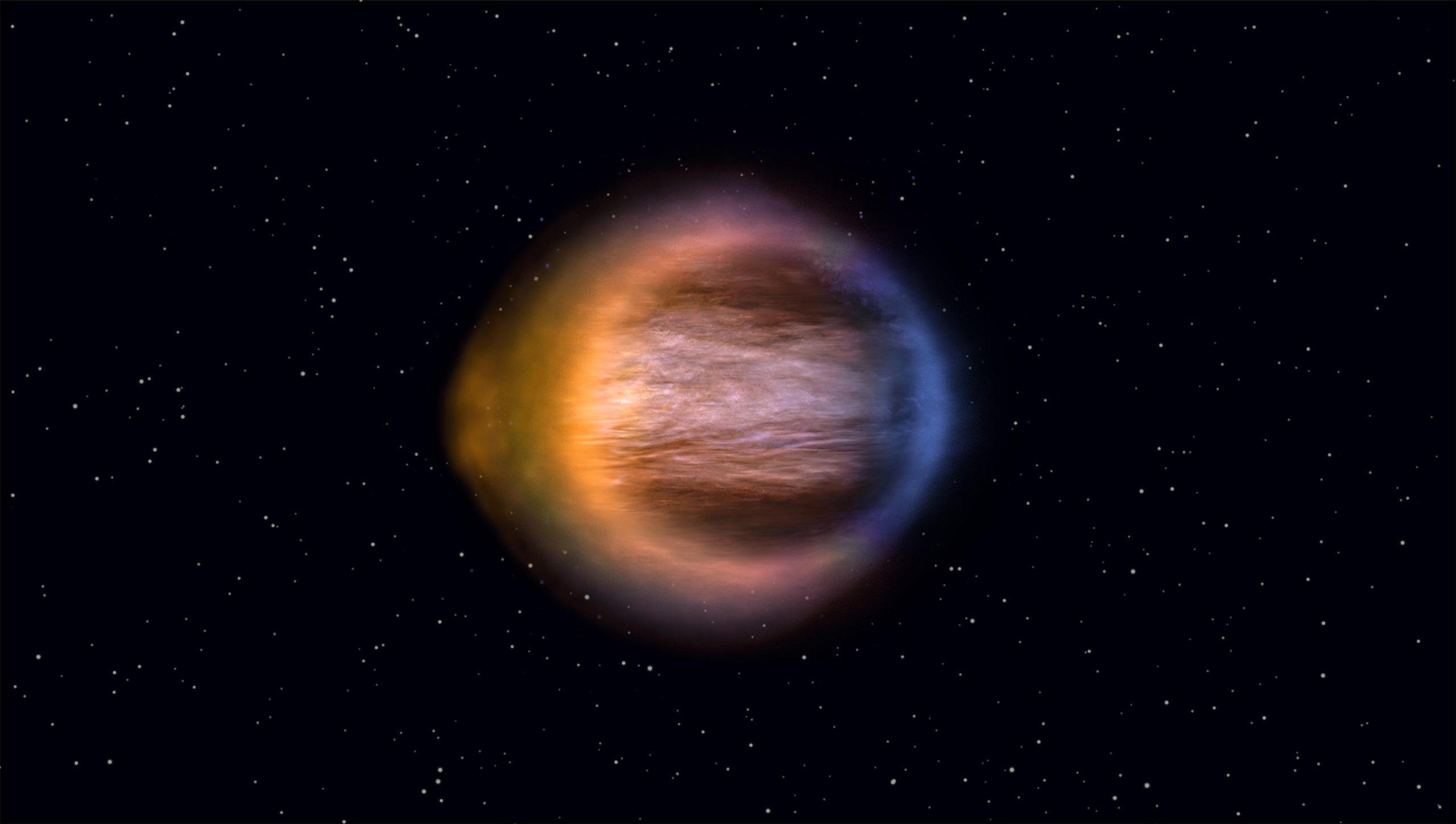
Weather maps of distant planets are a step closer after the James Webb Space Telescope distinguished hotter and cooler regions around the giant exoplanet WASP-17b.
One side of WASP-17b’s atmosphere extends farther into space than the other, giving this intensely hot giant planet an uneven outline. Astronomers have now mapped that distortion with the James Webb Space Telescope (JWST), finding a pattern consistent with predictions of how heat and powerful winds shape a world with permanent day and night sides.
WASP-17b is a hot Jupiter, a giant planet that orbits close to its star, about 1,300 light-years from Earth. The study, co-led by Cornell University in the United States and the University of Bristol in the United Kingdom, was published in Nature Astronomy. It marks the first application of a method called transmission strings, developed at Bristol by astrophysicists Dr. David Grant and Dr. Hannah Wakeford.
“Having this very robust mathematical model that we can apply to this state-of-the-art data is incredibly exciting. The results are a really beautiful demonstration of the dynamics that are going on in these multidimensional and multifaceted worlds,” said Wakeford, a study co-author and associate professor of astrophysics at the University of Bristol.
Resolving differences around the atmospheric edge
JWST, the largest telescope in space, has already enabled researchers to use a technique called eclipse mapping, which measures changes in light as a planet passes behind its host star. Transmission strings, also called transit mapping, follows the planet as it crosses in front of the star. It analyzes the light passing through different parts of the atmosphere’s edge, or limb, to distinguish conditions around that boundary. Traditional modeling instead extracts a single spectrum, a measurement of light across different wavelengths, averaged over the entire limb.
Lead author Dr. Lili Alderson, a Klarman Postdoctoral Fellow at Cornell, began the investigation at the University of Bristol, where she earned her doctorate in physics.
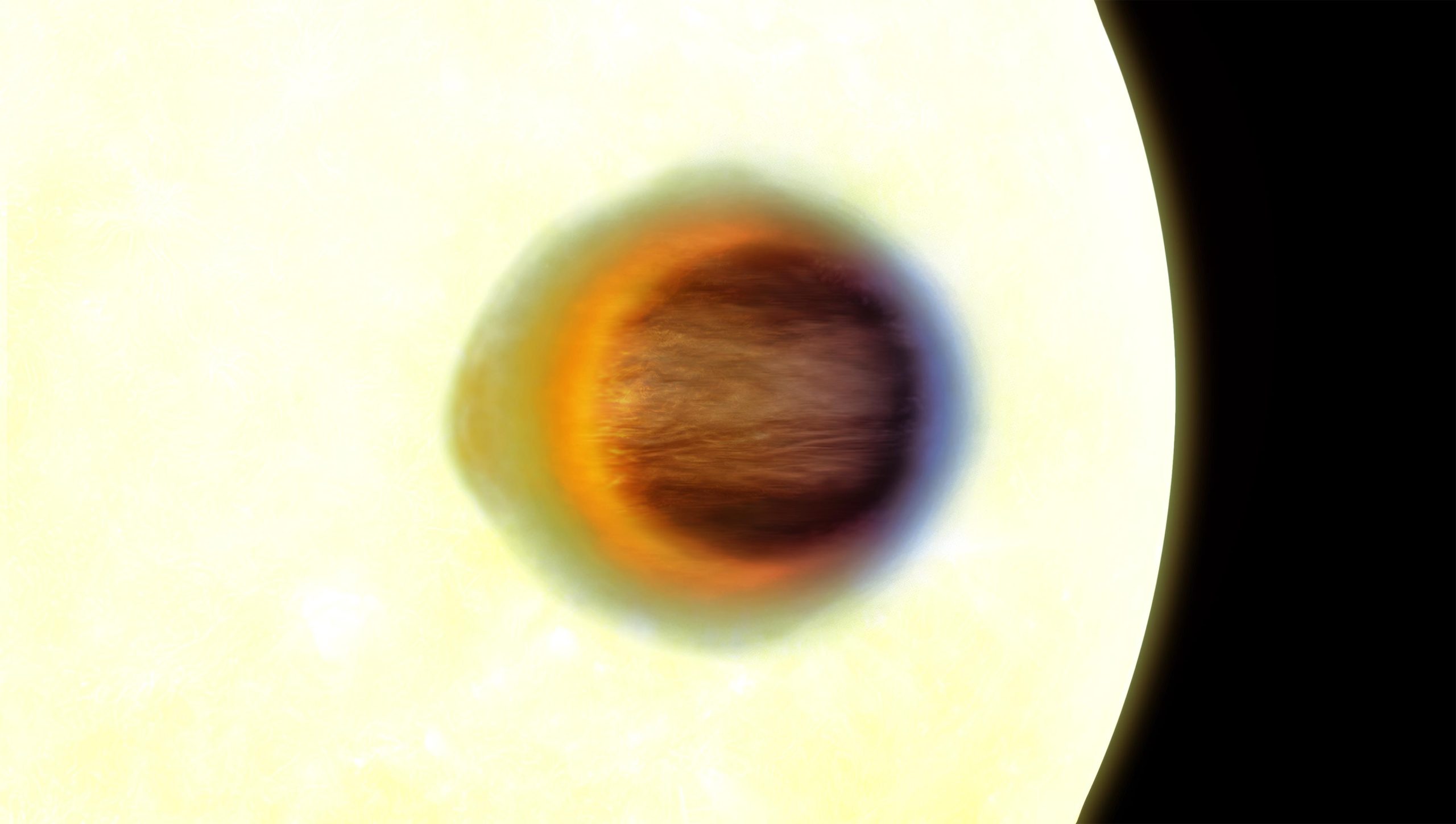
“Rather than assuming your atmosphere is a circle with the same radius all the way around, our technique allows you to pull out different distances from the center to the edge of the planet,” Alderson said. “We’re able to go around the edge. So, we’ve gone from a ring to understanding where on the ring the gemstones are, so to speak.”
Heat swells the evening atmosphere
On WASP-17b, the mapped bulge lies on the evening side of the equator. There, jets of wind carry heat from the permanently illuminated day side toward the permanently shadowed night side, inflating the atmosphere relative to the equator’s cooler morning side. The location matches what theory and previous modeling had indicated.
“Theory predicts that the morning and the evening sides should have a strong temperature difference, and WASP-17b fits really nicely in that trend – pretty much bang-on what we thought it would be,” Alderson said.
The study’s findings on atmospheric chemical composition and temperature differences, both from equator to poles and between the day and night sides, also agree with theoretical predictions and other modeling techniques.
“Planets are temperamental, their atmospheres complex and chaotic. The fact that all of these numbers came together and showed us this very structured, dynamical picture of this giant world over 1,000 light-years away was just really exciting,” Wakeford said.
Toward weather maps of distant planets
Together, the findings provide one of the most comprehensive three-dimensional views of an exoplanet’s atmosphere. They also establish a benchmark for comparison with the more than 6,000 other exoplanets confirmed to date.
“This is proof of concept that planets are in fact 3D objects, and that consistently, as they go around their star, what we predict should be happening is happening. To move beyond computational exercises and see it for real is a different matter,” Alderson said.
The successful demonstration on WASP-17b opens the way to applying transmission strings to many more planets. The method is beginning to distinguish conditions across different latitudes, extending atmospheric maps beyond the contrast between day and night. That is a first step toward mapping weather-scale patterns in exoplanet climates.
Reference: “A spatial map of the atmospheric limb of a hot Jupiter” by Lili Alderson, Hannah R. Wakeford, David Grant, Nikole K. Lewis, Avinash Verma, Jayesh Goyal, Mark Hammond, Daniel Valentine, Natalie H. Allen, Ana Glidden, Amélie Gressier, Jingcheng Huang, Maura Lally, Dana R. Louie, Jacob Lustig-Yaeger, Cathal Maguire, Elijah Mullens, Kristin S. Sotzen, Jeff A. Valenti, Roeland P. van der Marel and Tiffany Kataria, 14 October 2026, Nature Astronomy.
DOI: 10.1038/s41550-026-02986-4
Funding is provided to the team by NASA through grant number 80NSSC20K0586. Based on observations with the NASA/ESA/CSA JWST, associated with program(s) GTO-1353 (PI: N.K.L.), obtained at the Space Telescope Science Institute, which is operated by AURA, Inc., under NASA contract NAS 5-03127.
Never miss a breakthrough: Join the SciTechDaily newsletter.
Follow us on Google and Google News.