
Close Menu
    Facebook X (Twitter) Instagram
    SciTechDaily
    • Biology
    • Chemistry
    • Earth
    • Health
    • Physics
    • Science
    • Space
    • Technology
    Facebook X (Twitter) Pinterest YouTube RSS
    SciTechDaily
    Home»Space»Lupus 4 – A Spider-Shaped Blob of Gas and Dust
    Space

    Lupus 4 – A Spider-Shaped Blob of Gas and Dust

    By European Southern ObservatorySeptember 8, 20141 Comment4 Mins Read
    Facebook Twitter Pinterest Telegram LinkedIn WhatsApp Email Reddit
    Share
    Facebook Twitter LinkedIn Pinterest Telegram Email Reddit
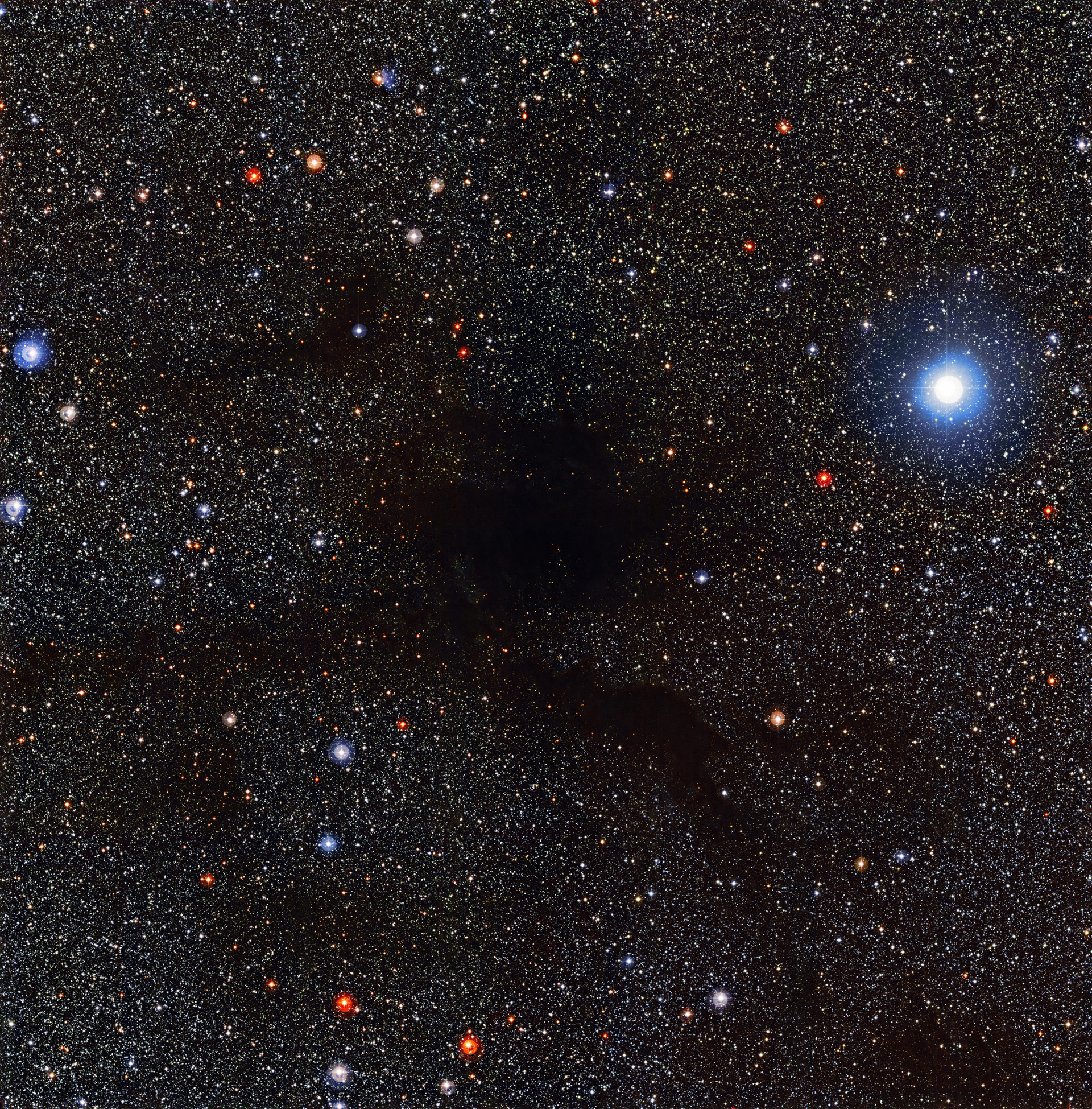
    ESO Views Lupus 4
    Lupus 4, a spider-shaped cloud of gas and dust, is located about 400 light-years away from Earth. It stretches across the Lupus (The Wolf) and Norma (The Carpenter’s Square) constellations. Credit: ESO

    ESO’s Wide Field Imager at the La Silla Observatory in Chile captured this new image of Lupus 4, which is located about 400 light-years away from Earth.

    Lupus 4, a spider-shaped blob of gas and dust, blots out background stars like a dark cloud on a moonless night in this intriguing new image. Although gloomy for now, dense pockets of material within clouds such as Lupus 4 are where new stars form and where they will later burst into radiant life.

    Lupus 4 is located about 400 light-years away from Earth, straddling the constellations of Lupus (The Wolf) and Norma (The Carpenter’s Square). The cloud is one of several affiliated dark clouds found in a loose star cluster called the Scorpius–Centaurus OB association. An OB association is a relatively young, yet widely dispersed grouping of stars.[1] The stars likely had a common origin in a gigantic cloud of material.

    Because the association, and its Lupus clouds, form the closest such grouping to the Sun, they are a prime target for studying how stars grow up together before going their separate ways. The Sun, along with most stars in our galaxy, is thought to have started out in a similar environment.

    American astronomer Edward Emerson Barnard is credited with the earliest descriptions of the Lupus dark clouds in the astronomical literature, back in 1927. Lupus 3, neighbor to Lupus 4, is the best studied, thanks to the presence of at least 40 fledgling stars formed over the last three million years, which are on the cusp of igniting their fusion furnaces (eso1303). The main energy source in these adolescent stars, known as T Tauri stars, is the heat generated by their gravitational contraction. That is in contrast to the fusion of hydrogen and other elements which powers mature stars such as the Sun.


    This close-up pan video shows a new view of the dark cloud Lupus 4 blotting out background stars. It was captured using Wide Field Imager (WFI) on the MPG/ESO 2.2-meter telescope at the La Silla Observatory in Chile. Lupus 4 is a dense pocket of gas and dust where new stars are expected to form. The cloud is located about 400 light-years away from Earth, on the border between the constellations of Lupus (The Wolf) and Norma (The Carpenter’s Square). Credit: ESO. Music: movetwo

    Observations of the cold darkness of Lupus 4 have turned up only a few T Tauri stars. Yet promisingly for Lupus 4 in terms of future star formation is a dense, starless core of material in the cloud. Given a few million years, that core should develop into T Tauri stars. Comparing Lupus 3 and Lupus 4 in this way suggests that the former is older than the latter, because its contents have had more time to develop into stars.

    How many stars might eventually start to shine within Lupus 4? It is hard to say, as mass estimates for Lupus 4 vary. Two studies agree on a figure of around 250 times the mass of the Sun, though another, using a different method, arrives at a figure of around 1600 solar masses. Either way, the cloud contains ample material to give rise to plenty of bright new stars. Rather as earthly clouds make way for sunshine, so, too, shall this cosmic dark cloud eventually dissipate and give way to brilliant starlight.

    Notes

    1. The “OB” refers to the hot, bright, short-lived stars of spectral types O and B that are still shining brilliantly within the widely dispersed cluster as it travels through the Milky Way galaxy.

    Never miss a breakthrough: Join the SciTechDaily newsletter.
    Follow us on Google and Google News.

    Astronomy European Southern Observatory Popular
    Share. Facebook Twitter Pinterest LinkedIn Email Reddit

    Related Articles

    Stunning Galactic Fireworks: New ESO Images Reveal Spectacular Features of Nearby Galaxies

    Astronomers Were Puzzled by “Great Dimming” of Betelgeuse – Now the Mystery Is Solved

    “Big Surprise!” – Heavy Metal Vapors Unexpectedly Found in Comets Throughout Our Solar System – and Beyond

    Mysterious Interstellar Visitor May Be the Most Pristine Comet Ever Found

    Event Horizon Telescope Images Magnetic Fields at the Edge of M87’s Supermassive Black Hole

    “Meteorological Beast in Our Solar System” – Powerful Stratospheric Winds Measured on Jupiter for the First Time

    Astronomers Have Discovered the Most Distant Source of Radio Emission Ever Known – 13 Billion Light-Years Away

    Distant Colliding Galaxy Dying Out As It Loses the Ability to Form Stars – Ejecting 10,000 Suns-Worth of Gas a Year

    Puzzling Six-Exoplanet System Discovered With Resonant Rhythmic Movement

    1 Comment

    1. Leo Vuyk on September 9, 2014 7:31 am

      Is there any Herbig Haro object observed inside the clouds?

      Reply
    Leave A Reply Cancel Reply

    • Facebook
    • Twitter
    • Pinterest
    • YouTube

    Don't Miss a Discovery

    Subscribe for the Latest in Science & Tech!

    Trending News

    Massive Study Warns Marijuana Use in Teens Is Linked to Serious Mental Illness

    Scientists Discover a Completely Unexpected Way T Cells Kill Cancer

    Scientists Just Found the Solar System’s Original “Planet Factory”

    Study Warns Widely Used Food Preservatives Linked to High Blood Pressure and Heart Disease

    New Treatment Could Reverse Osteoarthritis Within Weeks

    Physicists Have Measured “Negative Time” in Bizarre Quantum Experiment

    The Deadly Tapeworm Spreading Across America Has Reached the Pacific Northwest

    Could Low Vitamin D Be Making Your Pain Worse?

    Follow SciTechDaily
    • Facebook
    • Twitter
    • YouTube
    • Pinterest
    • Newsletter
    • RSS
    SciTech News
    • Biology News
    • Chemistry News
    • Earth News
    • Health News
    • Physics News
    • Science News
    • Space News
    • Technology News
    Recent Posts
    • Scientists Discover Two Strange Dead Stars That Defy Astronomical Expectations
    • Scientists Find a Smarter Way To Measure the Universe Using Exploding Stars
    • Earth May Be Seeding Venus With Life, According to New Research
    • Streetlights Are Trapping Thousands of Isopods in Mysterious “Death Spirals”
    • Scientists Have Discovered These Deadly Parasites Are Secretly Swapping DNA
    Copyright © 1998 - 2026 SciTechDaily. All Rights Reserved.
    • Science News
    • About
    • Contact
    • Editorial Board
    • Privacy Policy
    • Terms of Use

    Type above and press Enter to search. Press Esc to cancel.