
Close Menu
    Facebook X (Twitter) Instagram
    SciTechDaily
    • Biology
    • Chemistry
    • Earth
    • Health
    • Physics
    • Science
    • Space
    • Technology
    Facebook X (Twitter) Pinterest YouTube RSS
    SciTechDaily
    Home»Space»Mars Curiosity Rover Explores Stratigraphy of Gale Crater: Finds Multiple Transitions Between Drier and Wetter Climates
    Space

    Mars Curiosity Rover Explores Stratigraphy of Gale Crater: Finds Multiple Transitions Between Drier and Wetter Climates

    By Geological Society of AmericaMay 3, 2021No Comments2 Mins Read
    Facebook Twitter Pinterest Telegram LinkedIn WhatsApp Email Reddit
    Share
    Facebook Twitter LinkedIn Pinterest Telegram Email Reddit
    View of Mount Sharp Mars
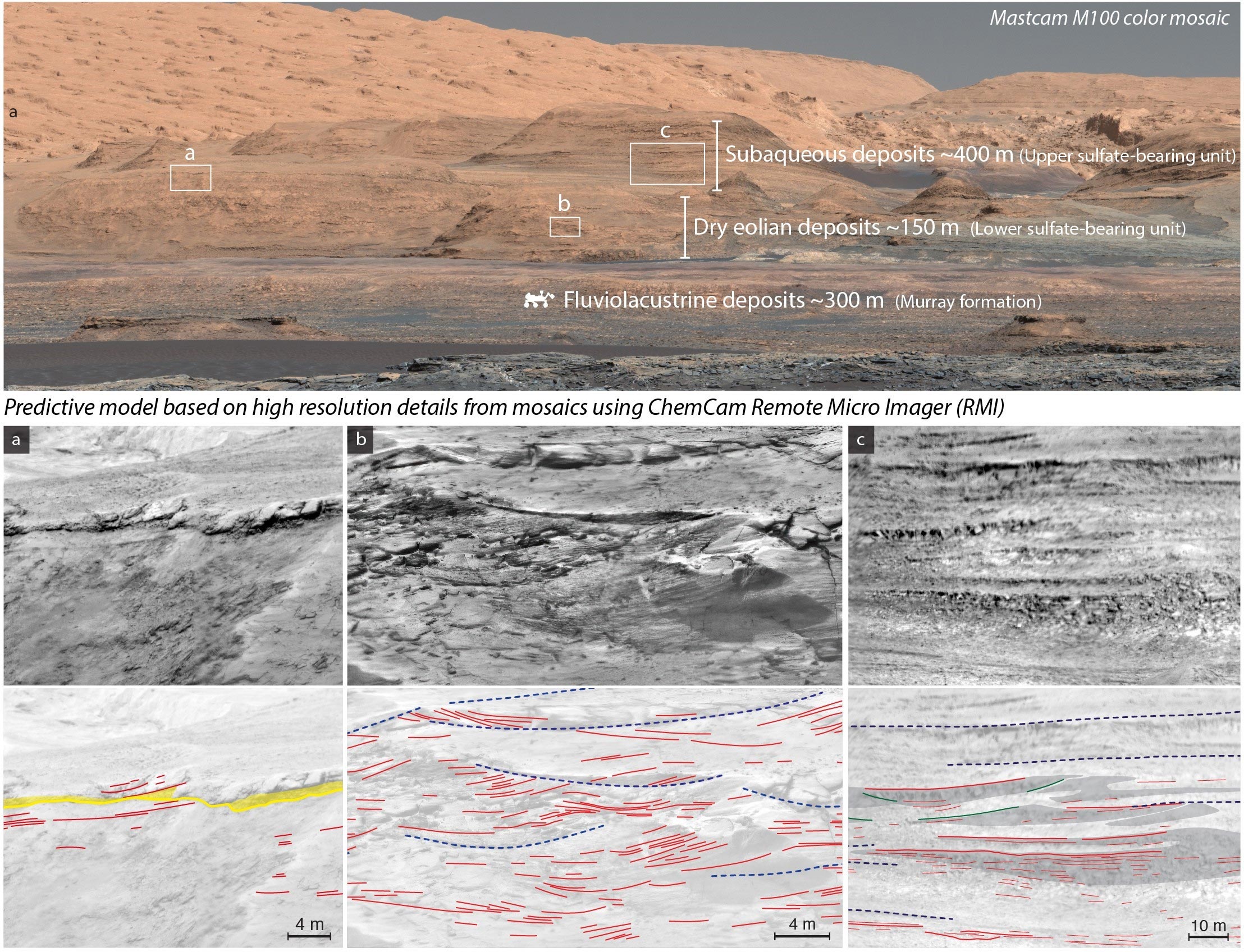
    View of Mount Sharp, Mars, with buttes showing main stratigraphy of the sulfate-bearing unit to be explored by the Curiosity rover, and expected ancient environments based on observed sedimentary structures. Credit: Rapin et al., Geology

    Gale Crater’s central sedimentary mound (Aeolis Mons or, informally, Mount Sharp) is a 5.5-km-tall (3.4-mi-tall) remnant of the infilling and erosion of this ancient impact crater. Given its thickness and age, Mount Sharp preserves one of the best records of early Martian climatic, hydrological, and sedimentary history.

    In this paper, published today in Geology, William Rapin and colleagues present the first description of key facies in the sulfate-bearing unit, recently observed in the distance by the rover, and propose a model for changes in depositional environments.

    The basal part of this sedimentary sequence is ahead of the Curiosity rover traverse and was recently analyzed with unprecedented resolution by the rover cameras. The telescopic imager of the ChemCam instrument was used here in particular, and its images show sedimentary structures that reveal evolution of environments on Mars during the Hesperian age (3.7–2.9 billion years ago).

    Analysis of the structures shows that on top of the ancient lake deposits currently explored by the rover (Murray formation), vast aeolian deposits were formed by a dune field during a prolonged dry climatic episode. Yet, higher up, the stratigraphy reveals the resumption of wetter climatic conditions.

    The climate of Mars appears therefore to have fluctuated several times at high order between dry conditions and wet conditions in the Hesperian age, a period during which Mars’ environment is thought to have changed globally due to the gradual loss of its atmosphere to space.

    For more on this research:

    • Mars Didn’t Dry Up in One Go – Martian Climate Cycled Between Dry and Wet Periods
    • Curiosity Rover Finds That Mars Did Not Dry Up All at Once

    Reference: “Alternating wet and dry depositional environments recorded in the stratigraphy of Mount Sharp at Gale crater, Mars” by W. Rapin, G. Dromart, D. Rubin, L. Le Deit, N. Mangold, L.A. Edgar, O. Gasnault, K. Herkenhoff, S. Le Mouélic, R.B. Anderson, S. Maurice, V. Fox, B.L. Ehlmann, J.L. Dickson and R.C. Wiens, 8 April 2021, Geology.
    DOI: 10.1130/G48519.1

    Never miss a breakthrough: Join the SciTechDaily newsletter.
    Follow us on Google and Google News.

    Curiosity Rover Geological Society of America Geology Mars
    Share. Facebook Twitter Pinterest LinkedIn Email Reddit

    Related Articles

    Martian “Spiderwebs” Revealed: Curiosity Captures Stunning 360° Panorama

    Mars Mystery Deepens: Curiosity Uncovers a Secret Lattice of Bizarre Ridges in Gale Crater

    This Martian “Stone Web” Could Rewrite Mars’ Geological History

    Subarctic Secrets: Mars’ Cold and Icy Past Revealed in New Research

    Searching for “Ground Truth” on Mars: Planetary Geologist To Lead Next Phase of Curiosity Rover Project

    Curiosity Rover Finds That Mars Did Not Dry Up All at Once

    Mars Didn’t Dry Up in One Go – Martian Climate Cycled Between Dry and Wet Periods

    Curiosity Reveals Clues About Past Water, Climate, and Habitability on Mars

    Curiosity Rover Reveals Evidence of Ancient Top-of-Atmosphere Loss

    Leave A Reply Cancel Reply

    • Facebook
    • Twitter
    • Pinterest
    • YouTube

    Don't Miss a Discovery

    Subscribe for the Latest in Science & Tech!

    Trending News

    Collapsing Plasma May Hold the Key to Cosmic Magnetism

    This Breakthrough Solar Panel Generates Power From Both Sunlight and Raindrops

    Scientists Uncover New Metabolic Effects Beyond Weight Loss of Mounjaro

    Scientists Discover Cancer Tumors Are “Addicted” to This Common Antioxidant

    1,800 Miles Down: Scientists Uncover Mysterious Movements at the Edge of Earth’s Core

    Scientists Discover Hidden “Good Fats” in Green Rice That Could Transform Nutrition

    Your Child’s Clothes Could Contain Toxic Lead, Study Finds

    Researchers Break a 150-Year-Old Math Law With a Surprising Donut Discovery

    Follow SciTechDaily
    • Facebook
    • Twitter
    • YouTube
    • Pinterest
    • Newsletter
    • RSS
    SciTech News
    • Biology News
    • Chemistry News
    • Earth News
    • Health News
    • Physics News
    • Science News
    • Space News
    • Technology News
    Recent Posts
    • Natural Oils vs. Antibiotics: The Swine Study That Could Change Farming
    • The Biggest Volcanic Event in Earth’s History Transformed an Entire Oceanic Plate
    • Scientists Warn: Humanity Has Pushed the Planet Past Its Limits
    • Stronger Flu Shot Linked to Nearly 55% Lower Alzheimer’s Risk, Study Finds
    • Researchers Say That Eating Mango With Avocado Offers Surprising Heart Benefits
    Copyright © 1998 - 2026 SciTechDaily. All Rights Reserved.
    • Science News
    • About
    • Contact
    • Editorial Board
    • Privacy Policy
    • Terms of Use

    Type above and press Enter to search. Press Esc to cancel.