
Close Menu
    Facebook X (Twitter) Instagram
    SciTechDaily
    • Biology
    • Chemistry
    • Earth
    • Health
    • Physics
    • Science
    • Space
    • Technology
    Facebook X (Twitter) Pinterest YouTube RSS
    SciTechDaily
    Home»Earth»Martian Mirage: Unveiling Namibia’s Otherworldly Terrains
    Earth

    Martian Mirage: Unveiling Namibia’s Otherworldly Terrains

    By European Space Agency (ESA)May 6, 2024No Comments3 Mins Read
    Facebook Twitter Pinterest Telegram LinkedIn WhatsApp Email Reddit
    Share
    Facebook Twitter LinkedIn Pinterest Telegram Email Reddit
    Northwest Namibia From Space
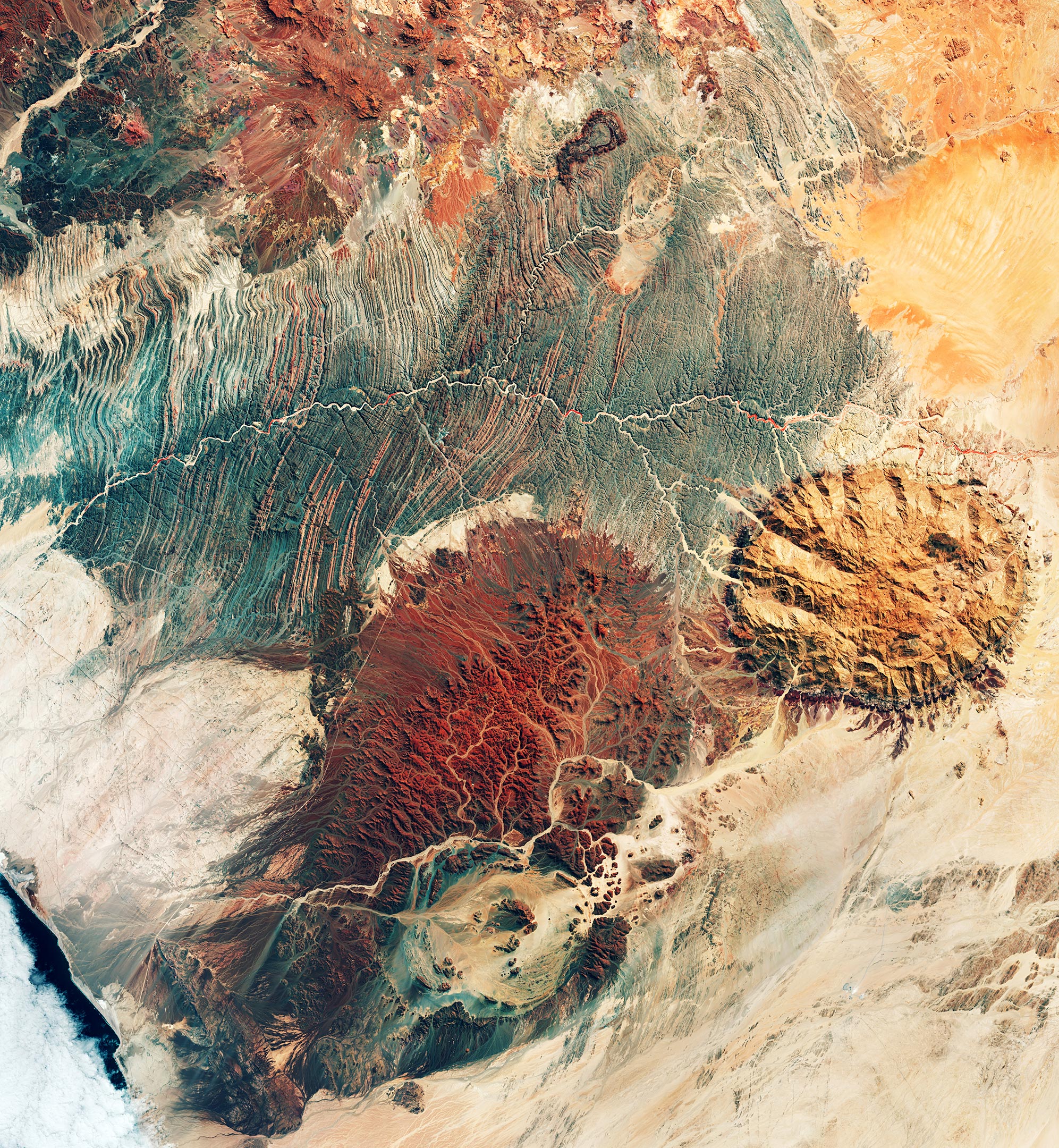
    Copernicus Sentinel-2 satellite image highlights northwest Namibia’s dramatic landscapes and key water sources supporting unique ecosystems. This image reveals northwest Namibia’s arid terrain, including geological formations and the Ugab River, essential for local wildlife. Credit: Contains modified Copernicus Sentinel data (2024), processed by ESA

    The Copernicus Sentinel-2 mission captured a stunning false-color image of northwest Namibia, showcasing the arid landscapes of the Kunene and Erongo regions, emphasized by the near-infrared channel to highlight sparse vegetation. Significant geological features such as the Brandberg Massif and the Zerrissene turbidite system are visible, alongside the ephemeral Ugab River, which supports rare wildlife like the desert elephant.

    This image may resemble the surface of Mars, but it was actually captured by the Copernicus Sentinel-2 mission, revealing the stunning terrain of northwest Namibia.

    The area pictured here includes part of the Kunene and Erongo regions, two of Namibia’s 13 regions. The Ugab River, visible as a winding, white line cutting through the center of the image, clearly marks the border between Kunene (to the north) and Erongo.

    This false-color image was taken in April 2024 and Copernicus Sentinel-2’s near-infrared channel was used to highlight the sparse vegetation of this extremely arid, desert landscape. Red patches of vegetation are discernible along the Ugab’s main course.

    The Ugab is ephemeral, only flowing above the surface of its sandy bed a few days each year. However, its subterranean water serves as an important resource for diverse wildlife, including the rare desert elephant.

    Namibia is renowned not only for its spectacular landscape, but also for offering clues to the history of tectonic plate movement in this part of Africa.

    Several significant geological features dominate this image.

    The circular, light brown formation on the right stands out from the surrounding plane; it is the Brandberg Massif, a granite mountain and, reaching 2500 m, one of the highest points in Namibia. It originated during the Early Cretaceous rifting that led to the opening of the South Atlantic Ocean.

    In the Ugab River valley, the impressive outcrop visible in shades of blue is the Zerrissene turbidite system, comprising folded, sedimentary rocks and spanning nearly 2700 sq km.

    The ring-shaped rim of the Messum Crater can be seen in the bottom center of the image. Contrary to its appearance, the crater was not formed by a meteorite or asteroid impact, rather it’s part of a collapsed volcano. With a diameter of more than 20 km, it consists of two concentric circles of hills surrounding a wide, flat basin.

    Human presence in the area is minimal. Straight, white lines cutting across the landscape are roads, a subtle reminder that this region is not entirely unpopulated.

    Never miss a breakthrough: Join the SciTechDaily newsletter.
    Follow us on Google and Google News.

    European Space Agency Geography
    Share. Facebook Twitter Pinterest LinkedIn Email Reddit

    Related Articles

    Breathtaking View of Andros, Bahamas From Space [Video]

    Stunning Views of Houston Texas From Copernicus Sentinel-1 Satellite

    Earth From Space: Bolivian Highland Heart [Video]

    Flevoland, Netherlands From Space: One of the Largest Land Reclamation Projects in the World

    Earth From Space: Lake George, Uganda – A Center for Biological Diversity [Video]

    Deforestation in Bolivia Spied From Space Satellite

    Earth From Space: Japanese Archipelago [Video]

    Earth From Space: Faroe Islands [Video]

    Earth From Space: Tromsø, Norway [Video]

    Leave A Reply Cancel Reply

    • Facebook
    • Twitter
    • Pinterest
    • YouTube

    Don't Miss a Discovery

    Subscribe for the Latest in Science & Tech!

    Trending News

    Just 3,000 Steps a Day May Help Protect the Brain From Alzheimer’s

    “Weird Clams” Reveal a New Invasion Along the U.S. Northeast Coast

    Archaeologists Decapitated Tutankhamun and Glued His Body Back Together

    New Black Hole Theory Solves a 50-Year-Old Problem

    Researchers Warn Rising CO₂ May Already Be Changing Human Blood Chemistry

    Scientists Discover AI Models May Not Think Like the Brain After All

    Global Cancer Cases Could Surge 67% by 2050, New Report Warns

    New Study Suggests Vitamin C Could Help Prevent Cancer

    Follow SciTechDaily
    • Facebook
    • Twitter
    • YouTube
    • Pinterest
    • Newsletter
    • RSS
    SciTech News
    • Biology News
    • Chemistry News
    • Earth News
    • Health News
    • Physics News
    • Science News
    • Space News
    • Technology News
    Recent Posts
    • Einstein’s “Greatest Blunder” May Be Breaking Cosmology
    • A Century-Old Belief About Diamond Has Just Been Overturned
    • The Universe Can Expand Faster Than Light Without Breaking Physics
    • Healthier Eating Could Trigger a $630 Billion Farming Shake-Up
    • A Hidden Protein-Folding Failure May Help Drive Diabetes
    Copyright © 1998 - 2026 SciTechDaily. All Rights Reserved.
    • Science News
    • About
    • Contact
    • Editorial Board
    • Privacy Policy
    • Terms of Use

    Type above and press Enter to search. Press Esc to cancel.