
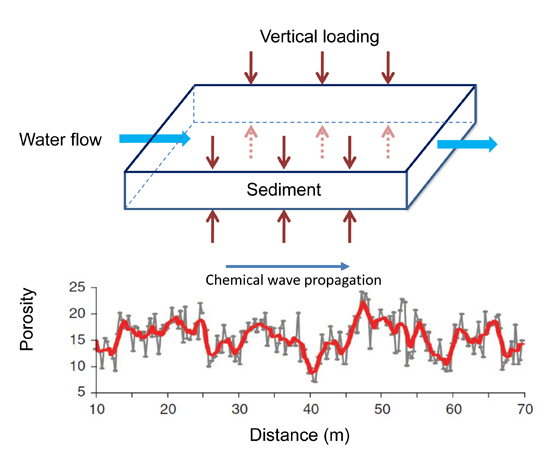
A better understanding of the variety of pore sizes and spatial patterns in strata would allow for more production from underground oil reservoirs and water aquifers. Using the chemical wave concept and equations for material stresses, Sandia geologists formulated a mathematical model that reveals important information about Earth’s geological changes.
ALBUQUERQUE, New Mexico — A Sandia modeling study contradicts a long-held belief of geologists that pore sizes and chemical compositions are uniform throughout a given strata, which are horizontal slices of sedimentary rock.
By understanding the variety of pore sizes and spatial patterns in strata, geologists can help achieve more production from underground oil reservoirs and water aquifers. Better understanding also means more efficient use of potential underground carbon storage sites, and better evaluations of the possible movement of radionuclides in nuclear waste depositories to determine how well the waste will be isolated.
“I think our paper for the first time provides a reasonable explanation for the origin of patterns,” said lead researcher Yifeng Wang. “We found we could predict the variations in pores as well as the heterogeneity of a reservoir.”
The analysis, published on February 21 in Nature Communications, was able to match the field observations published in 2006 by second author David Budd, professor of geological sciences at the University of Colorado at Boulder.
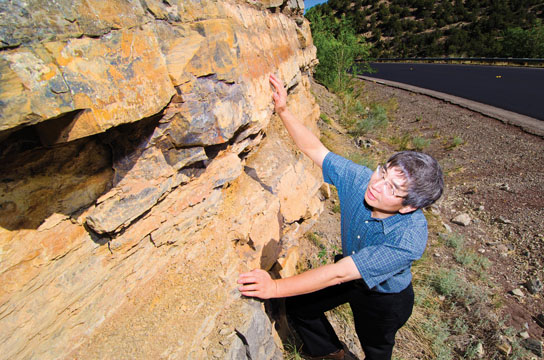
Budd said Wang put together a session at the 2010 annual meeting of the Geochemical Society at which Budd presented field studies of porosity and chemical composition. “He recognized that the data I showed could be explained by stress-induced chemical waves. He subsequently developed the numerical model to test his idea. Then we used the 2006 data set to demonstrate the correspondence between his model’s outcomes and the field data.”
A chemical wave in this context relies upon mineral dissolution and precipitation, powered by geologic stress, to penetrate surrounding material, just as an ocean wave powered by the moon’s gravitational pull rides up on a beach. Ocean waves shift sand; Wang found that chemical waves modify the spatial distribution of rock porosity.
As Wang puts it, a chemical wave is “like water rippling. The concentration of a chemical species varies periodically in space (a standing wave) or sometimes such variations propagate through space (a traveling wave).
“The one we revealed in dolomite (a type of sedimentary rock) may be the largest chemical wave ever known, because no one has thought to look for chemical waves in strata. It occurred on the scale of meters to tens of meters and propagated between a hundred to a thousand years.” Chemical waves are usually observed on much smaller scales in laboratories.
Using the chemical wave concept and well-known equations for material stresses, Wang formulated a mathematical model.
“The remarkable thing is that the model predictions match very well with many seemingly uncorrelated observations. The model predictions not only match the observed porosity patterns, but also match very well with chemical and isotopic signatures. This is the power of mathematical analysis,” Wang said.
Wang’s model isn’t large enough yet to derive equations meaningful to an entire reservoir — a process called upscaling. Still, he said, “Another way to capture this variability is to use mathematical analysis to derive upscaled flow-transport equations. This work is on the way.”
The work may help trounce geologists’ belief that each layer of sedimentary rock, deposited over eons, is more or less homogenous in porosity and composition. Thus a single core sample obtained from a given depth was thought to chemically represent the entire layer.
But Budd’s findings showed that horizontal variations within a layer of sedimentary rock could be quite significant — in some cases, as large as vertical variations. This would affect not only the amount of fluid stored or percolating through a rock but the amount of pressure needed to shoot liquids to Earth’s surface. No one knew why these variations occurred, nor had anyone measured their magnitude.
The problem has always been how to extend horizontally the knowledge gained from vertical boreholes that may be 1,300 feet (400 meters)apart, Budd said.
Wang’s model also reveals important information about Earth’s geological changes.
“Even the shape of a variation may reveal important facts about past times,” he said. “Our work may have geologists rethinking their method of field sampling and their interpretation of data about Earth’s evolution.”
Reference: “Stress-induced chemical waves in sediment burial diagenesis” by Yifeng Wang and David A. Budd, 21 February 2012, Nature Communications.
DOI: 10.1038/ncomms1684
The work was supported by Sandia’s Laboratory Directed Research and Development program and by industrial supporters of the AVID (analysis of variability in dolomites) consortium.
Never miss a breakthrough: Join the SciTechDaily newsletter.
Follow us on Google and Google News.