
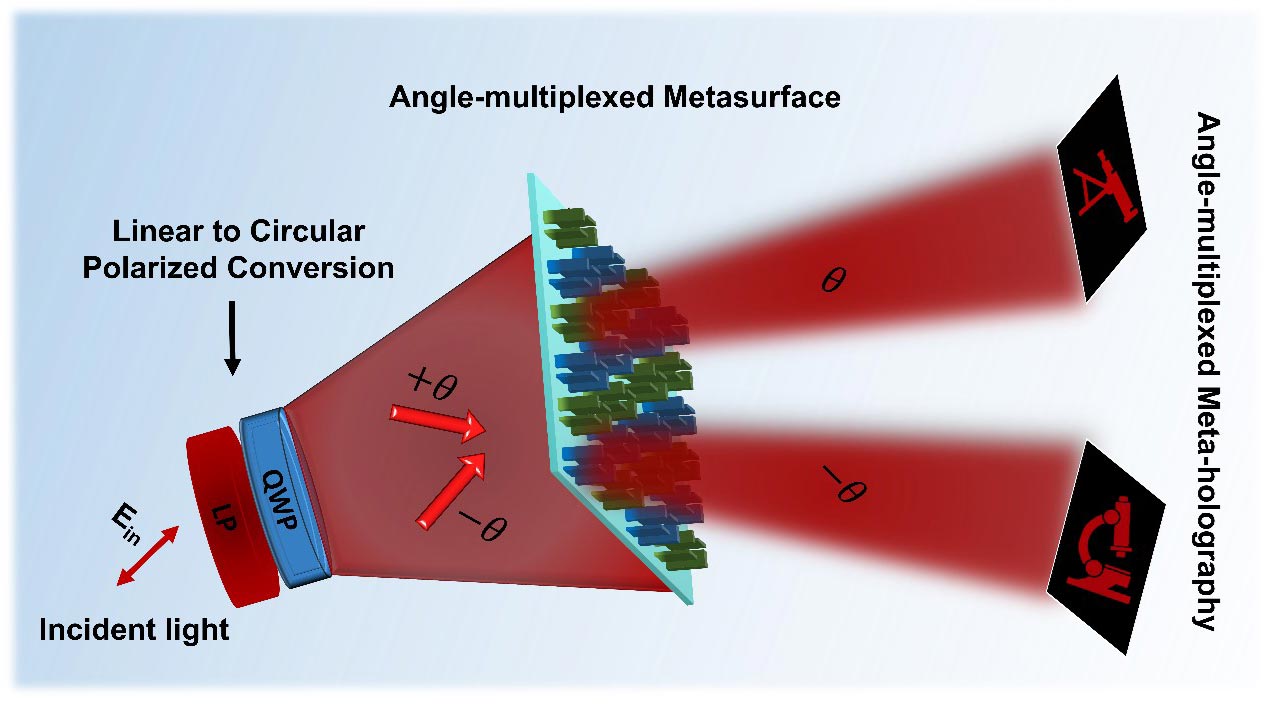
POSTECH’s new metasurface display technology projects angle-dependent holograms, enhancing virtual and augmented reality experiences.
The expression “flawless from every angle” is commonly used to characterize a celebrity’s appearance. This doesn’t simply imply that they appear attractive from a specific viewpoint, but rather that their appeal remains consistent and appealing from various angles and perspectives. Recently, a research team from Pohang University of Science and Technology (POSTECH) has employed metasurface to fabricate angle-dependent holograms with multiple functions, capturing significant interest within the academic community.
Breakthrough in Display Technology by POSTECH
A research team comprising Professor Junsuk Rho from the Department of Mechanical Engineering and the Department of Chemical Engineering and PhD candidate Joohoon Kim from the Department of Mechanical Engineering at the POSTECH created metasurface display technology. This technology allows holograms to display multiple images based on the observer’s viewing angle. The findings were recently published in Nano Letters, an international journal focusing on nanoscale research and applications.
Objects can appear distinct depending on the viewer’s position, a concept that can be harnessed in holographic technology to generate cinematic and realistic 3D holograms presenting different images based on the viewing angle. However, the current challenge lies in controlling light dispersion according to the angle, making the application of nano-optics in this context a complex endeavor.
Metasurface: A Solution to Angle-Dependent Imaging
The team addressed this challenge by leveraging metasurfaces, artificial nanostructures capable of precisely manipulating the characteristics of light. These metasurfaces are incredibly thin and lightweight, approximately one-hundredth the thickness of a human hair, making them promising for applications in miniaturized displays such as virtual and augmented reality devices. Through the use of metasurfaces, the team devised a system that controls light to convey only a specific phase of information at a given angle, resulting in diverse images based on the angle of incidence.
In their experiments, the team’s metasurface generated distinct 3D holographic images at angles of both +35˚ and -35˚ for left-circular polarization. Remarkably, the team achieved the production of different images for incident light by using a single metasurface, contingent on the specific polarization. Notably, the holographic display demonstrated an extensive viewing angle of 70 degrees (±35 degrees), enabling observers to perceive the three-dimensional hologram from various directions.
Professor Junsuk Rho who led the research explained, “We have successfully achieved an effective display from diverse angles.” He added, “We anticipate this technology will make significant contributions to the commercialization of technology in virtual and augmented reality displays, encrypted imaging, information storage, and other applications.”
Reference: “Spin-Selective Angular Dispersion Control in Dielectric Metasurfaces for Multichannel Meta-Holographic Displays” by Sabiha Latif, Joohoon Kim, Hafiz Saad Khaliq, Nasir Mahmood, Muhammad Afnan Ansari, Xianzhong Chen, Jehan Akbar, Trevon Badloe, Muhammad Zubair, Yehia Massoud, Muhammad Qasim Mehmood and Junsuk Rho, 2 January 2024, Nano Letters.
DOI: 10.1021/acs.nanolett.3c04064
The study was conducted with the support from the program of POSCO-POSTECH-RIST Convergence Research Center program, the STEAM Research Program of the National Research Foundation of Korea funded by the Ministry of Science and ICT, and the Alchemist fellowship of the Ministry of Trade, Industry and Energy.
Never miss a breakthrough: Join the SciTechDaily newsletter.
Follow us on Google and Google News.
1 Comment
The most informative and interesting blogs. Keep them coming.