
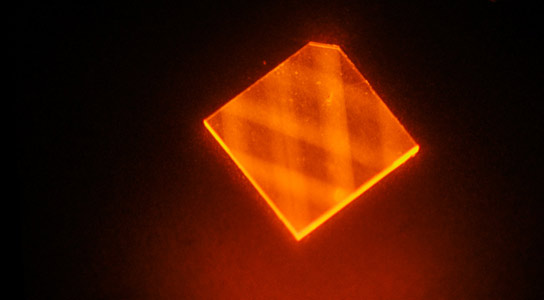
Engineers at MIT have developed a new, ultrasensitive magnetic-field detector that is 1,000 times more energy-efficient than its predecessors. The detectors could lead to better sensors for medical imaging and contraband detection.
Magnetic-field detectors, or magnetometers, are already used for all those applications. But existing technologies have drawbacks: Some rely on gas-filled chambers; others work only in narrow frequency bands, limiting their utility.
Synthetic diamonds with nitrogen vacancies (NVs) — defects that are extremely sensitive to magnetic fields — have long held promise as the basis for efficient, portable magnetometers. A diamond chip about one-twentieth the size of a thumbnail could contain trillions of nitrogen vacancies, each capable of performing its own magnetic-field measurement.
The problem has been aggregating all those measurements. Probing a nitrogen vacancy requires zapping it with laser light, which it absorbs and re-emits. The intensity of the emitted light carries information about the vacancy’s magnetic state.
“In the past, only a small fraction of the pump light was used to excite a small fraction of the NVs,” says Dirk Englund, the Jamieson Career Development Assistant Professor in Electrical Engineering and Computer Science and one of the designers of the new device. “We make use of almost all the pump light to measure almost all of the NVs.”
The MIT researchers report their new device in the latest issue of Nature Physics. First author on the paper is Hannah Clevenson, a graduate student in electrical engineering who is advised by senior authors Englund and Danielle Braje, a physicist at MIT Lincoln Laboratory. They’re joined by Englund’s students Matthew Trusheim and Carson Teale (who’s also at Lincoln Lab) and by Tim Schröder, a postdoc in MIT’s Research Laboratory of Electronics.
Telling absence
A pure diamond is a lattice of carbon atoms, which don’t interact with magnetic fields. A nitrogen vacancy is a missing atom in the lattice, adjacent to a nitrogen atom. Electrons in the vacancy do interact with magnetic fields, which is why they’re useful for sensing.
When a light particle — a photon — strikes an electron in a nitrogen vacancy, it kicks it into a higher energy state. When the electron falls back down into its original energy state, it may release its excess energy as another photon. A magnetic field, however, can flip the electron’s magnetic orientation, or spin, increasing the difference between its two energy states. The stronger the field, the more spins it will flip, changing the brightness of the light emitted by the vacancies.
Making accurate measurements with this type of chip requires collecting as many of those photons as possible. In previous experiments, Clevenson says, researchers often excited the nitrogen vacancies by directing laser light at the surface of the chip.
“Only a small fraction of the light is absorbed,” she says. “Most of it just goes straight through the diamond. We gain an enormous advantage by adding this prism facet to the corner of the diamond and coupling the laser into the side. All of the light that we put into the diamond can be absorbed and is useful.”
Covering the bases
The researchers calculated the angle at which the laser beam should enter the crystal so that it will remain confined, bouncing off the sides — like a tireless cue ball ricocheting around a pool table — in a pattern that spans the length and breadth of the crystal before all of its energy is absorbed.
“You can get close to a meter in path length,” Englund says. “It’s as if you had a meter-long diamond sensor wrapped into a few millimeters.” As a consequence, the chip uses the pump laser’s energy 1,000 times as efficiently as its predecessors did.
Because of the geometry of the nitrogen vacancies, the re-emitted photons emerge at four distinct angles. A lens at one end of the crystal can collect 20 percent of them and focus them onto a light detector, which is enough to yield a reliable measurement.
“NV centers are very nice to work with,” says Frank Narducci, a physicist at the U.S. Naval Air Systems Command. “You just have this little solid-state sample. You don’t have to do anything to it. You don’t have to put it in a vacuum. You don’t have to cryogenically cool it. To get them excited, you can just use a green laser — a laser pointer is good enough. You don’t have to have anything super-fancy in the way of stabilized lasers.”
“What’s cool about this is that they’re using the sample itself kind of like a waveguide, to bounce the light around,” he continues. “Their sample is quite small. Because the laser doesn’t have to be anything particularly special, that could be small, too. So you could envision very small magnetometers. And correspondingly, you could make them very cheap.”
“From a Navy perspective,” he adds, “we talk about throwaway magnetometers a lot, where you might be flying over some area of the ocean and you want to make some measurements, so you just throw a handful of these out. If you get a really high-sensitivity magnetometer that’s really cheap, that would be one really good application for it.”
Reference: “Broadband magnetometry and temperature sensing with a light-trapping diamond waveguide” by Hannah Clevenson, Matthew E. Trusheim, Carson Teale, Tim Schröder, Danielle Braje and Dirk Englund, 6 April 2015, Nature Physics.
DOI: 10.1038/nphys3291
arXiv: 1406.5235
Never miss a breakthrough: Join the SciTechDaily newsletter.
Follow us on Google and Google News.