
Cooperativity in organic semiconductors may enhance the performance of smartwatches, solar cells, and other organic electronics.
The virus responsible for E. coli infection has a secret weapon: teamwork.
Always scrappy in its bid for survival, the virus alights on an unassuming host cell and grips the surface with the business end of its tubular tail. Then, the proteins in the tail contract in unison, flattening its structure like a stepped-on spring and reeling the virus’s body in for the critical strike.
Thanks to the proteins’ teamwork, the tail can flex and flatten with ease. This process, called molecular cooperativity, is often observed in nature but rarely seen in non-living systems.
Bringing Life to Semiconductors
Researchers at the Beckman Institute for Advanced Science and Technology discovered a way to trigger this cooperative behavior in organic semiconductors. The energy- and time-saving phenomenon may help enhance the performance of smartwatches, solar cells, and other organic electronics.
Their work will be published today (March 21) in the journal Nature Communications.
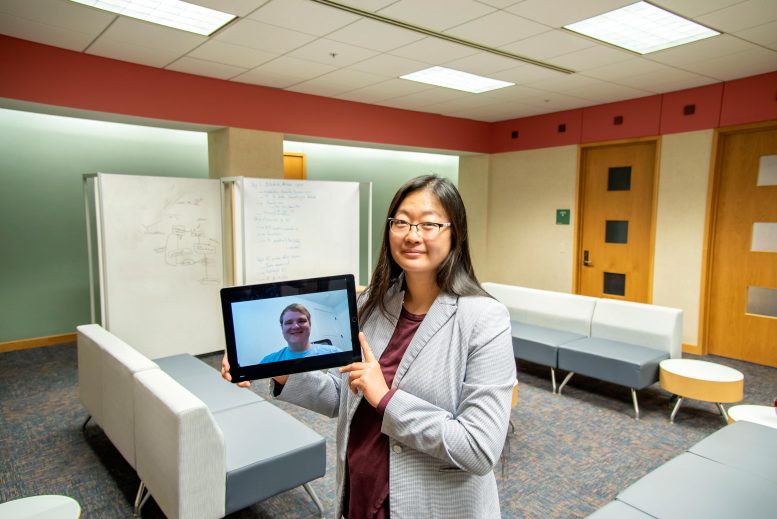
“Our research brings semiconductors to life by unlocking the same dynamic qualities that natural organisms like viruses use to adapt and survive,” said Ying Diao, a researcher at the Beckman Institute and a coauthor of the study.
Viruses may have mastered molecular cooperativity, but the same cannot be said of crystals: non-living molecular structures classified by their symmetry. Though aesthetically pleasing, the molecules that comprise crystalline structures have diva-like dispositions and seldom work together. Instead, they test researchers’ patience by plodding through structural transitions one molecule at a time — a process famously demonstrated by diamonds growing from carbon, which demands blistering heat, intense pressure, and thousands of years sequestered deep beneath the earth.
“Imagine taking down an elaborate domino display brick by brick. It’s exhausting and laborious, and once you’ve finished, you would most likely not have the energy to try it again,” said Daniel Davies, the study’s lead author and a researcher at the Beckman Institute at the time of the study.
By contrast, cooperative transitions occur when molecules shift their structure in synchrony, like a row of dominoes flowing seamlessly to the floor. The collaborative method is fast, energy-efficient, and easily reversible — it’s why the virus responsible for E. coli infection can tirelessly contract its protein-packed tail with little energy lost.
Harnessing Molecular Teamwork for Electronics
For a long time, researchers have struggled to replicate this cooperative process in non-living systems to reap its time- and energy-saving benefits. This problem was of particular interest to Diao and Davies, who wondered how molecular teamwork might impact the electronics sector.
“Molecular cooperativity helps living systems operate quickly and efficiently,” Davies said. “We thought, ‘If the molecules in electronic devices worked together, could those devices display those same benefits?'”
Diao and Davies study organic electronic devices, which rely on semiconductors made from molecules like hydrogen and carbon rather than inorganic ones like silicon, a ubiquitous ingredient in the laptops, desktops, and smart devices saturating the market today.
“Since organic electronics are made from the same basic elements as living beings, like people, they unlock many new possibilities for applications,” said Diao, who is also an associate professor of chemical and biological engineering at the University of Illinois Urbana-Champaign. “In the future, organic electronics might be able to attach to our brains to enhance cognition or, be worn like a Band-aid to convert our body heat into electricity.”
Diao studies the design of solar cells: wafer-thin window clings that soak up sunlight to convert into electricity. Organic semiconductors that can flex without breaking and contour to human skin would likewise be “an important part of the future of organic electronic devices,” Davies said.
It’s a bright future indeed, but an important step toward designing dynamic organic electronics like these is fashioning dynamic organic semiconductors. And for that to happen, the semiconductor molecules must cooperate.
Domino Effect: Triggering Cooperation in Semiconductors
Dominoes inspired the researchers’ approach to trigger molecular teamwork in a semiconductor crystal. They discovered that rearranging the clusters of hydrogen and carbon atoms spooling out from a molecule’s core — otherwise known as alkyl chains — causes the molecular core itself to tilt, triggering a crystal-wide chain of collapse the researchers refer to as an “avalanche.”
“Just like dominoes, the molecules don’t move from where they are fixed. Only their tilt changes,” Davies said.
But tilting a string of molecules is neither as easy nor as tactile as picking up a domino and rotating it 90 degrees. On a scale much smaller than a plastic game piece, the researchers gradually applied heat to the molecule’s alkyl chain; the increased temperature induced the domino-like effect.
Using heat to rearrange the molecules’ alkyl chains also caused the crystal itself to shrink — just like the virus’s tail prior to E. coli infection. In an electronic device, this property translates to an easy, temperature-induced on-off switch.
The applications of this discovery have yet to be fully realized; for now, the researchers are thrilled with the first step.
“The most exciting part was being able to observe how these molecules are changing and how their structure is evolving throughout these transitions,” Davies said.
Reference: “Unraveling two distinct polymorph transition mechanisms in one n-type single crystal for dynamic electronics” by Daniel William Davies, Bumjoon Seo, Sang Kyu Park, Stephen B. Shiring, Hyunjoong Chung, Prapti Kafle, Dafei Yuan, Joseph W. Strzalka, Ralph Weber, Xiaozhang Zhu, Brett M. Savoie and Ying Diao, 21 March 2023, Nature Communications.
DOI: 10.1038/s41467-023-36871-9
Unlocking the potential of molecular collaboration was possible through teamwork on an international scale, with contributing researchers hailing from Purdue University, the Chinese Academy of Sciences, and Argonne National Laboratory. Raman spectroscopy was conducted in the Beckman Institute Microscopy Suite.
Never miss a breakthrough: Join the SciTechDaily newsletter.
Follow us on Google and Google News.