
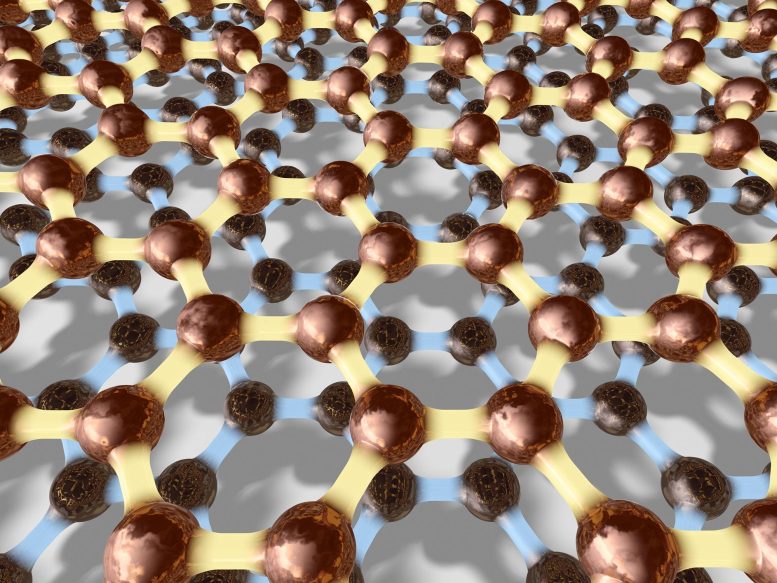
Just recently Rice University shared news of their 2-D Boron Nanotubes that have advantages over carbon nanotubes and now scientists at MIT have found another compound made from a thin film of bismuth-antimony that shares similarities and complementary properties to graphene.
Graphene, a single-atom-thick layer of carbon, has spawned much research into its unique electronic, optical, and mechanical properties. Now, researchers at MIT have found another compound that shares many of graphene’s unusual characteristics — and in some cases has interesting complementary properties to this much-heralded material.
The material, a thin film of bismuth-antimony, can have a variety of different controllable characteristics, the researchers found, depending on the ambient temperature and pressure, the material’s thickness and the orientation of its growth. The research, carried out by materials science and engineering PhD candidate Shuang Tang and Institute Professor Mildred Dresselhaus, appears in the journal Nano Letters.
Like graphene, the new material has electronic properties that are known as two-dimensional Dirac cones, a term that refers to the cone-shaped graph plotting energy versus momentum for electrons moving through the material. These unusual properties — which allow electrons to move in a different way than is possible in most materials — may give the bismuth-antimony films properties that are highly desirable for applications in manufacturing next-generation electronic chips or thermoelectric generators and coolers.

In such materials, Tang says, electrons “can travel like a beam of light,” potentially making possible new chips with much faster computational abilities. The electron flow might in some cases be hundreds of times faster than in conventional silicon chips, he says.
Similarly, in a thermoelectric application — where a temperature difference between two sides of a device creates a flow of electrical current — the much faster movement of electrons, coupled with strong thermal insulating properties, could enable much more efficient power production. This might prove useful in powering satellites by exploiting the temperature difference between their sunlit and shady sides, Tang says.
Such applications remain speculative at this point, Dresselhaus says, because further research is needed to analyze additional properties and eventually to test samples of the material. This initial analysis was based mostly on theoretical modeling of the bismuth-antimony film’s properties.
Until this analysis was carried out, Dresselhaus says, “we never thought of bismuth” as having the potential for Dirac cone properties. But recent unexpected findings involving a class of materials called topological insulators suggested otherwise: Experiments carried out by a Ukrainian collaborator suggested that Dirac cone properties might be possible in bismuth-antimony films.
While it turns out that the thin films of bismuth-antimony can have some properties similar to those of graphene, changing the conditions also allows a variety of other properties to be realized. That opens up the possibility of designing electronic devices made of the same material with varying properties, deposited one layer atop another, rather than layers of different materials.
The material’s unusual properties can vary from one direction to another: Electrons moving in one direction might follow the laws of classical mechanics, for example, while those moving in a perpendicular direction obey relativistic physics. This could enable devices to test relativistic physics in a cheaper and simpler way than existing systems, Tang says, although this remains to be shown through experiments.
“Nobody’s made any devices yet” from the new material, Dresselhaus cautions, but adds that the principles are clear and the necessary analysis should take less than a year to carry out.
“Anything can happen, we really don’t know,” Dresselhaus says. Such details remain to be ironed out, she says, adding: “Many mysteries remain before we have a real device.”
Joseph Heremans, a professor of physics at Ohio State University who was not involved in this research, says that while some unusual properties of bismuth have been known for a long time, “what is surprising is the richness of the system calculated by Tang and Dresselhaus. The beauty of this prediction is further enhanced by the fact that system is experimentally quite accessible.”
Heremans adds that in further research on the properties of the bismuth-antimony material, “there will be difficulties, and a few are already known,” but he says the properties are sufficiently interesting and promising that “this paper should stimulate a large experimental effort.”
Reference: “Constructing Anisotropic Single-Dirac-Cones in Bi1–xSbx Thin Films” by Shuang Tang and Mildred S. Dresselhaus, 20 March 2012, Nano Letters.
DOI: 10.1021/nl300064d
The work was funded by a grant from the U.S. Air Force Office of Scientific Research.
Never miss a breakthrough: Join the SciTechDaily newsletter.
Follow us on Google and Google News.