
Close Menu
    Facebook X (Twitter) Instagram
    SciTechDaily
    • Biology
    • Chemistry
    • Earth
    • Health
    • Physics
    • Science
    • Space
    • Technology
    Facebook X (Twitter) Pinterest YouTube RSS
    SciTechDaily
    Home»Space»Images From ESA’s Mars Express Reveals the Features of Ladon Basin
    Space

    Images From ESA’s Mars Express Reveals the Features of Ladon Basin

    By European Space AgencyAugust 2, 2012No Comments4 Mins Read
    Facebook Twitter Pinterest Telegram LinkedIn WhatsApp Email Reddit
    Share
    Facebook Twitter LinkedIn Pinterest Telegram Email Reddit
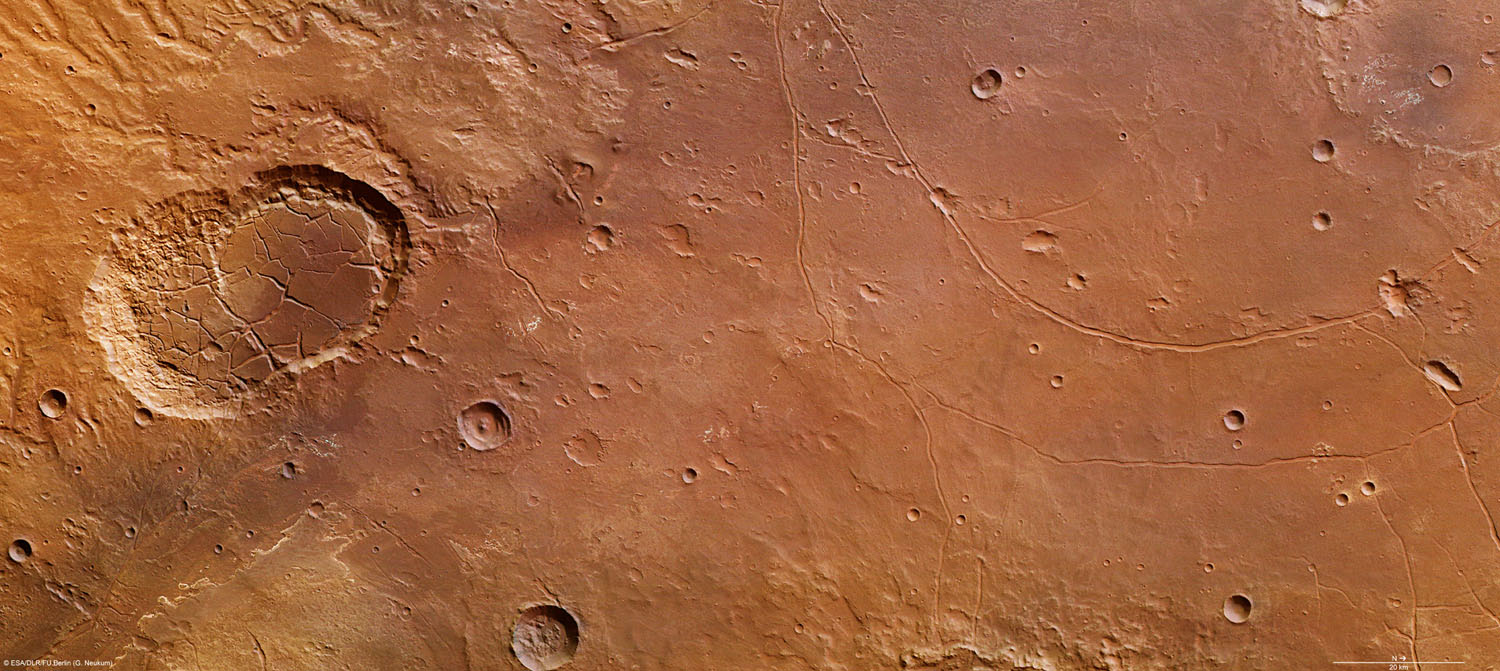
    Ladon basin in full color
    High-Resolution Stereo Camera (HRSC) nadir and color channel data taken during revolution 10602 on April 27, 2012, by ESA’s Mars Express have been combined to form a natural-color view of the Ladon Valles region. Centered at around 18°S and 329°E, this image has a ground resolution of about 20 m per pixel. The image shows the interconnected craters Sigli and Shambe, believed to have formed when a large meteorite fragmented into two pieces just before impact. Extensive fracturing can be seen within the craters. Above the craters (west), creek-like flow channels can be seen leading into the wider impact basin region to the right (north). Credit: ESA/DLR/FU Berlin (G. Neukum)

    New images from the high-resolution stereo camera on ESA’s Mars Express reveal a variety of features of several impact craters and their surrounding areas on Mars.

    ESA’s Mars Express has observed the southern part of a partially buried approximately 440 km (270 mi) wide crater, informally named Ladon basin.

    The images, near to where Ladon Valles enters this large impact region reveal a variety of features, most notably the double interconnected impact craters Sigli and Shambe, the basins of which are crisscrossed by extensive fracturing.

    This region, imaged on April 27 by the high-resolution stereo camera on Mars Express is of great interest to scientists since it shows significant signs of ancient lakes and rivers.

    Both Holden and Eberswalde Craters were on the final shortlist of four candidate landing sites for NASA’s Mars Science Laboratory, which is due now to land in Gale Crater on August 6.

    Large-scale overview maps show clear evidence that vast volumes of water once flowed from the southern highlands. This water carved Ladon Valles, eventually flowing into Ladon basin, an ancient large impact region.
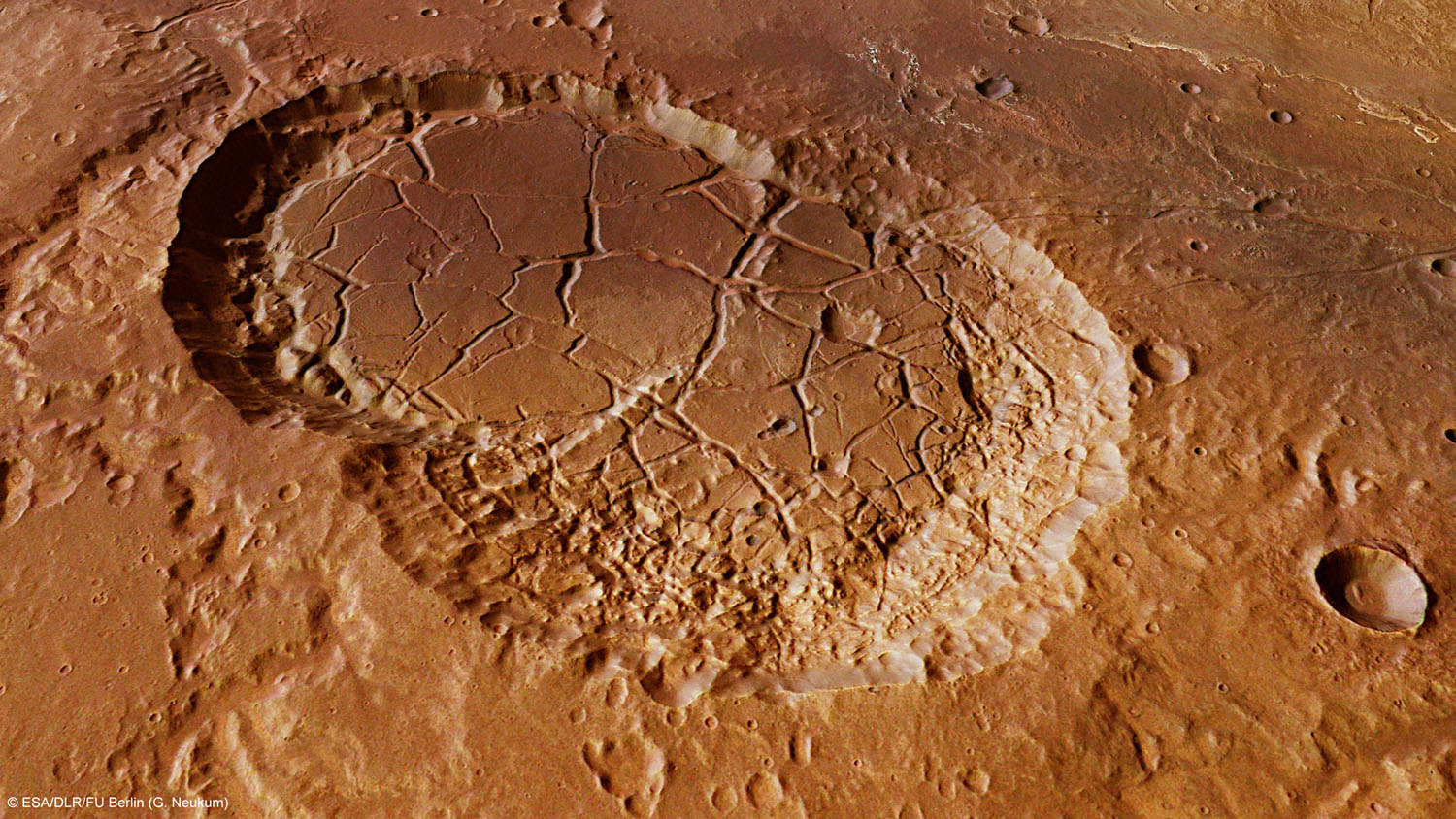
    computer-generated perspective view ladon basin
    This computer-generated perspective view was created using data obtained from the High-Resolution Stereo Camera (HRSC) on ESA’s Mars Express. Centered at around 18°S and 329°E, this image has a ground resolution of about 20 m per pixel. Sigli and Shambe dominate this image, which highlights the deep fracturing within the crater walls. The shape of the craters leads scientists to believe they were formed from the same impactor, which fragmented into two pieces just before hitting Mars. Credit: ESA/DLR/FU Berlin (G. Neukum)

    Elliptical craters like this 16 km-wide (10 mi-wide) example are formed when asteroids or comets strike the surface of the planet at a shallow angle.

    Scientists have suggested that a fluidized ejecta pattern indicates the presence of subsurface ice that melted during the impact. Subsequent impacts have created a number of smaller craters in the ejecta blanket.

    The interconnected craters Sigli and Shambe are thought to have formed later when an incoming projectile split into two pieces just before impact. The joined craters were then partly filled with sediments at some later epoch.
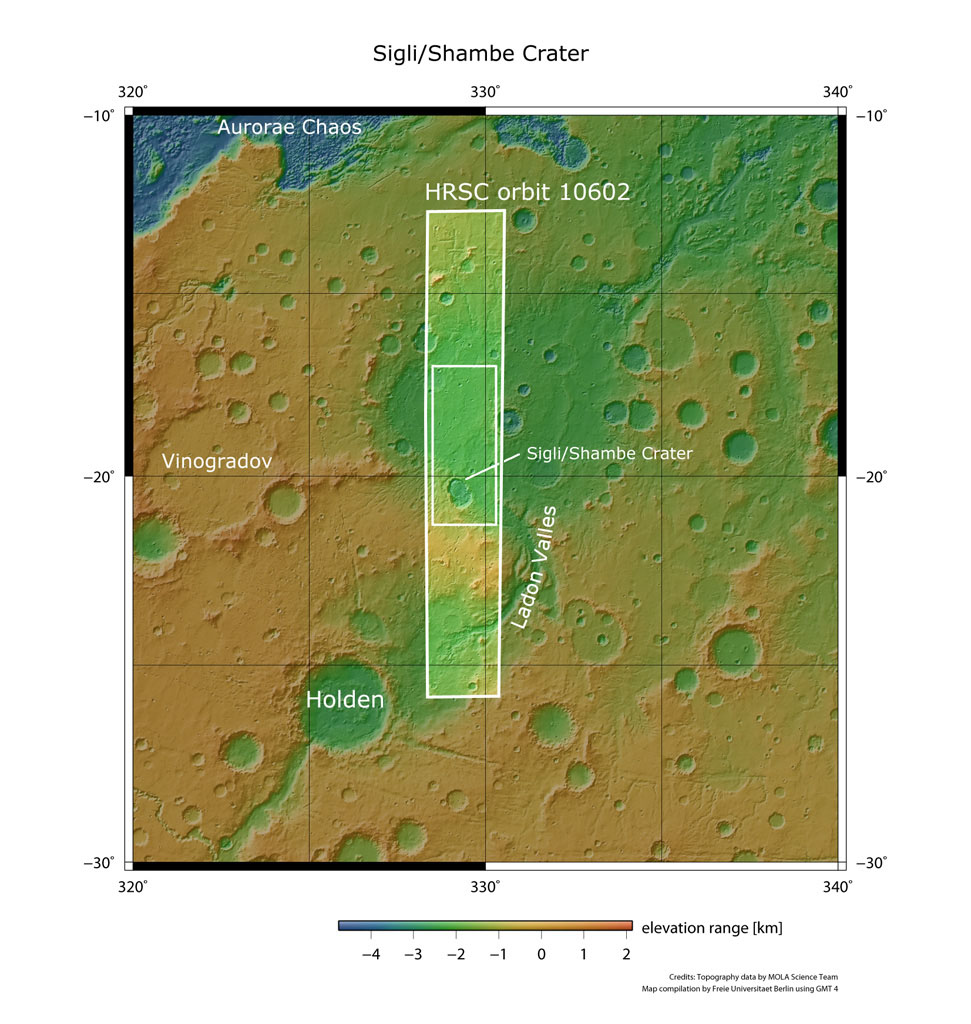
    Ladon basin is seen here in broader context
    Ladon basin is seen here in a broader context. The smaller rectangle shows the region covered in this ESA Mars Express HRSC image release. Ladon Valles, which flows into Ladon basin, is north of the well-known craters Holden and Eberswalde, which were potential landing-site candidates for NASA’s Mars Science Laboratory. Credit: NASA MGS MOLA Science Team

    Deep fractures can be seen within the craters whilst in the central and right part of the image, smaller craters and more subtle curved fractures appear. These fractures on the basin floor extend beyond the image borders and form concentric patterns. The fractures are believed to have evolved by compaction of the huge sediment loads deposited within the impact basin.

    The outflow of Ladon Valles into Ladon basin is located towards the east of Sigli and Shambe Craters, towards the bottom of this image. Here, and in several other parts of the image, lighter-toned layered deposits can be seen. Researchers have detected clay minerals within these deposits, suggesting a relatively long-lasting presence of liquid water in the region’s past.
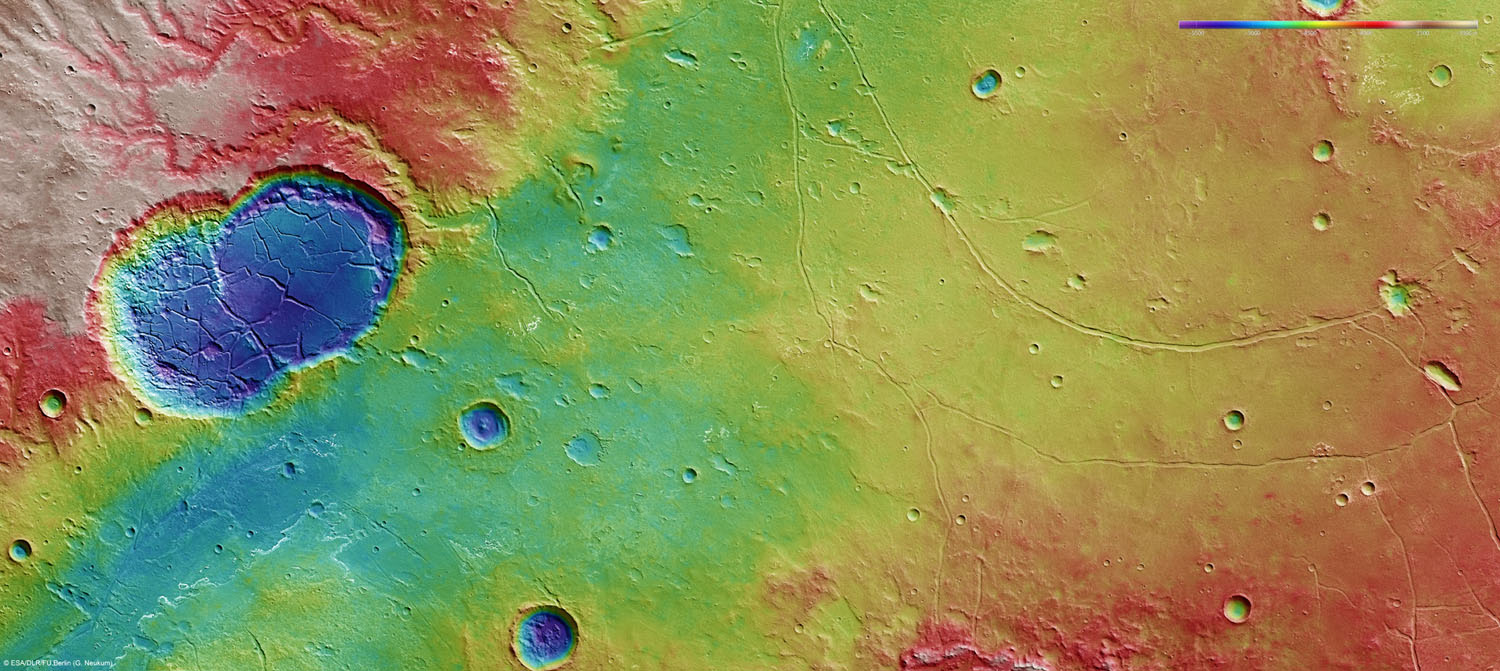
    color coded plan view of Ladon Basin
    This color-coded plan view is based on a digital terrain model of the region, from which the topography of the landscape can be derived. The color coding brings into stark relief the fracturing inside Sigli and Shambe and the winding flow channels above (west) of the craters leading into the relatively flat impact basin. Centered at around 18°S and 329°E, the image has a ground resolution of about 20 m per pixel. Credit: ESA/DLR/FU Berlin (G. Neukum)

    In addition, winding, valley-like dendritic structures running into the larger basin can be seen above Sigli and Shambe Craters, running into the larger impact basin, again indicating flowing water at some distant epoch.

    Never miss a breakthrough: Join the SciTechDaily newsletter.
    Follow us on Google and Google News.

    Astronomy European Space Agency Mars Popular
    Share. Facebook Twitter Pinterest LinkedIn Email Reddit

    Related Articles

    Unique Green Glow Spotted on Mars – First Time Around a Planet Other Than Earth

    Color HiRISE Image of Curiosity Rover on Mars

    Curiosity’s First Color Image of Mars

    A Connection Between Volatiles in the Subsurface of Mars and the Impact Process

    Mission Engineers Prepare for Curiosity’s Landing on Mars

    Herschel Image of the Vela C Region

    CO2 Snow Particles on Mars Are About the Size of Red Blood Cells

    High-Energy UV Radiation Triggers Methane on Mars

    ESA’s Mars Express MARSIS Radar Explores Martian Oceans

    Leave A Reply Cancel Reply

    • Facebook
    • Twitter
    • Pinterest
    • YouTube

    Don't Miss a Discovery

    Subscribe for the Latest in Science & Tech!

    Trending News

    Popular Sugar-Free Sweetener Linked to Liver Disease, Study Warns

    What Is Hantavirus? The Deadly Disease Raising Alarm Worldwide

    Scientists Just Discovered How the Universe Builds Monster Black Holes

    Scientists Unveil New Treatment Strategy That Could Outsmart Cancer

    A Simple Vitamin May Hold the Key to Treating Rare Genetic Diseases

    Scientists Think the Real Fountain of Youth May Be Hiding in Your Gut

    Ravens Don’t Follow Wolves, They Predict Them

    This Common Knee Surgery May Be Doing More Harm Than Good

    Follow SciTechDaily
    • Facebook
    • Twitter
    • YouTube
    • Pinterest
    • Newsletter
    • RSS
    SciTech News
    • Biology News
    • Chemistry News
    • Earth News
    • Health News
    • Physics News
    • Science News
    • Space News
    • Technology News
    Recent Posts
    • Why Are So Many New Fathers Dying? Scientists Say the U.S. Has a Dangerous Blind Spot
    • Scientists Identify Simple Supplement That Greatly Reduces Alzheimer’s Damage
    • You May Have a Dangerous Type of Cholesterol Even if Your Tests Look Normal
    • Study Reveals Dangerous Flaw in AI Symptom Checkers
    • New MRI Breakthrough Captures Stunningly Clear Images of the Eye and Brain
    Copyright © 1998 - 2026 SciTechDaily. All Rights Reserved.
    • Science News
    • About
    • Contact
    • Editorial Board
    • Privacy Policy
    • Terms of Use

    Type above and press Enter to search. Press Esc to cancel.