
Close Menu
    Facebook X (Twitter) Instagram
    SciTechDaily
    • Biology
    • Chemistry
    • Earth
    • Health
    • Physics
    • Science
    • Space
    • Technology
    Facebook X (Twitter) Pinterest YouTube RSS
    SciTechDaily
    Home»Space»Astronomers Complete the Largest Census of Dust in the Local Universe
    Space

    Astronomers Complete the Largest Census of Dust in the Local Universe

    By Royal Astronomical SocietyMarch 18, 2014No Comments4 Mins Read
    Facebook Twitter Pinterest Telegram LinkedIn WhatsApp Email Reddit
    Share
    Facebook Twitter LinkedIn Pinterest Telegram Email Reddit
    Astronomers Complete the Largest Census of Dust in the Local Universe
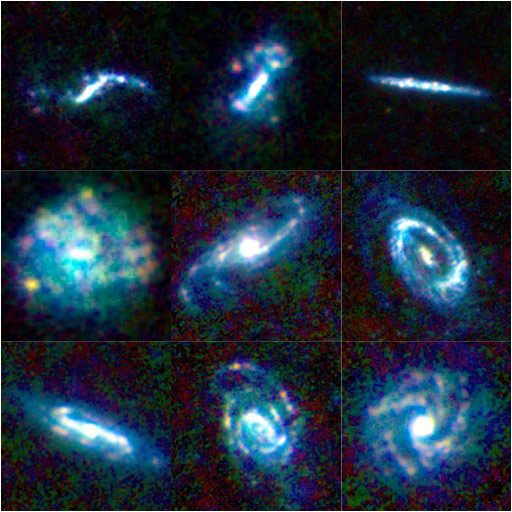
    Galaxies in the Herschel Reference Survey. The images are presented in false color to highlight different dust temperatures, with blue and red representing colder and warmer regions respectively. Credit: ESA/Herschel/HRS-SAG2 and HeViCS Key Programmes/L. Cortese (Swinburne University)

    Using data from the Herschel satellite, astronomers completed the largest census of dust in the local Universe, the Herschel Reference Survey.

    An international team of astronomers has completed a benchmark study of more than 300 galaxies, producing the largest census of dust in the local Universe, the Herschel Reference Survey. Led by Dr. Luca Cortese from Swinburne University of Technology in Melbourne, Australia, the team used the Herschel Space Observatory to observe galaxies at far‐infrared and sub‐millimeter wavelengths and captured the light directly emitted by dust grains. The results appear in the journal Monthly Notices of the Royal Astronomical Society.

    “These dust grains are believed to be fundamental ingredients for the formation of stars and planets, but until now very little was known about their abundance and physical properties in galaxies other than our own Milky Way,” said Dr. Cortese.

    “Cosmic dust is heated by starlight to temperatures of only a few tens of degrees above absolute zero, and can thus be only seen at far‐infrared/sub‐millimeter wavelengths.”
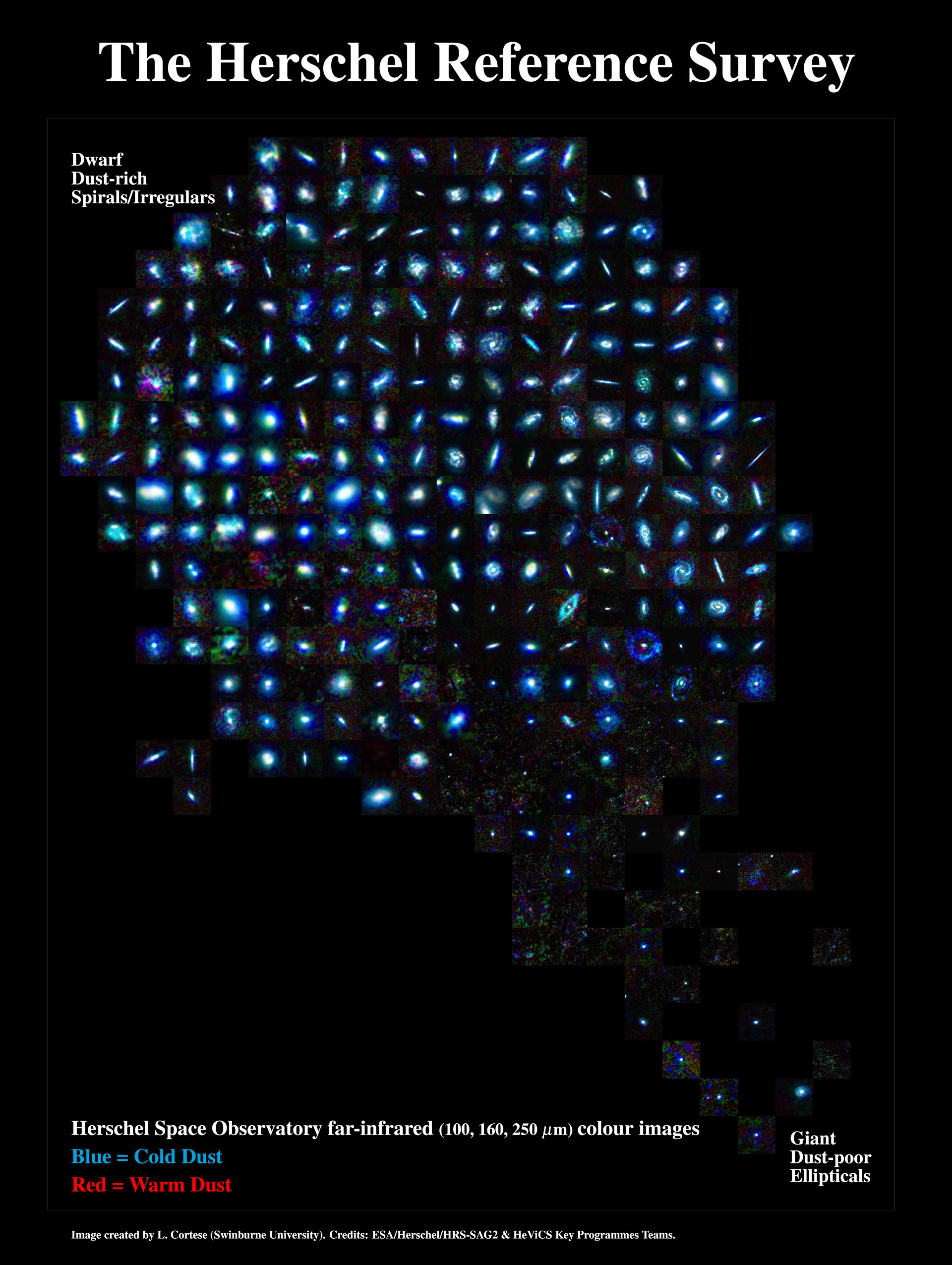
    The Herschel Reference Survey at infrared wavelengths. Collage of galaxies in the Herschel Reference Survey, the largest census of cosmic dust in the local Universe. The galaxies are presented in false-color to highlight different dust temperatures, with blue and red representing colder and warmer regions respectively. The collage is presented with dust-rich, spiral and irregular galaxies in the top left, and giant, dust-poor elliptical galaxies in the bottom-right. The images were composed from PACS and SPIRE observations at 100, 160 and 250 micron. Credit: ESA/Herschel/HRS-SAG2 and HeViCS Key Programmes/L. Cortese (Swinburne University)

    The two cameras on board the Herschel satellite, SPIRE and PACS, allowed astronomers to probe different frequencies of dust emission, which bear imprints on the physical properties of the grains and therefore were critical for this study. Although the SPIRE data were obtained three years ago, the team had to wait for the completion of the PACS survey last year.
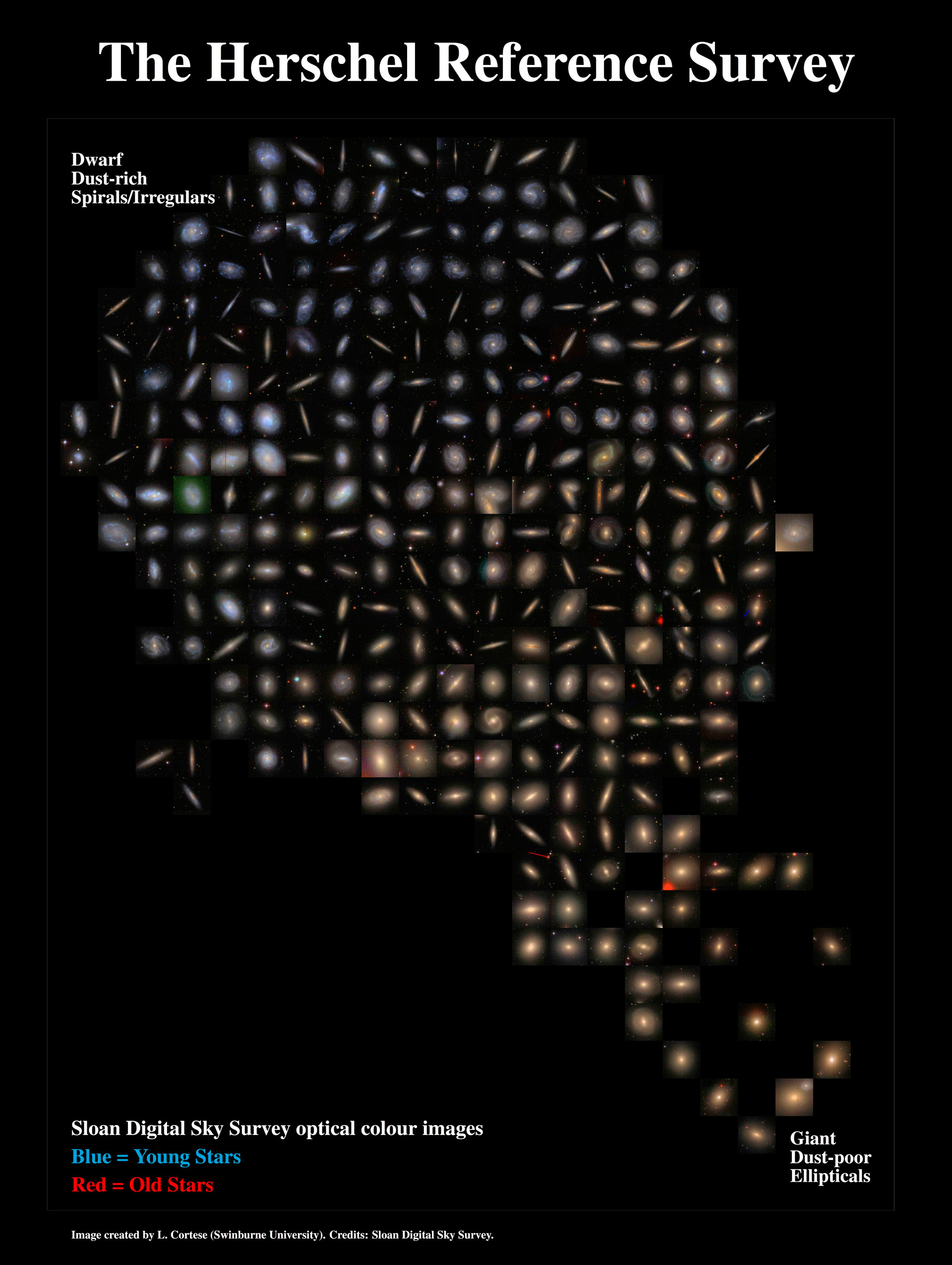
    Galaxies in the Herschel Reference Survey at Visible Wavelengths
    The Herschel Reference Survey at visible wavelengths. Collage of the 323 galaxies in the Herschel Reference Survey, shown at visible wavelengths by the Sloan Digital Sky Survey. The color distribution highlights different stellar ages, with red and blue indicating older and younger stars, respectively. Credit: ESA/Herschel/HRS-SAG2 and HeViCS Key Programmes/L. Cortese (Swinburne University)

    “The long wait was worthwhile, as the combination of the PACS and SPIRE data shows that the properties of grains vary from one galaxy to another – more than we originally expected. As dust is heated by starlight, we knew that the frequencies at which grains emit should be related to a galaxy’s star formation activity. However, our results show that galaxies’ chemical history plays an equally important role,” commented Dr. Cortese.

    Co‐author of the work, Dr. Jacopo Fritz, from Ghent University in Belgium, said: “This affects our ability to accurately estimate how much dust is in the Universe. It is particularly an issue for the most distant galaxies, which have a star formation and chemical history significantly different to the one in our own Milky Way.”

    The data obtained for the Herschel Reference Survey have been made publicly available to allow further studies of dust properties in nearby galaxies. Although the Herschel Space Observatory completed its mission in April 2013, the combination of data in the Herschel Archive, with future observations from the newly commissioned Atacama Large Millimeter/submillimeter Array (ALMA) in Chile, will help astronomers to further unveil the mystery of cosmic dust in galaxies in the years to come.

    Reference: “PACS photometry of the Herschel Reference Survey – far-infrared/submillimeter colors as tracers of dust properties in nearby galaxies” by L. Cortese, J. Fritz, S. Bianchi, A. Boselli, L. Ciesla, G. J. Bendo, M. Boquien, H. Roussel, M. Baes, V. Buat, M. Clemens, A. Cooray, D. Cormier, J. I. Davies, I. De Looze, S. A. Eales, C. Fuller, L. K. Hunt, S. Madden, J. Munoz-Mateos, C. Pappalardo, D. Pierini, A. Rémy-Ruyer, M. Sauvage, S. di Serego Alighieri, M. W. L. Smith, L. Spinoglio, M. Vaccari and C. Vlahakis,  28 February 2014, MNRAS.
    DOI: 10.1093/mnras/stu175

    Never miss a breakthrough: Join the SciTechDaily newsletter.
    Follow us on Google and Google News.

    Astronomy Astrophysics Herschel Space Observatory Royal Astronomical Society
    Share. Facebook Twitter Pinterest LinkedIn Email Reddit

    Related Articles

    Herschel Discovers a Comet Belt around Fomalhaut C

    Astronomers Discover a Rare Triple Quasar

    Astronomers Believe a Gamma-Ray Burst Hit Earth in the 8th Century

    The Large Quasar Group, the Largest Structure in the Universe

    Herschel Finds a Clue to How Planetary Systems Form and Evolve

    Artificial Intelligence Algorithm Helps Chart the Universe

    99.996 Percent Chance That Dark Energy Exists

    New Measuring Technique Suggests Plenty of Dark Matter Near the Sun

    Ultramassive Stars of Cluster R136 Were Created from the Merger of Lighter Stars

    Leave A Reply Cancel Reply

    • Facebook
    • Twitter
    • Pinterest
    • YouTube

    Don't Miss a Discovery

    Subscribe for the Latest in Science & Tech!

    Trending News

    Millions Take These IBS Drugs, But a New Study Finds Serious Risks

    Scientists Unlock Hidden Secrets of 2,300-Year-Old Mummies Using Cutting-Edge CT Scanner

    Bread Might Be Making You Gain Weight Even Without Eating More Calories

    Scientists Discover Massive Magma Reservoir Beneath Tuscany

    Europe’s Most Active Volcano Just Got Stranger – Here’s Why Scientists Are Rethinking It

    Alzheimer’s Symptoms May Start Outside the Brain, Study Finds

    Millions Take This Popular Supplement – Scientists Discover a Concerning Link to Heart Failure

    The Universe Is Expanding Too Fast and Scientists Can’t Explain Why

    Follow SciTechDaily
    • Facebook
    • Twitter
    • YouTube
    • Pinterest
    • Newsletter
    • RSS
    SciTech News
    • Biology News
    • Chemistry News
    • Earth News
    • Health News
    • Physics News
    • Science News
    • Space News
    • Technology News
    Recent Posts
    • U.S. Waste Holds $5.7 Billion Worth of Crop Nutrients
    • Scientists Say a Hidden Structure May Exist Inside Earth’s Core
    • Doctors Surprised by the Power of a Simple Drug Against Colon Cancer
    • Why Popular Diabetes Drugs Like Ozempic Don’t Work for Everyone: The “Genetic Glitch”
    • Scientists Create Improved Insulin Cells That Reverse Diabetes in Mice
    Copyright © 1998 - 2026 SciTechDaily. All Rights Reserved.
    • Science News
    • About
    • Contact
    • Editorial Board
    • Privacy Policy
    • Terms of Use

    Type above and press Enter to search. Press Esc to cancel.