
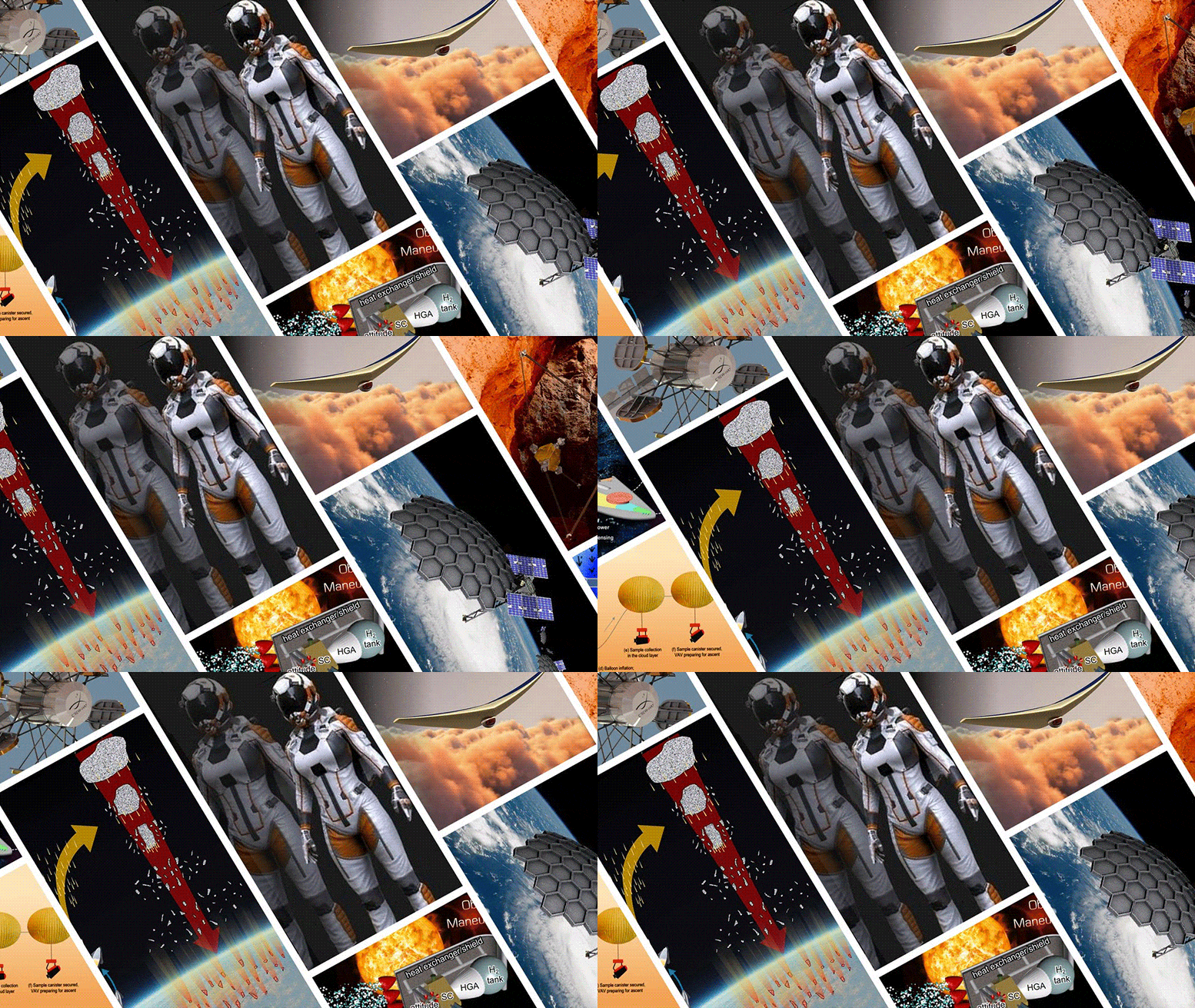
The selected concepts include three from JPL. The projects are still in the early stages of development and are not considered official NASA missions.
An astronaut steps into a body scanner and, hours later, walks on Mars in a custom-made spacesuit, breathing oxygen that was extracted from Mars’ carbon dioxide-rich atmosphere. On Venus, an inflatable bird-like drone swoops through the sky, studying the planet’s atmosphere and weather patterns. Ideas like these are currently science fiction, but they could one day become reality, thanks to a new round of grants awarded by NASA.
The NASA Innovative Advanced Concepts (NIAC) program fosters exploration by funding early-stage studies to evaluate technologies that could support future aeronautics and space missions. A new slate of awards will provide a total of $5.1 million to 17 researchers from nine states.
“As we set our sights on ever more challenging destinations for exploration with humans and robots, innovative ideas and future thinking will be critical to helping us reach new milestones,” said NASA Deputy Administrator Pam Melroy. “Concepts like those being studied with this new round of NIAC funding are helping us expand the scope of the possible so we can make it reality.”
The Bio-inspired Ray for Extreme Environments and Zonal Exploration (BREEZE) is one of 17 futuristic concepts to be studied with NASA’s Innovative Advanced Concepts program. Credit: NASA
The selected concepts include 12 new projects for Phase I study, as well as five Phase II awards that will allow researchers to continue their prior work on innovative concepts. The projects are still in the early stages of development and are not considered official NASA missions. Phase I fellows will each receive $175,000 for a nine-month study, and Phase II fellows will receive $600,000 each for study over a two-year period.
“NASA’s mission to explore the universe requires new technologies and new ways of doing things,” said Jim Reuter, associate administrator for NASA’s Space Technology Mission Directorate (STMD) at the agency’s headquarters in Washington. “Studying these creative ideas is the first step to turn science fiction into science fact.”
The new Phase I projects include a novel design for a crewed spacecraft that provides more protection from radiation on long journeys than conventional crew modules, a concept for a completely silent electric airplane, and an idea for a spacecraft that could harness the Sun’s heat to propel it out of the solar system at unprecedented speeds.
John Mather, Nobel laureate and astrophysicist at NASA’s Goddard Space Flight Center in Greenbelt, Maryland, proposes a concept that could help humanity study distant, Earth-like exoplanets. A football field-size starshade in space would be aligned with ground-based telescopes, blocking out the light from distant stars and allowing astronomers to search for signs of life in the atmospheres of planets in other star systems.
A concept proposed by Sara Seager of the Massachusetts Institute of Technology would help scientists study a planet much closer to home: Venus. A probe would parachute into the planet’s atmosphere to capture a sample of gas and clouds. The sample would be brought to Earth, where scientists could look for signs of life in Venus’ atmosphere – one of the few potential places it could survive on the otherwise hot, high-pressure planet.
“As in years past, our new group of NIAC fellows showcases the creativity and vision of the space community at large,” said Michael LaPointe, acting program executive for the NIAC program at NASA Headquarters.
The selected Phase II projects include a design for small climbing robots that could explore subsurface caves on Mars, a novel way of using nuclear power for spacecraft, and a concept for a swarm of 3D-printed swimming micro-robots that could explore ocean worlds like Enceladus, Europa, and Titan.
Phase II fellow Zac Manchester of Carnegie Mellon University will continue his work on a concept for artificial gravity in space using a kilometer-size rotating structure. After launching on a single rocket, the proposed structure would deploy to 150 times its original size, becoming a huge rotating habitat that would provide artificial gravity equal to Earth’s gravity in some parts of the structure.
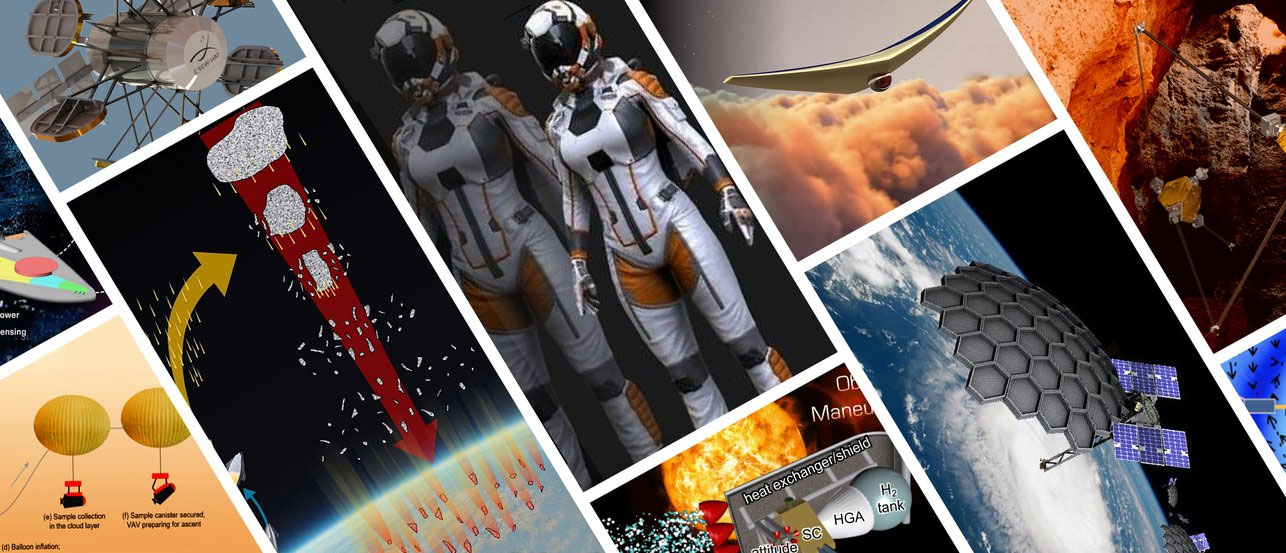
The researchers selected to receive NIAC Phase I grants in 2022, their institutions, and the titles of their proposals are:
- Darmindra Arumugam, NASA’s Jet Propulsion Laboratory in Southern California: Cryospheric Rydberg Radar
- Steven Barrett, Massachusetts Institute of Technology in Cambridge: Silent, Solid-State Propulsion for Advanced Air Mobility Vehicles
- Jason Benkoski, Johns Hopkins University in Baltimore: Combined Heat Shield and Solar Thermal Propulsion System for an Oberth Maneuver
- Elena D’Onghia, University of Wisconsin–Madison: CREW HaT: Cosmic Radiation Extended Warding using the Halbach Torus
- Bonnie Dunbar, Texas A&M University in College Station: The Spacesuit Digital Thread: 4.0 Manufacture of Custom High Performance Spacesuits for the Exploration of Mars
- Ivan Ermanoski, Arizona State University in Tempe: Breathing Mars Air: Stationary and Portable O2 Generation
- Philip Lubin, University of California, Santa Barbara: Pi – Terminal Defense for Humanity
- John Mather, NASA Goddard: Hybrid Observatory for Earth-like Exoplanets (HOEE)
- Marcin Pilinski, University of Colorado, Boulder: In-situ Neutral-Optics Velocity Analyzer for Thermospheric Exploration (INOVATE)
- Jonathan Sauder, NASA JPL: Starburst: A Revolutionary Under-Constrained Adaptable Deployable Structure Architecture
- Sara Seager, Massachusetts Institute of Technology in Cambridge: Venus Atmosphere and Cloud Particle Sample Return for Astrobiology
- Mahmooda Sultana, NASA Goddard: SCOPE: ScienceCraft for Outer Planet Exploration
The researchers selected to receive Phase II grants in 2022, their institutions, and the titles of their proposals are:
- Javid Bayandor, State University of New York at Buffalo: BREEZE: Bioinspired Ray for Extreme Environments and Zonal Exploration
- Zac Manchester, Carnegie Mellon University in Pittsburgh, Pennsylvania: Kilometer-Scale Space Structures from a Single Launch
- E. Joseph Nemanick, The Aerospace Corporation in El Segundo, California: Atomic Planar Power for Lightweight Exploration (APPLE)
- Marco Pavone, Stanford University in California: ReachBot: Small Robot for Large Mobile Manipulation Tasks in Martian Cave Environments
- Ethan Schaler, NASA JPL: SWIM: Sensing with Independent Micro-swimmers
NIAC is funded by STMD, which is responsible for developing the new cross-cutting technologies and capabilities needed by the agency to achieve its current and future missions.
Never miss a breakthrough: Join the SciTechDaily newsletter.
Follow us on Google and Google News.
1 Comment
I’m not against this, however there is something missing. Just ask Elon Musk to sit in. He might do it for $0. I suggest this will triple the results.