
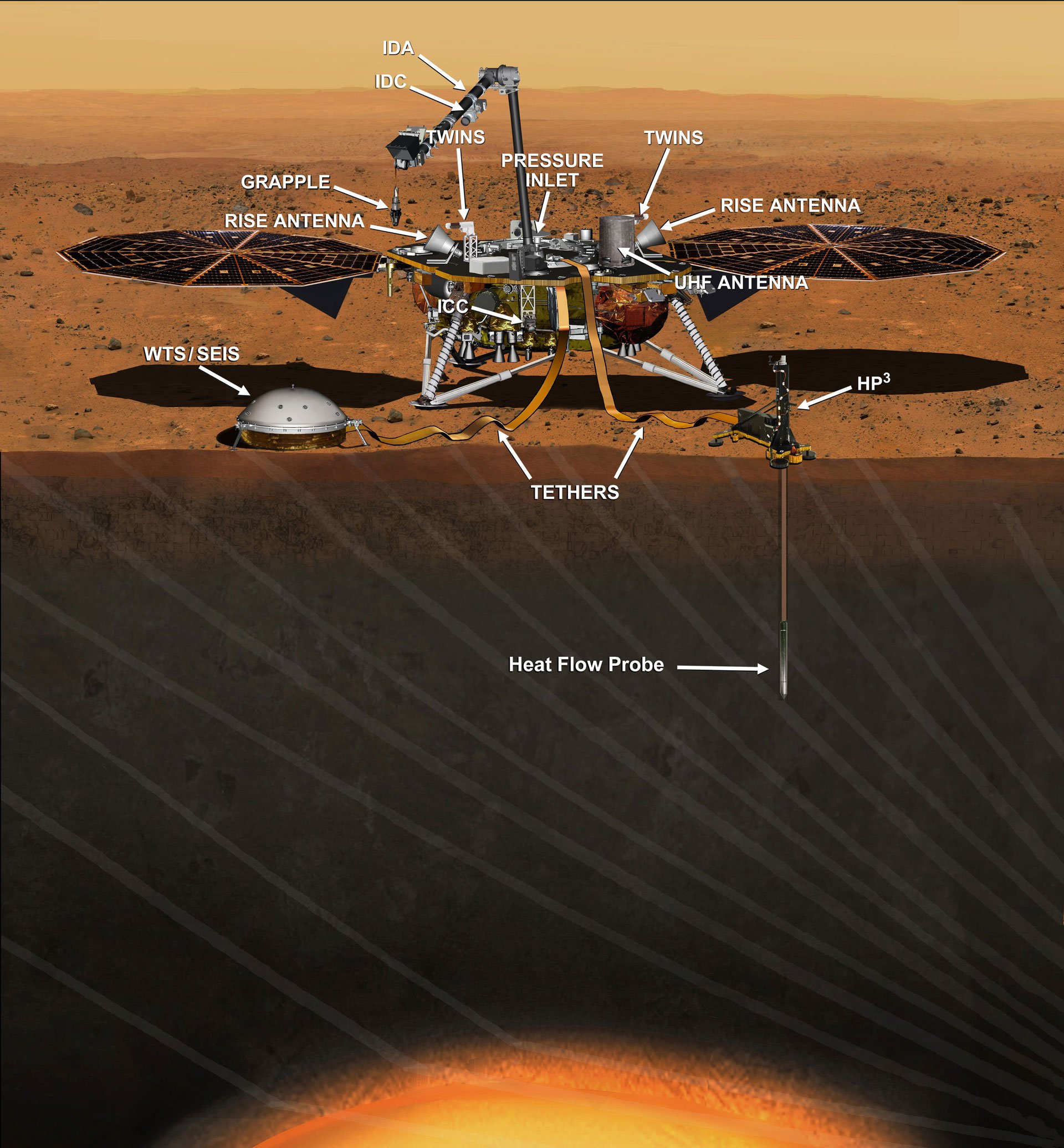
Unsuccessful attempts to repair a leak in a section of the prime instrument in the science payload has led to NASA’s decision to suspend the planned March 2016 launch of the Interior Exploration using Seismic Investigations Geodesy and Heat Transport (InSight) mission.
“Learning about the interior structure of Mars has been a high-priority objective for planetary scientists since the Viking era,” said John Grunsfeld, associate administrator for NASA’s Science Mission Directorate in Washington. “We push the boundaries of space technology with our missions to enable science, but space exploration is unforgiving, and the bottom line is that we’re not ready to launch in the 2016 window. A decision on a path forward will be made in the coming months, but one thing is clear: NASA remains fully committed to the scientific discovery and exploration of Mars.”
The instrument involved is the Seismic Experiment for Interior Structure (SEIS), a seismometer provided by France’s Centre National d’Études Spatiales (CNES). Designed to measure ground movements as small as the diameter of an atom, the instrument requires a vacuum seal around its three main sensors to withstand the harsh conditions of the Martian environment.
“InSight’s investigation of the Red Planet’s interior is designed to increase understanding of how all rocky planets, including Earth, formed and evolved,” said Bruce Banerdt, InSight Principal Investigator at NASA’s Jet Propulsion Laboratory (JPL), Pasadena, California. “Mars retains evidence about the rocky planets’ early development that has been erased on Earth by internal churning Mars lacks. Gaining information about the core, mantle, and crust of Mars is a high priority for planetary science, and InSight was built to accomplish this.”
A leak earlier this year that previously had prevented the seismometer from retaining vacuum conditions was repaired, and the mission team was hopeful the most recent fix also would be successful. However, during testing on Monday in extreme cold temperature (-49 degrees Fahrenheit/-45 degrees Celsius) the instrument again failed to hold a vacuum.
NASA officials determined there is insufficient time to resolve another leak, and complete the work and thorough testing required to ensure a successful mission.
“It’s the first time ever that such a sensitive instrument has been built. We were very close to succeeding, but an anomaly has occurred, which requires further investigation. Our teams will find a solution to fix it, but it won’t be solved in time for a launch in 2016,” said Marc Pircher, Director of CNES’s Toulouse Space Centre.
The spacecraft, built by Lockheed Martin, was delivered to Vandenberg Air Force Base in California, on December 16. With the 2016 launch canceled, the spacecraft will be returned from Vandenberg to Lockheed’s facility in Denver.
The relative positions of the planets are most favorable for launching missions from Earth to Mars for only a few weeks every 26 months. For InSight, that 2016 launch window existed from March 4 to March 30.
“In 2008, we made a difficult, but correct decision to postpone the launch of the Mars Science Laboratory mission for two years to better ensure mission success,” said Jim Green, director, Planetary Science Division, in Washington. “The successes of that mission’s rover, Curiosity, have vastly outweighed any disappointment about that delay.”
NASA is on an ambitious journey to Mars that includes sending humans to the Red Planet, and that work remains on track despite Tuesday’s decision. Robotic spacecraft are leading the way for NASA’s Mars Exploration Program, with the upcoming Mars 2020 rover being designed and built, the Opportunity and Curiosity rovers exploring the Martian surface, the Odyssey and Mars Reconnaissance Orbiter spacecraft currently orbiting the planet, along with the MAVEN orbiter, which recently helped scientists understand what happened to the Martian atmosphere.
NASA and CNES also are participating in the European Space Agency’s (ESA’s) Mars Express mission currently operating at Mars and plan to participate in ESA’s 2016 and 2018 ExoMars missions, including providing telecommunication radios for ESA’s 2016 orbiter and a critical element of a key astrobiology instrument on the 2018 ExoMars rover.
“The JPL and CNES teams and their partners have made a heroic effort to prepare the InSight instrument, but have run out of time given the celestial mechanics of a launch to Mars,” said JPL Director Charles Elachi. “It is more important to do it right than take an unacceptable risk.”
InSight’s science payload includes two key instruments: SEIS, provided by CNES, and the Heat Flow and Physical Properties Package (HP3), provided by the German Aerospace Center (DLR).
SEIS was built with the participation of the Institut de Physique du Globe de Paris (IPGP) and the Swiss Federal Institute of Technology (ETH), with support from the Swiss Space Office and the European Space Agency PRODEX program; the Max Planck Institute for Solar System Research (MPS), supported by DLR; Imperial College, supported by the United Kingdom Space Agency; and JPL.
Never miss a breakthrough: Join the SciTechDaily newsletter.
Follow us on Google and Google News.
1 Comment
Good luck!