

By combining data from NASA’s IRAS and NuSTAR telescopes, scientists have uncovered more hidden supermassive black holes than earlier estimates suggested.
Their findings indicate that over a third of these black holes are obscured by thick gas and dust, influencing how galaxies grow and evolve. The study demonstrates the power of combining archival infrared data with modern X-ray observations to better understand these mysterious cosmic objects.
Searching the Skies for Supermassive Black Holes
Multiple NASA telescopes have recently helped scientists search the skies for supermassive black holes — colossal objects that can be billions of times more massive than the Sun. What makes this survey unique is its ability to detect both black holes that are hidden behind thick clouds of gas and dust and those that are not.
Astronomers believe that nearly every large galaxy in the universe has a supermassive black hole at its center. However, proving this theory is challenging because counting the billions or even trillions of these black holes across the universe is impossible. Instead, scientists analyze smaller samples and use them to estimate the larger population. By accurately determining how many black holes are hidden within a given sample, researchers can make better predictions about the total number of supermassive black holes in the universe.
Published in the Astrophysical Journal, the new study found that about 35% of supermassive black holes are heavily obscured, meaning the surrounding clouds of gas and dust are so thick they block even low-energy X-ray light. Comparable searches have previously found less than 15% of supermassive black holes are so obscured. Scientists think the true split should be closer to 50/50 based on models of how galaxies grow. If observations continue to indicate significantly less than half of supermassive black holes are hidden, scientists will need to adjust some key ideas they have about these objects and the role they play in shaping galaxies.

Hidden Treasure: Illuminating the Darkness
Although black holes are inherently dark — not even light can escape their gravity — they can also be some of the brightest objects in the universe: When gas gets pulled into orbit around a supermassive black hole, like water circling a drain, the extreme gravity creates such intense friction and heat that the gas reaches hundreds of thousands of degrees and radiates so brightly it can outshine all the stars in the surrounding galaxy.
The clouds of gas and dust that surround and replenish the bright central disk may roughly take the shape of a torus, or doughnut. If the doughnut hole is facing toward Earth, the bright central disk within it is visible; if the doughnut is seen edge-on, the disk is obscured.
A thick torus of gas and dust surrounding a supermassive black hole is shown in this artist’s concept. The torus can obscure light that’s generated by material falling into the black hole. Observations by NASA telescopes have helped scientists identify more of these hidden black holes. Credit: NASA/JPL-Caltech
Identifying Hidden Giants with Modern Telescopes
Most telescopes can rather easily identify face-on supermassive black holes, though not edge-on ones. But there’s an exception to this that the authors of the new paper took advantage of: The torus absorbs light from the central source and reemits lower-energy light in the infrared range (wavelengths slightly longer than what human eyes can detect). Essentially, the doughnuts glow in infrared.
These wavelengths of light were detected by NASA’s Infrared Astronomical Satellite, or IRAS, which operated for 10 months in 1983 and was managed by NASA’s Jet Propulsion Laboratory in Southern California. A survey telescope that imaged the entire sky, IRAS was able to see the infrared emissions from the clouds surrounding supermassive black holes. Most importantly, it could spot edge-on and face-on black holes equally well.
Combining Observations for a Clearer Picture
IRAS caught hundreds of initial targets. Some of them turned out to be not heavily obscured black holes but galaxies with high rates of star formation that emit a similar infrared glow. So the authors of the new study used ground-based, visible-light telescopes to identify those galaxies and separate them from the hidden black holes.
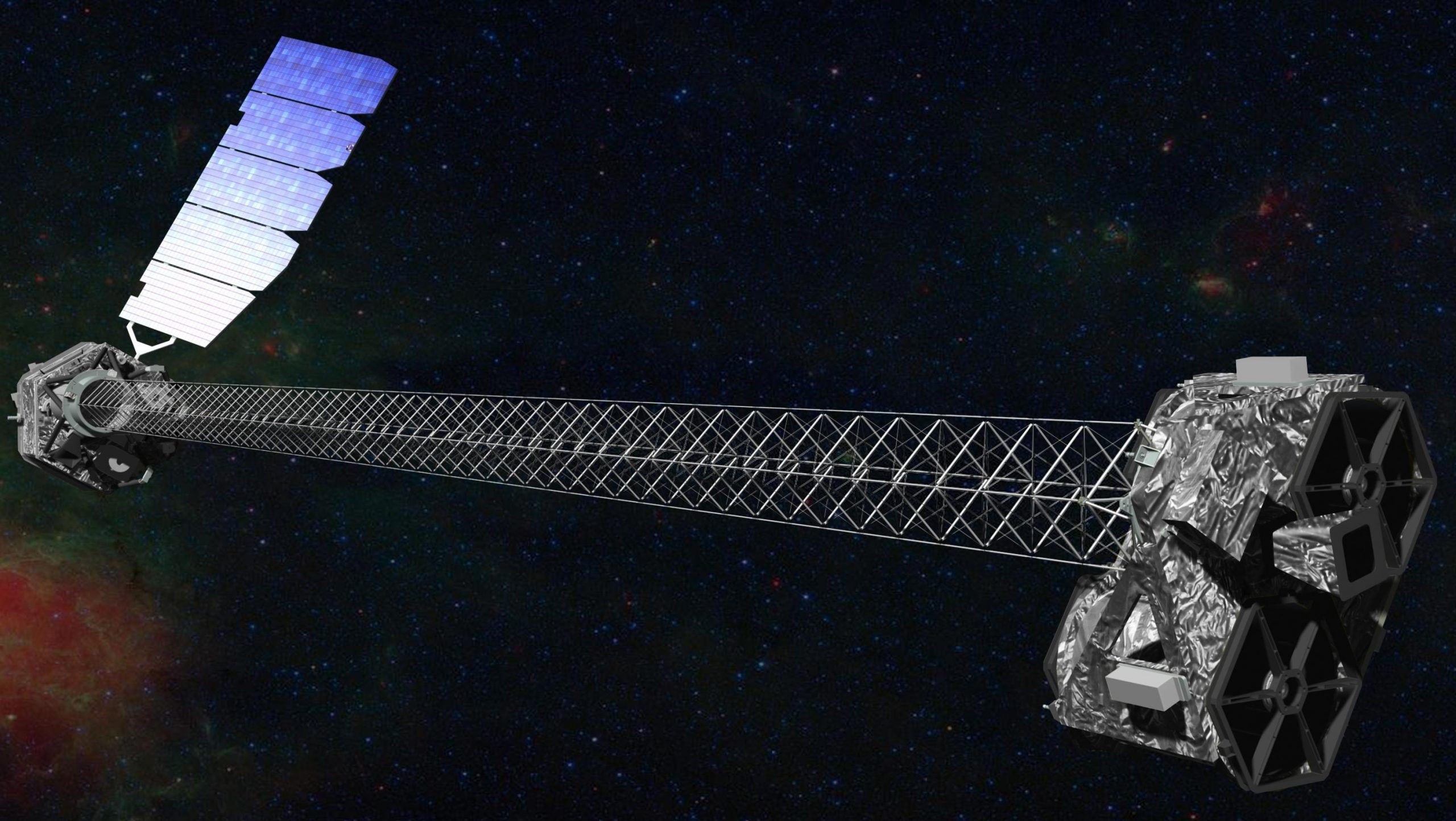
To confirm edge-on, heavily obscured black holes, the researchers relied on NASA’s NuSTAR (Nuclear Spectroscopic Telescope Array), an X-ray observatory also managed by JPL. X-rays are radiated by some of the hottest material around the black hole. Lower-energy X-rays are absorbed by the surrounding clouds of gas and dust, while the higher-energy X-rays observed by NuSTAR can penetrate and scatter off the clouds. Detecting these X-rays can take hours of observation, so scientists working with NuSTAR first need a telescope like IRAS to tell them where to look.
“It amazes me how useful IRAS and NuSTAR were for this project, especially despite IRAS being operational over 40 years ago,” said study lead Peter Boorman, an astrophysicist at Caltech in Pasadena, California. “I think it shows the legacy value of telescope archives and the benefit of using multiple instruments and wavelengths of light together.”
Understanding Black Hole Growth and Impact
Determining the number of hidden black holes compared to nonhidden ones can help scientists understand how these black holes get so big. If they grow by consuming material, then a significant number of black holes should be surrounded by thick clouds and potentially obscured. Boorman and his coauthors say their study supports this hypothesis.
In addition, black holes influence the galaxies they live in, mostly by impacting how galaxies grow. This happens because black holes surrounded by massive clouds of gas and dust can consume vast — but not infinite — amounts of material. If too much falls toward a black hole at once, the black hole starts coughing up the excess and firing it back out into the galaxy. That can disperse gas clouds within the galaxy where stars are forming, slowing the rate of star formation there.
“If we didn’t have black holes, galaxies would be much larger,” said Poshak Gandhi, a professor of astrophysics at the University of Southampton in the United Kingdom and a co-author on the new study. “So if we didn’t have a supermassive black hole in our Milky Way galaxy, there might be many more stars in the sky. That’s just one example of how black holes can influence a galaxy’s evolution.”
Reference: “The NuSTAR Local AGN NH Distribution Survey (NuLANDS). I. Toward a Truly Representative Column Density Distribution in the Local Universe” by Peter G. Boorman, Poshak Gandhi, Johannes Buchner, Daniel Stern, Claudio Ricci, Mislav Baloković, Daniel Asmus, Fiona A. Harrison, Jiří Svoboda, Claire Greenwell, Michael J. Koss, David M. Alexander, Adlyka Annuar, Franz E. Bauer, William N. Brandt, Murray Brightman, Francesca Civano, Chien-Ting J. Chen, Duncan Farrah, Karl Forster, Brian Grefenstette, Sebastian F. Hönig, Adam B. Hill, Elias Kammoun, George Lansbury, Lauranne Lanz, Stephanie LaMassa, Kristin Madsen, Stefano Marchesi, Matthew Middleton, Beatriz Mingo, Michael L. Parker, Ezequiel Treister, Yoshihiro Ueda, C. Megan Urry and Luca Zappacosta, 30 December 2024, The Astrophysical Journal.
DOI: 10.3847/1538-4357/ad8236
More About NuSTAR
A Small Explorer mission led by Caltech and managed by NASA’s Jet Propulsion Laboratory in Southern California for the agency’s Science Mission Directorate in Washington, NuSTAR was developed in partnership with the Danish Technical University and the Italian Space Agency (ASI). The spacecraft was built by Orbital Sciences Corp. in Dulles, Virginia. NuSTAR’s mission operations center is at the University of California, Berkeley, and the official data archive is at NASA’s High Energy Astrophysics Science Archive Research Center at NASA’s Goddard Space Flight Center. ASI provides the mission’s ground station and a mirror data archive. Caltech manages JPL for NASA.
Never miss a breakthrough: Join the SciTechDaily newsletter.
Follow us on Google and Google News.
10 Comments
The last I heard, astronomers still have no idea how supermassive Black Holes form. If they’re the center of galaxies, combining smaller Black Holes wouldn’t work because the enormous gravitational waves produced by the combination would annihilate any stars etc. in the region, making galaxy formation impossible. Any answers out there?
Ever since I was very young, (I’m 60 now) I’ve always thought that black holes were in every galaxy. I also thought that black holes were the engines of a galaxy and the faster a galaxy spun, the bigger the black hole. I think without a black hole in its center powering and giving it momentum, a galaxy would ultimately die and therefore any life existing in it would die as well. I may be wrong, but it’s fascinating to think about.
Yes, almost all astronomers say a supermassive Black Hole is the center of each galaxy. Almost all, but a view of String Theory suggests that the center of galaxies could be branes (dimensional membranes), separate universes within our universe. If you look at the center of the Andromeda Galaxy you’ll see 4 new blue stars right at the center where the supermassive Black Hole should be. Naturally, such a Black Hole would destroy such stars before they developed. Also, the center of our Milky Way contains a nuclear star cluster, also impossible if a supermassive Black Hole was there. And, for your amusement, when you were born I was starting college.
Astronomers have too many ideas – but they are paring them down.
“Current models are based on one of two types of BH seeds: “light” or “heavy”. A light seed is any seed BH with a mass of less than 1000 solar masses, while a heavy seed starts with a mass of over 1000 solar masses. The key challenge in understanding the seed population in the early universe is identifying their formation and growth channels. The simplest case of a light seed assumes all of the BHs originate from the remnants of the first stars in the universe, but it is hard to explain their growth into MBHs with masses over 100,000 solar masses with just accretion. Alternatively, heavy seeds are thought to be formed through several mechanisms including a direct collapse of massive gas clouds resulting in the formation of a supermassive star. Such heavy seeds could explain the over-massive BHs we see in the early universe, but the conditions favoring their existence in the early universe are much rarer than the light seeds.”
– Astrobites, “The seeds that formed the garden of massive black holes”
Here is the review most likely seed scenario, essentially starting with the likeliest light seed channel and switching to a heavy seed channel:
“Other heavy seed formation channels include collisions of stars in young star clusters and hierarchical BH mergers within a star cluster. Such dynamical pathways to heavy seeds can generate a spectrum of seed masses. In the second halo model considered in this paper, the authors find seed BHs up to 10,000 solar masses, generated through such dynamical channels. The formation of these seeds is 100,000 times more likely than heavy seeds produced via direct collapse and are therefore more likely to explain the overall MBH population.”
What ever is observed by telescope is already past or history because universe expanding at faster speed than light… don’t need to be rocket scientist to know that this is “OLD NEWS” or “NEWS FROM THE PAST” 😉
According to Einstein, the speed of light is the fastest speed possible in the universe. Nothing, including the universe expansion, can go faster. BTW, the universe is now expanding at about 41 miles/sec.
Yes, almost all astronomers say a supermassive Black Hole is the center of each galaxy. Almost all, but a view of String Theory suggests that the center of galaxies could be branes (dimensional membranes), separate universes within our universe. If you look at the center of the Andromeda Galaxy you’ll see 4 new blue stars right at the center where the supermassive Black Hole should be. Naturally, such a Black Hole would destroy such stars before they developed. Also, the center of our Milky Way contains a nuclear star cluster, also impossible if a supermassive Black Hole was there. And, for your amusement, when you were born I was starting college.
What are you on about? We have images of the Milky Way central supermassive black hole, see the Event Horizon Telescope.
Central blue stars are associated with a SMBH as rejuvenated blue stars can form from star mergers or stripping collisions that happen around it.
That is also the case for nuclear clusters [Wikipedia]:
“Although the mechanisms behind their formation are not entirely known, hypotheses provide four possibilities:[4] [5]
Nuclear star clusters originate somewhere else and are captured by a central black hole.
Nuclear star clusters are due to an incidence of gas at some distance from the center of the galaxy.
A combination of the above possibilities whereby the gravitational potential of a trapped object, such as the nucleus of a dwarf galaxy, triggers new star formation by incident gas near the galactic center.
Nuclear star clusters are created by merging star clusters with subsequent migration to the galactic center due to dynamical friction with background stars. [6]”
Here’s a twist that further show the connection between supermassive black hole and galaxy physics:
“Data from NASA’s Chandra X-ray Observatory and the Very Large Telescope (VLT) provide new evidence that outbursts from black holes can help cool down gas to feed themselves.”
“The results support a model where outbursts from the black holes trigger hot gas to cool and form narrow filaments of warm gas. Turbulence in the gas also plays an important role in this triggering process.
According to this model, some of the warm gas in these filaments should then flow into the centers of the galaxies to feed the black holes, causing an outburst. The outburst causes more gas to cool and feed the black holes, leading to further outbursts.”
“The newly found relationship for these filaments shows remarkable similarity to the one found in the tails of jellyfish galaxies, which have had gas stripped away from them as they travel through surrounding gas, forming long tails. This similarity reveals an unexpected cosmic connection between the two objects and implies a similar process is occurring in these objects.”
– NASA, “Black Holes Can Cook for Themselves, Chandra Study Shows”
A universe of Black holes!
It seems to me that all the BH’s observed are in this universe. To imply that BH are their own category of universe or universes (plural) plays into the unproven multi-verses paradigm and models most popularly being circulated as the most probable cosmological hypothesis of theoretical physics and physicists.
A universe of BH’s as a gateway into dimensions unknown and untested by the laws of the physics operating in this universal system which currently contains many BH’s.
Hypotheses and frameworks based upon other unfalsifiable hypotheses. What are the assumptions?
Fact: Every BH present in this universe is present in this universe.
No gateways into other universes or dimensions that don’t exist or function in this universe is currently observed or proven by science as far as I am aware presently. Apart from predictions based upon inferences from evidence that is inconclusive at present.
At least what is observed on the other side of BH’s in this universe is the same stuff on this side of the BH and not some galactic gateway into dimensions and zones unknown and unexplored.