
Close Menu
    Facebook X (Twitter) Instagram
    SciTechDaily
    • Biology
    • Chemistry
    • Earth
    • Health
    • Physics
    • Science
    • Space
    • Technology
    Facebook X (Twitter) Pinterest YouTube RSS
    SciTechDaily
    Home»Space»NASA’s NuSTAR is One Step Closer to Launching
    Space

    NASA’s NuSTAR is One Step Closer to Launching

    By Whitney Clavin, Jet Propulsion Laboratory; Trent J. Perrotto, NASAJanuary 26, 2012No Comments4 Mins Read
    Facebook Twitter Pinterest Telegram LinkedIn WhatsApp Email Reddit
    Share
    Facebook Twitter LinkedIn Pinterest Telegram Email Reddit
    NASA's Nuclear Spectroscopic Telescope Array
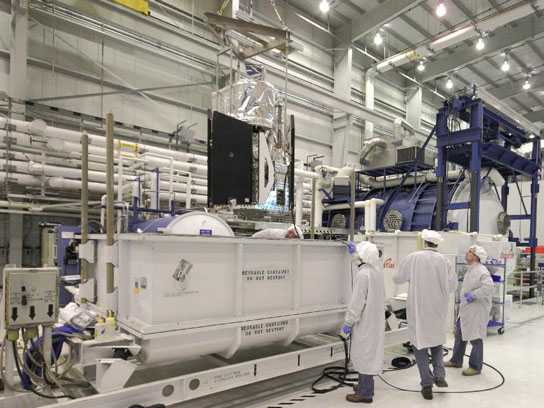
    NASA’s Nuclear Spectroscopic Telescope Array, or NuSTAR, mission is seen here being lowered into its shipping container at Orbital Sciences Corporation in Dulles, Va. The spacecraft is headed to Vandenberg Air Force Base in Central California, where it will be mated to its rocket. It is scheduled to launch from Kwajalein Atoll in the Marshall Islands on March 14. Credit: NASA/JPL-Caltech/Orbital

    NASAA’s Nuclear Spectroscopic Telescope Array, or NuSTAR, is one step closer to its March launch. The NuSTAR was shipped to the Vandenberg Air Force Base where it will be mated to its Pegasus launch vehicle. Scientists believe NuSTAR will enable years of astronomical discovery from its advanced telescope consisting of two sets of 133 concentric shells of mirrors shaped from flexible glass.

    NASA’s Nuclear Spectroscopic Telescope Array, or NuSTAR, shipped to Vandenberg Air Force Base, California, on Tuesday, to be mated to its Pegasus launch vehicle. The observatory will detect X-rays from objects ranging from our sun to giant black holes billions of light-years away. It is scheduled to launch on March 14 from an aircraft operating out of Kwajalein Atoll in the Marshall Islands.

    “The NuSTAR mission is unique because it will be the first NASA mission to focus X-rays in the high-energy range, creating the most detailed images ever taken in this slice of the electromagnetic spectrum,” said Fiona Harrison, the mission’s principal investigator at the California Institute of Technology in Pasadena, California.

    The observatory shipped from Orbital Sciences Corporation in Dulles, Va., where the spacecraft and science instrument were integrated. It is scheduled to arrive at Vandenberg on January 27, where it will be mated to the Pegasus, also built by Orbital, on February 17.

    The mission will be launched from the L-1011 “Stargazer” aircraft, which will take off near the equator from Kwajalein Atoll in the Pacific. NuSTAR and its Pegasus will fly from Vandenberg to Kwajalein attached to the underside of the L-1011, and are scheduled to arrive on March 7.

    On launch day, after the airplane arrives at the planned drop site over the ocean, the Pegaus will drop from the L-1011 and carry NuSTAR to an orbit around Earth.

    “NuSTAR is an engineering achievement, incorporating state-of-the-art high-energy X-ray mirrors and detectors that will enable years of astronomical discovery,” said Yunjin Kim, the mission’s project manager at NASA’s Jet Propulsion Laboratory in Pasadena.

    NuSTAR’s advanced telescope consists of two sets of 133 concentric shells of mirrors, which were shaped from flexible glass similar to that found in laptop screens. Because X-rays require large focusing distances, or focal lengths, the telescope has a lengthy 33-foot (10-meter) mast, which will unfold a week after launch.

    These and other advances in technology will enable NuSTAR to explore the cosmic world of high-energy X-rays with much improved sensitivity and resolution over previous missions. During its two-year primary mission, NuSTAR will map the celestial sky in X-rays, surveying black holes, mapping supernova remnants, and studying particle jets travelling away from black holes near the speed of light.

    NuSTAR also will probe the sun, looking for microflares theorized to be on the surface that could explain how the sun’s million-degree corona, or atmosphere, is heated. It will even test a theory of dark matter, the mysterious substance making up about one-quarter of our universe, by searching the sun for evidence of a hypothesized dark matter particle.

    “NuSTAR will provide an unprecedented capability to discover and study some of the most exotic objects in the universe, from the corpses of exploded stars in the Milky Way to supermassive black holes residing in the hearts of distant galaxies,” said Lou Kaluzienski, NuSTAR program scientist at NASA Headquarters in Washington.

    Never miss a breakthrough: Join the SciTechDaily newsletter.
    Follow us on Google and Google News.

    Astronomy Black Hole Exploration JPL NASA NuSTAR Sun X-ray
    Share. Facebook Twitter Pinterest LinkedIn Email Reddit

    Related Articles

    Data Reveals Dormant Black Hole Amidst Stellar Chaos

    Scientists Measure the Spin Rates of Supermassive Black Holes

    NuSTAR Images of Spiral Galaxy IC 342 & Supernova Remnant Cassiopeia A

    New NASA InSight Mission Set to Explore the Depths of Mars

    First Images From Project 1640

    Ultrafine Loops of Solar Material Scattered on the Sun’s Surface

    NuSTAR Set to Study Some of the Most Energetic Phenomena in the Universe

    Black Hole Rips Apart a Helium Rich Star

    Spacecraft to Explore Supermassive Black Holes at Center of Galaxies

    Leave A Reply Cancel Reply

    • Facebook
    • Twitter
    • Pinterest
    • YouTube

    Don't Miss a Discovery

    Subscribe for the Latest in Science & Tech!

    Trending News

    First-of-Its-Kind Discovery: Homer’s Iliad Found Embedded in a 1,600-Year-Old Egyptian Mummy

    Beyond Inflammation: Scientists Uncover New Cause of Persistent Rheumatoid Arthritis

    A Simple Molecule Could Unlock Safer, Easier Weight Loss

    Scientists Just Built a Quantum Battery That Charges Almost Instantly

    Researchers Unveil Groundbreaking Sustainable Solution to Vitamin B12 Deficiency

    Millions of People Have Osteopenia Without Realizing It – Here’s What You Need To Know

    Researchers Discover Boosting a Single Protein Helps the Brain Fight Alzheimer’s

    World-First Study Reveals Human Hearts Can Regenerate After a Heart Attack

    Follow SciTechDaily
    • Facebook
    • Twitter
    • YouTube
    • Pinterest
    • Newsletter
    • RSS
    SciTech News
    • Biology News
    • Chemistry News
    • Earth News
    • Health News
    • Physics News
    • Science News
    • Space News
    • Technology News
    Recent Posts
    • Scientists Flip Immune System “Switch,” Uncover Surprising Path To Stop Gut Inflammation
    • Magnesium Magic: New Drug Melts Fat Even on a High-Fat, High-Sugar Diet
    • Weight-Loss Drugs Like Ozempic May Come With an Unexpected Cost
    • After Decades, MIT Researchers Capture the First 3D Atomic View of a Mysterious Material
    • Your Favorite Fishing Spot Is Turning Brown – and the Fish Are Changing
    Copyright © 1998 - 2026 SciTechDaily. All Rights Reserved.
    • Science News
    • About
    • Contact
    • Editorial Board
    • Privacy Policy
    • Terms of Use

    Type above and press Enter to search. Press Esc to cancel.