
Close Menu
    Facebook X (Twitter) Instagram
    SciTechDaily
    • Biology
    • Chemistry
    • Earth
    • Health
    • Physics
    • Science
    • Space
    • Technology
    Facebook X (Twitter) Pinterest YouTube RSS
    SciTechDaily
    Home»Space»New Cassini Image Shows Methane in Saturn’s Atmosphere
    Space

    New Cassini Image Shows Methane in Saturn’s Atmosphere

    By SciTechDailyFebruary 1, 2016No Comments2 Mins Read
    Facebook Twitter Pinterest Telegram LinkedIn WhatsApp Email Reddit
    Share
    Facebook Twitter LinkedIn Pinterest Telegram Email Reddit
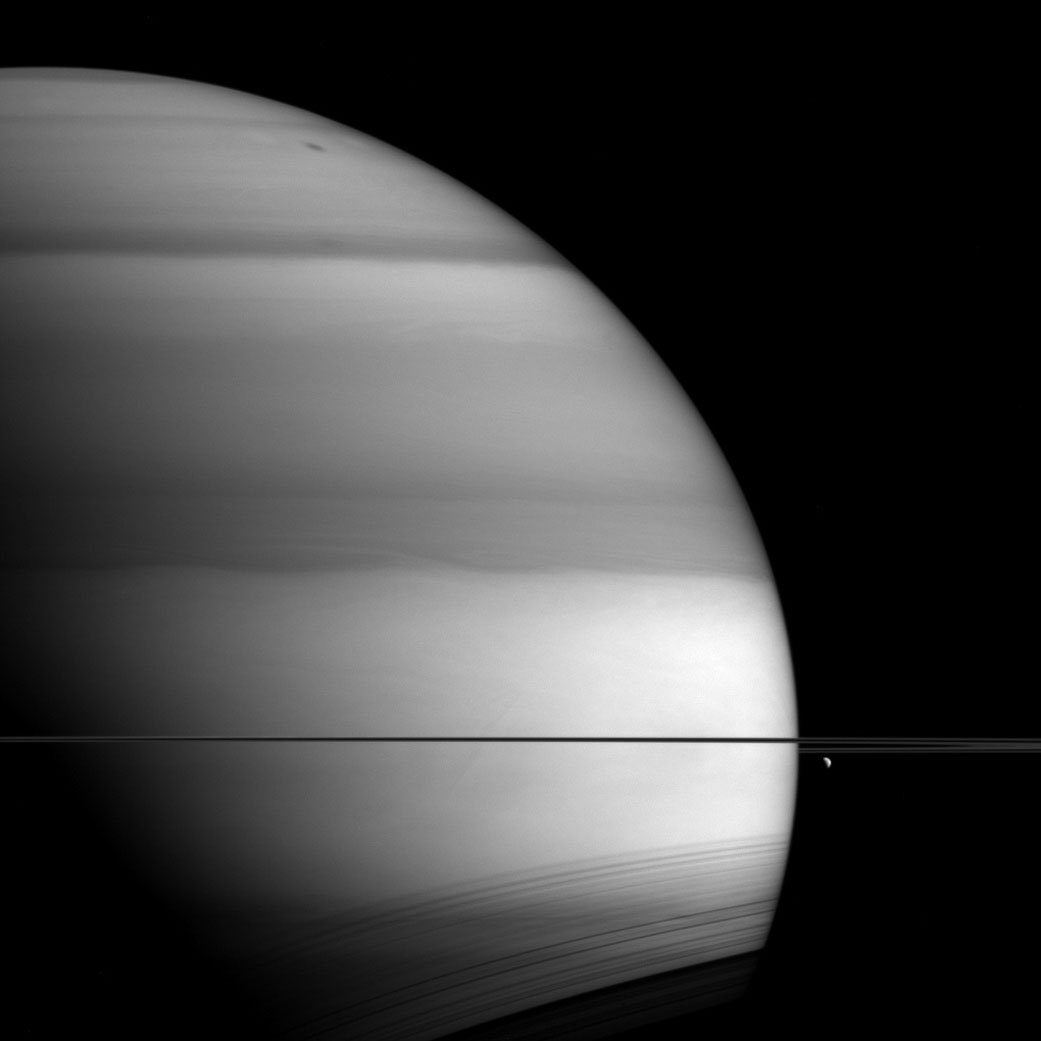
    Latest Cassini Spacecraft Image of Saturn
    Dark areas are regions where light travels deeper into the atmosphere (passing through more methane) before reflecting and scattering off of clouds and then heading back out of the atmosphere. The moon Dione (698 miles or 1,123 kilometers across) hangs below the rings at right.  Credit: NASA/JPL-Caltech/Space Science Institute

    The soft, bright-and-dark bands revealed in this new image from the Cassini Spacecraft are the signature of methane in Saturn’s atmosphere.

    This image was taken in wavelengths of light that are absorbed by methane on Saturn. Dark areas are regions where light travels deeper into the atmosphere (passing through more methane) before reflecting and scattering off of clouds and then heading back out of the atmosphere. In such images, the deeper the light goes, the more of it gets absorbed by methane, and the darker that part of Saturn appears.

    The moon Dione (698 miles or 1,123 kilometers across) hangs below the rings at right. Shadows of the rings are also visible here, cast onto the planet’s southern hemisphere, in an inverse view compared to early in Cassini’s mission at Saturn.

    This view looks toward the unilluminated side of the rings from about 0.3 degrees below the ringplane. The image was taken with the Cassini spacecraft wide-angle camera on September 6, 2015, using a spectral filter which preferentially admits wavelengths of near-infrared light centered at 728 nanometers.

    The view was acquired at a distance of approximately 819,000 miles (1.32 million kilometers) from Saturn. Image scale is 49 miles (79 kilometers) per pixel. Dione has been brightened by a factor of two to enhance its visibility.

    Never miss a breakthrough: Join the SciTechDaily newsletter.
    Follow us on Google and Google News.

    Astronomy Cassini-Huygens Mission Planetary Science Saturn
    Share. Facebook Twitter Pinterest LinkedIn Email Reddit

    Related Articles

    New Study Details the Changes in Saturn’s F Ring

    Cassini Reveals Possible New Moon Forming Around Saturn

    NASA Detects Ocean Inside Saturn’s Moon Enceladus

    Cassini Reveals Clues about Saturn’s Moon Titan

    Massive Saturn Storm Churns Up Water Ice from Great Depths

    Cassini Views a Spinning Vortex at Saturn’s North Pole

    Cassini Observes Meteors Colliding With Saturn’s Rings

    NASA’s Cassini Catches a Glimpse of Venus From Saturn Orbit

    Storm Spawns the Largest Tropospheric Vortex Ever Seen on Saturn

    Leave A Reply Cancel Reply

    • Facebook
    • Twitter
    • Pinterest
    • YouTube

    Don't Miss a Discovery

    Subscribe for the Latest in Science & Tech!

    Trending News

    Invisible Black Holes Could Be Triggering Supernovae

    Scientists Discover the First Contagious Cancer in a Freshwater Animal

    THC-CBD Treatment Dramatically Reduces Agitation in Dementia Trial

    Scientists Say Love Follows Mathematical Patterns

    “Zombie Cells” Reveal a Hidden Weakness That Could Help Fight Aging

    Alien Signals May Be Hiding in a Radio Band SETI Has Barely Explored

    Earth’s Hidden Thermostat Has Regulated Climate for 60 Million Years

    This 518-Million-Year-Old Creature Reveals How Spiders Got Their Bite

    Follow SciTechDaily
    • Facebook
    • Twitter
    • YouTube
    • Pinterest
    • Newsletter
    • RSS
    SciTech News
    • Biology News
    • Chemistry News
    • Earth News
    • Health News
    • Physics News
    • Science News
    • Space News
    • Technology News
    Recent Posts
    • Tiny Divers Challenge a Major Theory About Ocean Insects
    • More Than 1,500 Ships Could Carry a Marine Crisis Around the World
    • New Compound Could Help Aging Muscles Repair Themselves
    • Exercise Helps Hip Arthritis but the Relief May Be Hard to Notice
    • Rare Bourbon Virus Confirmed in New York for the First Time
    Copyright © 1998 - 2026 SciTechDaily. All Rights Reserved.
    • Science News
    • About
    • Contact
    • Editorial Board
    • Privacy Policy
    • Terms of Use

    Type above and press Enter to search. Press Esc to cancel.