
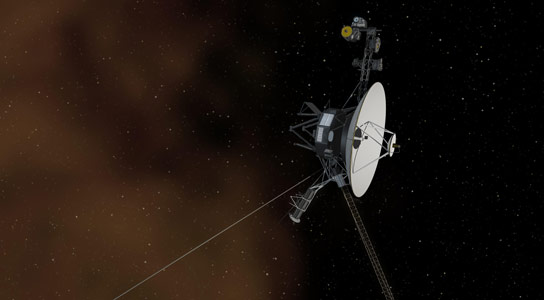
New Data from another “tsunami wave” generated by our sun confirms that NASA’s Voyager 1 spacecraft is in interstellar space.
NASA’s Voyager 1 spacecraft has experienced a new “tsunami wave” from the sun as it sails through interstellar space. Such waves are what led scientists to the conclusion, in the fall of 2013, that Voyager had indeed left our sun’s bubble, entering a new frontier.
“Normally, interstellar space is like a quiet lake,” said Ed Stone of the California Institute of Technology in Pasadena, California, the mission’s project scientist since 1972. “But when our sun has a burst, it sends a shock wave outward that reaches Voyager about a year later. The wave causes the plasma surrounding the spacecraft to sing.”
Data from this newest tsunami wave generated by our sun confirm that Voyager is in interstellar space — a region between the stars filled with a thin soup of charged particles, also known as plasma. The mission has not left the solar system — it has yet to reach a final halo of comets surrounding our sun — but it broke through the wind-blown bubble, or heliosphere, encasing our sun. Voyager is the farthest human-made probe from Earth, and the first to enter the vast sea between stars.
“All is not quiet around Voyager,” said Don Gurnett of the University of Iowa, Iowa City, the principal investigator of the plasma wave instrument on Voyager, which collected the definitive evidence that Voyager 1 had left the sun’s heliosphere. “We’re excited to analyze these new data. So far, we can say that it confirms we are in interstellar space.”
Our sun goes through periods of increased activity, where it explosively ejects material from its surface, flinging it outward. These events, called coronal mass ejections, generate shock, or pressure, waves. Three such waves have reached Voyager 1 since it entered interstellar space in 2012. The first was too small to be noticed when it occurred and was only discovered later, but the second was clearly registered by the spacecraft’s cosmic ray instrument in March of 2013.
The first two tsunami waves to reach Voyager 1 caused surrounding ionized matter to ring like a bell at frequencies expected in interstellar space. The third tsunami caused similar ringing, confirming that Voyager 1 continues it journey into interstellar space. Credit: NASA’s Voyager 1 spacecraft captured these sounds of interest
Cosmic rays are energetic charged particles that come from nearby stars in the Milky Way galaxy. The sun’s shock waves push these particles around like buoys in a tsunami. Data from the cosmic ray instrument tell researchers that a shock wave from the sun has hit.
Meanwhile, another instrument on Voyager registers the shock waves, too. The plasma wave instrument can detect oscillations of the plasma electrons.
“The tsunami wave rings the plasma like a bell,” said Stone. “While the plasma wave instrument lets us measure the frequency of this ringing, the cosmic ray instrument reveals what struck the bell — the shock wave from the sun.”
This ringing of the plasma bell is what led to the key evidence showing Voyager had entered interstellar space. Because denser plasma oscillates faster, the team was able to figure out the density of the plasma. In 2013, thanks to the second tsunami wave, the team acquired evidence that Voyager had been flying for more than a year through plasma that was 40 times denser than measured before — a telltale indicator of interstellar space.
Why is it denser out there? The sun’s winds blow a bubble around it, pushing out against denser matter from other stars.
Now, the team has new readings from a third wave from the sun, first registered in March of this year. These data show that the density of the plasma is similar to what was measured previously, confirming the spacecraft is in interstellar space. Thanks to our sun’s rumblings, Voyager has the opportunity to listen to the singing of interstellar space — an otherwise silent place.
Voyager 1 and its twin, Voyager 2, were launched 16 days apart in 1977. Both spacecraft flew by Jupiter and Saturn. Voyager 2 also flew by Uranus and Neptune. Voyager 2, launched before Voyager 1, is the longest continuously operated spacecraft and is expected to enter interstellar space in a few years.
JPL, a division of Caltech, built and operates the twin Voyager spacecraft. The Voyagers Interstellar Mission is a part of NASA’s Heliophysics System Observatory, sponsored by the Heliophysics Division of NASA’s Science Mission Directorate in Washington. NASA’s Deep Space Network, managed by JPL, is an international network of antennas that supports interplanetary spacecraft missions and radio and radar astronomy observations for the exploration of the solar system and the universe. The network also supports selected Earth-orbiting missions. The spacecraft’s nuclear batteries were provided by the Department of Energy.
Never miss a breakthrough: Join the SciTechDaily newsletter.
Follow us on Google and Google News.