
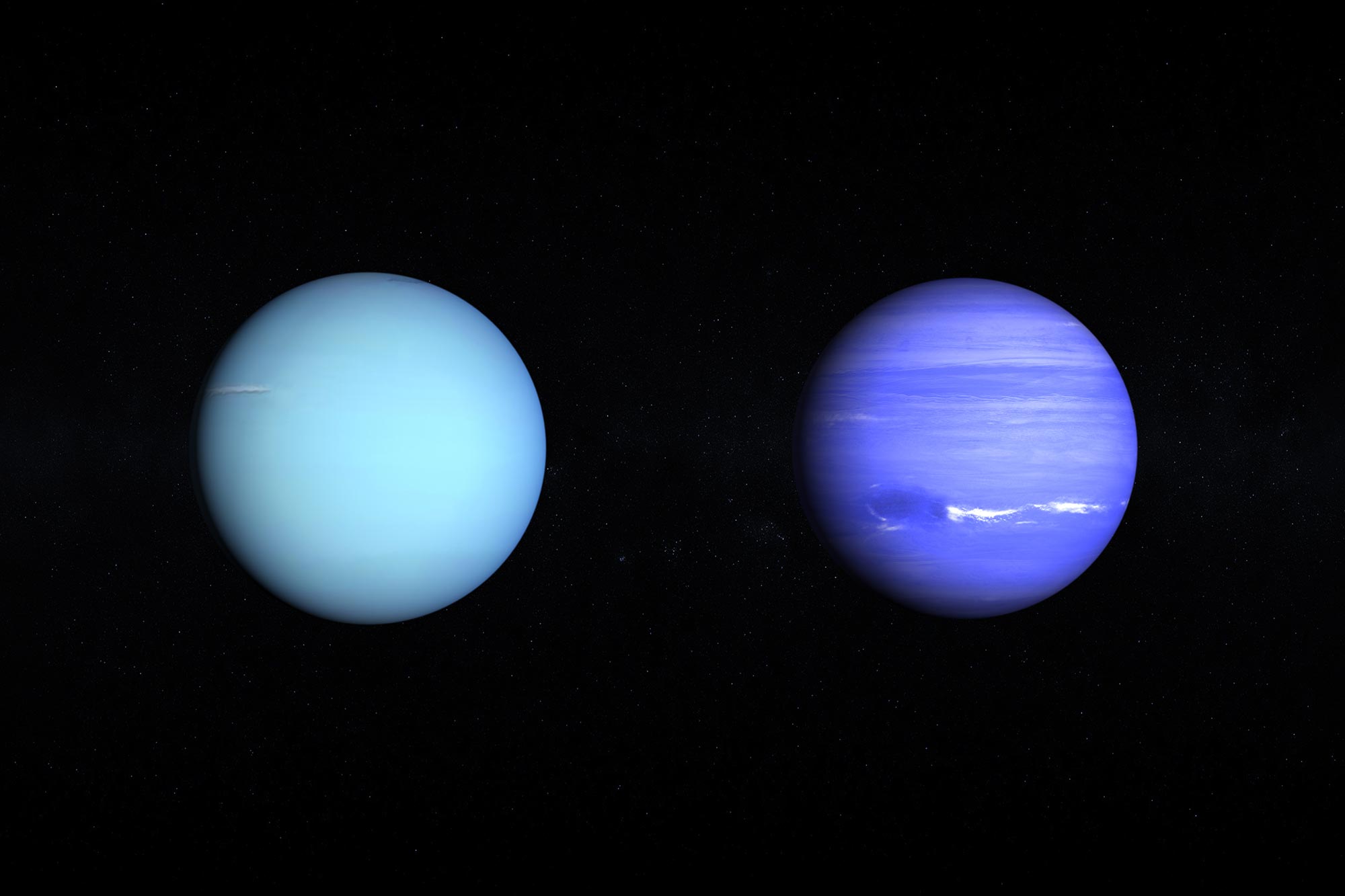
The Solar System is usually grouped into three main types of planets based on what they are made of: the four rocky terrestrial worlds (Mercury, Venus, Earth ,and Mars), the two massive gas giants (Jupiter and Saturn), and the pair of ice giants (Uranus and Neptune).
New research from a scientific team at the University of Zurich (UZH) suggests that Uranus and Neptune may not fit neatly into that final category. Their findings indicate that both planets could contain much more rock than previously assumed. The study does not argue that the two worlds must be water-rich or rock-rich; instead, it challenges the long-standing belief that an ice-heavy composition is the only viable explanation. This perspective is also supported by the discovery that the dwarf planet Pluto is primarily made of rock.
A New Approach to Modeling Planet Interiors
To investigate these possibilities, the researchers developed a specialized method for simulating the internal structures of Uranus and Neptune. “The ice giant classification is oversimplified as Uranus and Neptune are still poorly understood,” says Luca Morf, PhD student at the University of Zurich and lead author of the work. “Models based on physics were too assumption-heavy, while empirical models are too simplistic. We combined both approaches to get interior models that are both “agnostic” or unbiased and yet, are physically consistent.”
Their process begins with a randomly generated density profile for each planet. They then compute a gravitational field that matches observational data and use this to infer what the planets may contain. The steps are repeated many times to identify the versions that best agree with available measurements.
A Wider Range of Planetary Possibilities
Using this unbiased modeling framework, the University of Zurich team found that the internal structure of the Solar System’s so-called ice giants does not have to be dominated by ice (usually represented by water).
“It is something that we first suggested nearly 15 years ago, and now we have the numerical framework to demonstrate it,” reveals Ravit Helled, Professor at the University of Zurich, and initiator of the project. Their results indicate that either Uranus or Neptune could be rich in water or rich in rock depending on which models align with the observations.
New Clues About Puzzling Magnetic Fields
The research also sheds light on the complex magnetic fields of both planets. Unlike Earth, which has two clear magnetic poles, Uranus and Neptune have fields with multiple poles and unusual geometries. Helled explains that “Our models have so-called “ionic water” layers which generate magnetic dynamos in locations that explain the observed non-dipolar magnetic fields. We also found that Uranus’ magnetic field originates deeper than Neptune’s.” These insights offer new context for some of the most baffling features of the ice giants.
Why Future Missions Are Essential
Even with these advances, uncertainties remain. “One of the main issues is that physicists still barely understand how materials behave under the exotic conditions of pressure and temperature found at the heart of a planet, this could impact our results,” says Morf, who aims to refine the models further.
Despite these challenges, the work introduces promising new scenarios for the interiors of Uranus and Neptune and encourages a reevaluation of long-standing assumptions. It may also help guide future research into how materials behave under extreme planetary conditions. “Both Uranus and Neptune could be rock giants or ice giants depending on the model assumptions. Current data are currently insufficient to distinguish the two, and we therefore need dedicated missions to Uranus and Neptune that can reveal their true nature,” concludes Ravit Helled.
Reference: “Icy or rocky? Convective or stable? – New interior models of Uranus and Neptune” by Luca Morf and Ravit Helled, 10 December 2025, Astronomy & Astrophysics.
DOI: 10.1051/0004-6361/202556911
Never miss a breakthrough: Join the SciTechDaily newsletter.
Follow us on Google and Google News.
6 Comments
So scientists have not yet realized that gravity doesn’t actually exist and is an emergent property. Mass does not bend space and planets rotation around our star is primordial. Meaning it’s isn’t gravity that makes everything rotate. Space is a superfluid medium and not flat like Einstein suggested. Hacking astrophysics with geometry and flattening space was a very wrong direction. Fluid dynamics governs all of space and because there’s no viscosity, orbits are actually vortices that emerge from this fluid pressure driven medium. Scientists have yet to discover this for themselves.
Einstein…will always be right…he was there..dude was a space jockey..lol but really he knew alot more than he should’ve
I have read that astronomers want to place orbiters around both of those planets. But they are talking in terms of 2050 or thereabouts. I won’t be here to see that then.
Quote
“Our models have so-called “ionic water” layers which generate magnetic dynamos in locations that explain the observed non-dipolar magnetic fields.”
Is this what’s happening in the so called ‘Bermuda triangle’? Causing magnetic compass failure.
Also does it explain why Earth’s magnetic field has weak spots?
I must learn more.
Look into tesla research and his inventions and then his idea inventions, dude was more than a genius….he was a god to the terms of knowledge of magnetic fields and electricity, he presumably showed that we could draw power out of the earth witch his substation where just wireless trans points for the wireless power grid he perposed but lack of technology of that time made him sound like a bafoon…..but fast forward to present day and that man’s design on electric motors and brushless power transfer with unwinded motors …..just magnets and current pass threw drives these Tesla cars to have somewhere in the 750 wheel horse power area and depending on the power avaliable….can load dump the batteries in a high power high amp discharge resulting in cars that in the drag race world out perform even that high horse high cost fuel fired beast of all motors and will drag his ass to 1/4 mile mark every time
I mean, isn’t EVERY planet in the entire universe made of “rock” at the end of the day?