
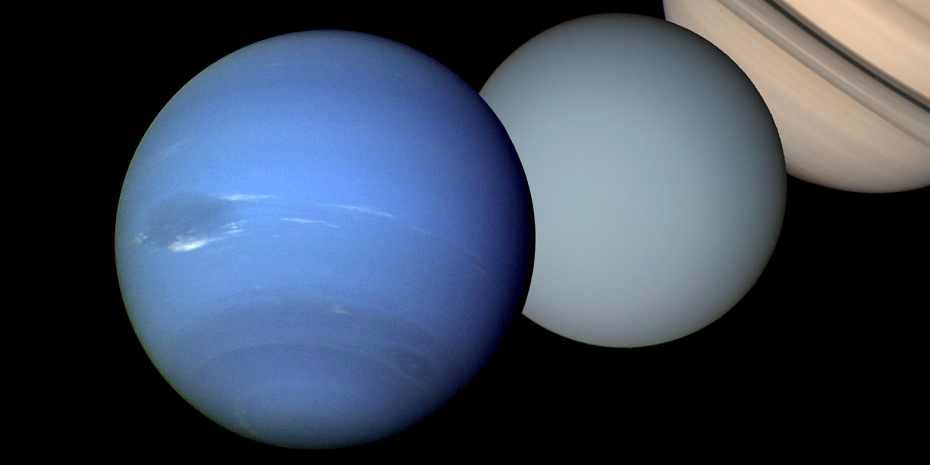
Uranus and Neptune both have a completely skewed magnetic field, perhaps due to the planets’ special inner structures. But new experiments by ETH Zurich researchers now show that the mystery remains unsolved.
The two large gas planets Uranus and Neptune have strange magnetic fields. These are each strongly tilted relative to the planet’s rotation axes and are significantly offset from the physical center of the planet. The reason for this has been a longstanding mystery in planetary sciences. Various theories assume that a unique inner structure of these planets could be responsible for this bizarre phenomenon. According to these theories, the skewed magnetic field is caused by circulations in a convective layer, which consists of an electrically conductive fluid. This convective layer in turn surrounds a stably layered, non-convective layer in which there is no circulation of the material due to its high viscosity and thus no contribution to the magnetic field.
Extraordinary States
Computer simulations show that water and ammonia, the main components of Uranus and Neptune, enter an unusual state at very high pressures and temperatures: a “superionic state,” which has the properties of both a solid and a liquid. In this state, the hydrogen ions become mobile within the lattice structure formed by oxygen or nitrogen.
Recent experimental studies confirm that superionic water can exist at the depth where, according to theory, the stably layered region is located. It could therefore be that the stratified layer is formed by superionic components. However, it is unclear whether the components are actually able to suppress convection, since the physical properties of the superionic state are not known.
High Pressure in the Smallest Space
Tomoaki Kimura and Motohiko Murakami from the Department of Earth Sciences at ETH Zurich are now one step closer to finding the answer. The two researchers have conducted high-pressure and high-temperature experiments with ammonia in their laboratory. The aim of the experiments was to determine the elasticity of the superionic material. Elasticity is one of the most important physical properties that influences thermal convection in the planetary mantle. It is remarkable that the elasticity of the materials in their solid and liquid states is completely different.
For their investigations, the researchers used a high-pressure apparatus called a diamond anvil cell. In this apparatus, the ammonia is placed in a small container with a diameter of about 100 micrometers, which is then clamped between two diamond tips that compress the sample. This makes it possible to subject materials to extremely high pressures, such as those found inside Uranus and Neptune.
The sample is then heated to over 2,000 degrees Celsius with an infrared laser. At the same time, a green laser beam illuminates the sample. By measuring the wave spectrum of the scattered green laser light, the researchers can determine the elasticity of the material and the chemical bonding in the ammonia. The shifts in the wave spectrum at different pressures and temperatures can be used to determine the elasticity of ammonia at different depths.
A New Phase Discovered
In their measurements, Kimura and Murakami have discovered a new superionic ammonia phase (γ phase) that exhibits an elasticity similar to that of the liquid phase. This new phase may be stable in the deep interior of Uranus and Neptune and therefore occur there. However, the superionic ammonia behaves like a liquid and thus it would not be viscous enough to contribute to the formation of the non-convective layer.
The question of what properties the superionic water has inside Uranus and Neptune is all the more urgent in light of the new results. For even now, the mystery of why the two planets have such an irregular magnetic field still remains unsolved.
Reference: “Fluid-like elastic response of superionic NH3 in Uranus and Neptune” by Tomoaki Kimura and Motohiko Murakami, 31 March 2021, Proceedings of the National Academy of Sciences.
DOI: 10.1073/pnas.2021810118
Never miss a breakthrough: Join the SciTechDaily newsletter.
Follow us on Google and Google News.
7 Comments
hello
very good website
Me agrada mucho gracias la información contenida, de los avances de investigación planetaria. Me interesa mucho gracias 😊
Dr Russell Humphries analysis from the 1980s predicted to near accuracy the existence and strength of Uranus and Neptune’s magnetic field when most of the scientific community scoffed. This was two years before voyager passed by and detected the existence. Feel free to look up his work.
Thank you
I honestly think They’re both teaming with life that can’t see the stars. Prove me wrong.
Great &interesting information. Wish they will find out an answer .